Recent Microbial Evolutionary Insights From Metagenomics
Microorganisms have profoundly shaped Earth’s biological and geological history, from the origins of oxygenic photosynthesis to present-day global biogeochemical cycles.
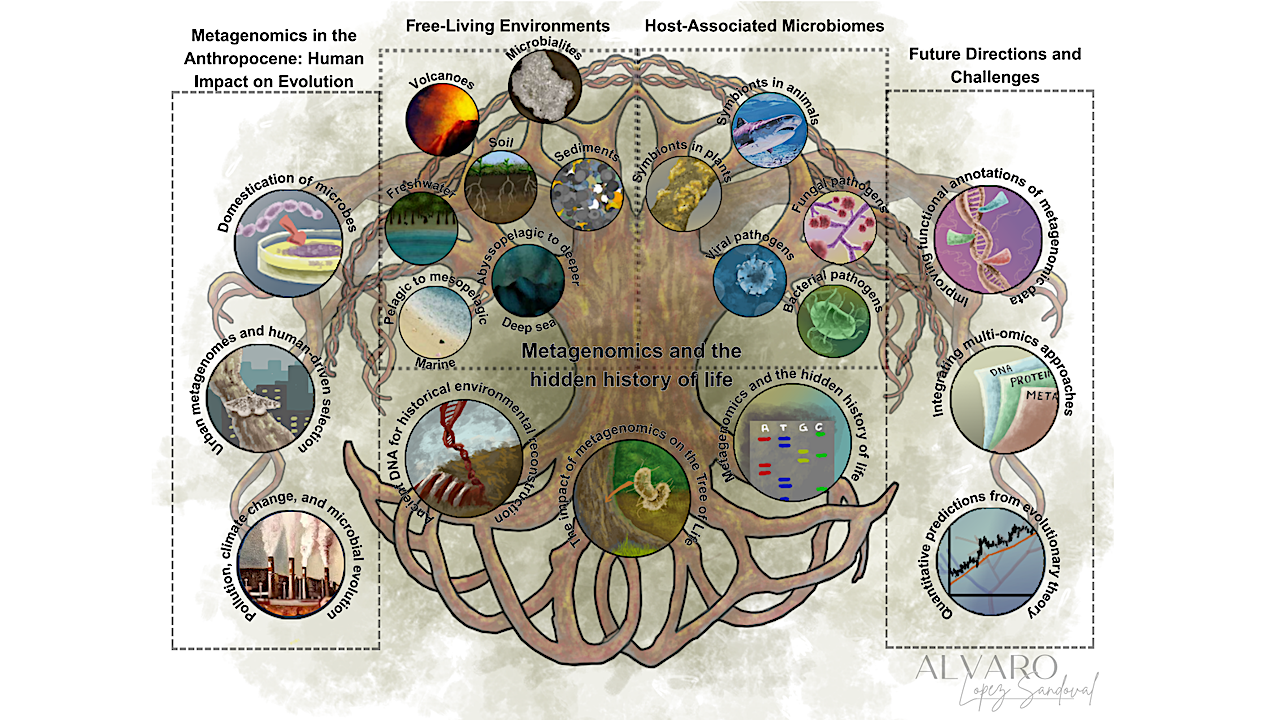
Metagenomics—through its ability to recover genomic information directly from environmental samples—has revolutionized our understanding of microbial evolution by uncovering unbeknownst lineages, revealing functional adaptations, and reshaping our view of the Tree of Life.
By bypassing the need for cultivation, shotgun metagenomics and metabarcoding approaches have enabled researchers to investigate microbial diversity, ecology, and evolutionary processes across aquatic, terrestrial, extreme, and host-associated environments.
This review highlights recent advances in evolutionary biology driven by metagenomics, including studies on deep evolutionary branching events, microbial adaptation to extreme environments, the evolution of host-associated microbiomes, and the emergence and spread of pathogens and antimicrobial resistance. The integration of ancient DNA has expanded our ability to reconstruct past ecosystems and disease dynamics, offering insights into long-term microbial evolution.
In parallel, studies of microbial domestication and urban settings reveal how human practices have shaped microbial genomes over millennia. Despite significant progress, key challenges remain—including improving bioinformatic tools for degraded ancient DNA, resolving deep phylogenetic relationships, identifying adaptive variants, and linking genomic shifts to ecosystem-level processes.
The future of microbial evolutionary research will depend on combining longitudinal metagenomic data, experimental evolution, functional assays, and predictive modeling to better understand microbial responses to climate change and anthropogenic pressures. Together, these approaches will deepen our understanding of microbial evolution and its consequences for life on Earth—past, present, and future.
- Recent Microbial Evolutionary Insights From Metagenomics, Genome Biology and Evolution via PubMed (open access)
- Recent Microbial Evolutionary Insights From Metagenomics, Genome Biology and Evolution (open access)
astrobiology,