The Dispersed Matter Planet Project Sample — Detection limits, Occurrence Rates and New Planets
DMPP is a radial-velocity survey that aims to detect planets around stars exhibiting anomalous activity signatures, consistent with the presence of close-in evaporating planets.
Here, we report the discovery of 7 new planetary signals in 5 different systems: DMPP-2c & d, HD67200/DMPP-6b & c, HD118006/DMPP-7b, HD191122/DMPP-8b, and HD200133/DMPP-9b. We update the orbital parameters of the DMPP-1, DMPP-2, and DMPP-3 systems, along with those of the planetary systems orbiting HD181433, HD39194, and HD89839.
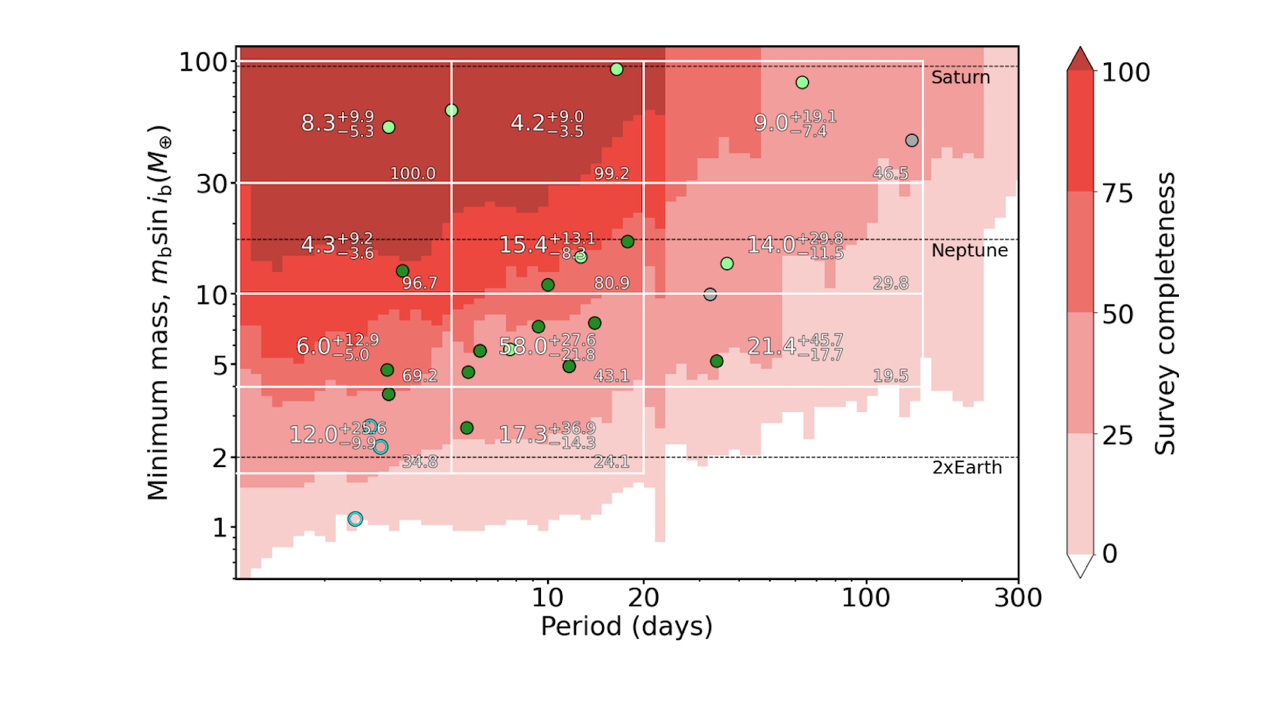
We derive detection limits for all 24 targets in our sample with adequate observational coverage, and test the DMPP hypothesis by calculating the occurrence rates for planets in this configuration.
We find that the occurrence rates of planets in our sample with orbital periods shorter than 50 d and masses in the range 3-10 M⊕ are 83.0+27.1−24.4%, for 10-30 M⊕ are 27.0+15.0−11.2%, and for 30-100 M⊕ are 13.9+11.8−7.5%. This is significantly higher than the occurrence rates reported by other radial velocity surveys, providing strong support for the DMPP hypothesis.
Matthew R. Standing, John R. Barnes, Carole A. Haswell, Adam T. Stevenson, João P. Faria, Erwan Quintin, Zachary O. B. Ross, Luca Fossati, James S. Jenkins, Douglas Alves, Daniel Staab
Comments: 16 pages, 10 figures, accepted for publication in MNRAS. Appendix: 20 pages, 47 figures
Subjects: Earth and Planetary Astrophysics (astro-ph.EP); Instrumentation and Methods for Astrophysics (astro-ph.IM); Solar and Stellar Astrophysics (astro-ph.SR)
Cite as: arXiv:2602.18207 [astro-ph.EP] (or arXiv:2602.18207v1 [astro-ph.EP] for this version)
https://doi.org/10.48550/arXiv.2602.18207
Focus to learn more
Submission history
From: Matthew Standing
[v1] Fri, 20 Feb 2026 13:35:46 UTC (13,682 KB)
https://arxiv.org/abs/2602.18207
Astrobiology,