Sculpting Of Martian Brain Terrain Reveals The Drying Of Ancient Mars
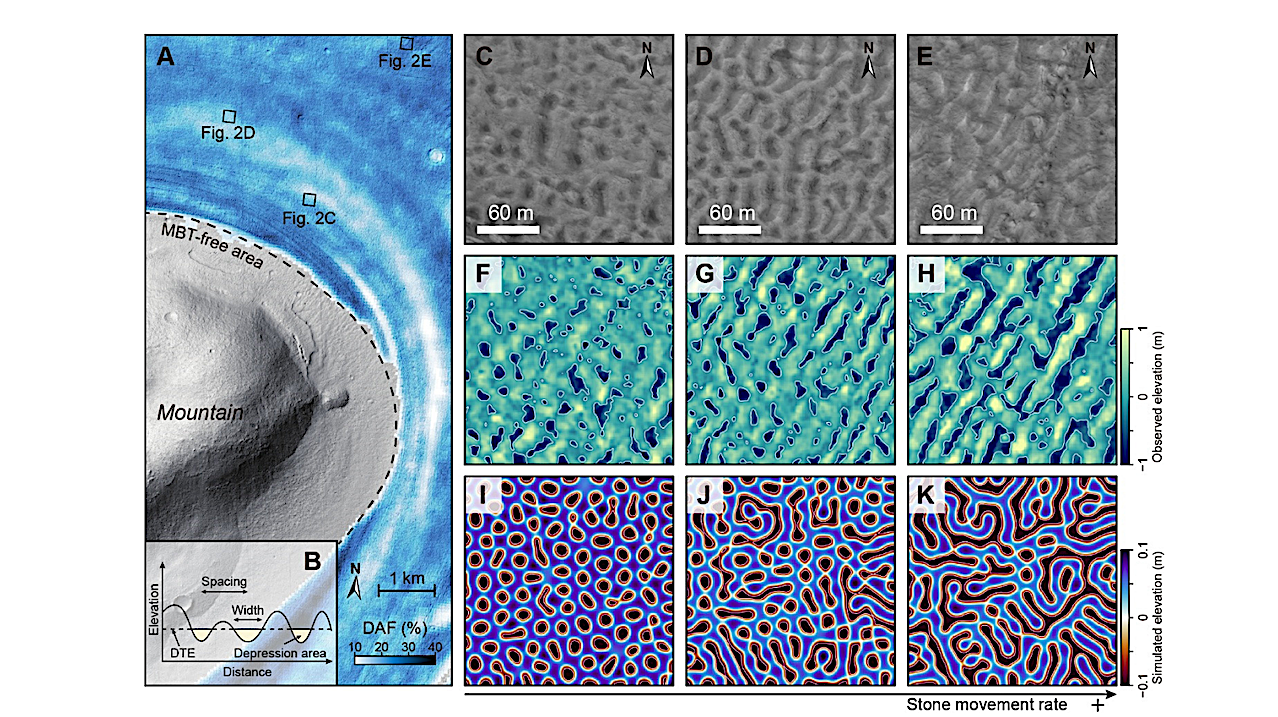
The Martian brain terrain (MBT), characterized by its unique brain-like morphology, is a potential geological archive for finding hints of paleoclimatic conditions during its formation period.
The morphological similarity of MBT to self-organized patterned ground on Earth suggests a shared formation mechanism. However, the lack of quantitative descriptions and robust physical modeling of self-organized stone transport jointly limits the study of the thermal and aqueous conditions governing MBT’s formation.
Here we established a specialized quantitative system for extracting the morphological features of MBT, taking a typical region located in the northern Arabia Terra as an example, and then employed a numerical model to investigate its formation mechanisms. Our simulation results accurately replicate the observed morphology of MBT, matching its key geometric metrics with deviations <10%.
Crucially, however, we find that the self-organized transport can solely produce relief <0.5 m, insufficient to explain the formation of MBT with average relief of 3.29±0.65 m. We attribute this discrepancy to sculpting driven by late-stage sublimation, constraining cumulative subsurface ice loss in this region to ∼3 meters over the past ∼3 Ma.
These findings demonstrate that MBT’s formation is a multi-stage process: initial patterning driven by freeze-thaw cycles (implying liquid water) followed by vertical sculpting via sublimation (requiring a dry environment). This evolution provides physical evidence for the transition of the ancient Martian climate from a wetter period to a colder hyper-arid state.
Shenyi Zhang, Lei Zhang, Yutian Ke, Jinhai Zhang
Subjects: Geophysics (physics.geo-ph); Earth and Planetary Astrophysics (astro-ph.EP); Computational Physics (physics.comp-ph)
Cite as: arXiv:2601.22606 [physics.geo-ph] (or arXiv:2601.22606v1 [physics.geo-ph] for this version)
https://doi.org/10.48550/arXiv.2601.22606
Focus to learn more
Submission history
From: Lei Zhang Dr.
[v1] Fri, 30 Jan 2026 06:01:02 UTC (10,938 KB)
https://arxiv.org/abs/2601.22606
Astrobiology,