Bridging the Gap: Using Brown Dwarfs to Examine Silicate Clouds in Giant Exoplanet Atmospheres
We present results from examining the silicate cloud modeling of four JWST-observed hot Jupiters in the context of brown dwarf theory to further explore signatures of formation in present-day atmospheres.
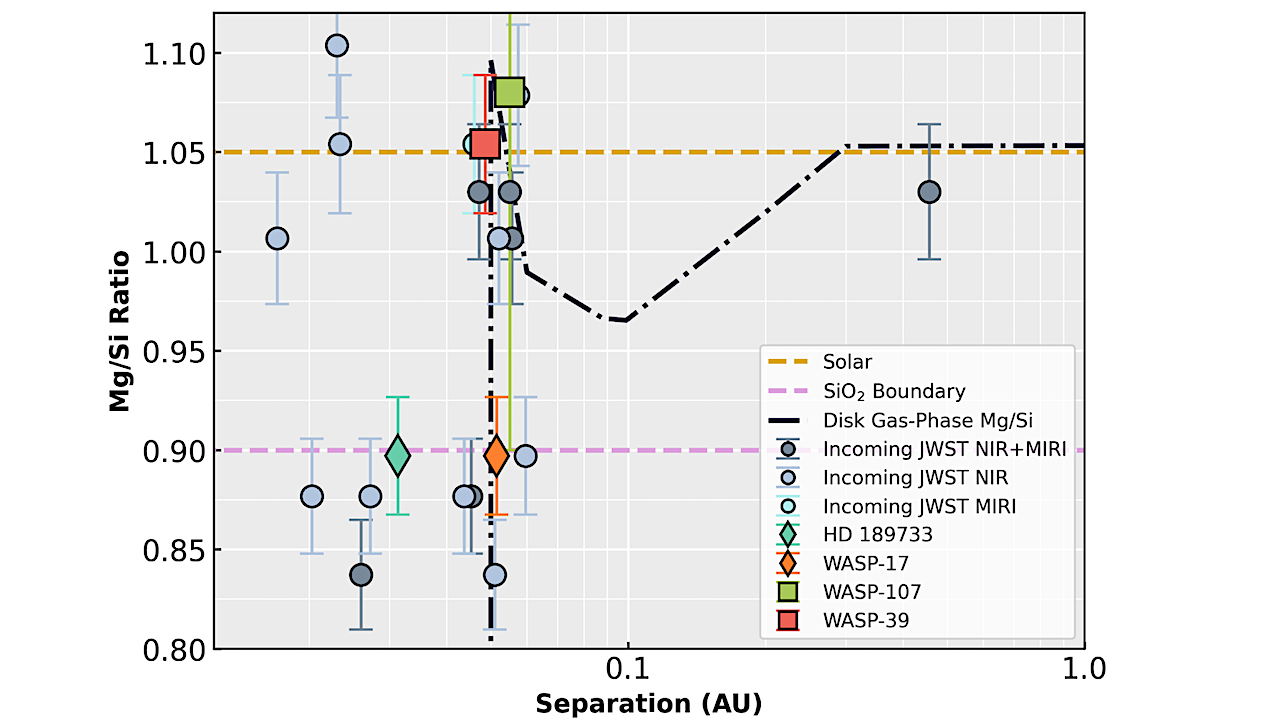
We contextualize our understanding of protoplanetary disk refractory chemistry with empirical evidence from chondritic meteorites to show that giant planets forming and accreting in the outer disk adopt their stellar Mg/Si value.
We show that current silicate cloud species determinations of WASP-17 b, WASP-107 b, WASP-39 b and HD 189733 b are in line with predictions laid out in Calamari et al. 2024 based on each system’s host star Mg/Si ratio, further supporting this hypothesis. We discuss physical motivations for potential atmospheric scenarios where apparent silicate cloud species is not in agreement with that predicted by its host star chemistry.
Additionally, we compare current transit spectroscopy for three of these four exoplanets against brown dwarf spectra to examine molecular absorption trends across the substellar mass temperature regime.
Emily Calamari, Jacqueline K. Faherty, Channon Visscher, Marina E. Gemma, Austin Rothermich, Francisco Ardévol Martínez, Sherelyn Alejandro Merchan, Genaro Suárez
Comments: 18 pages, 1 table, 6 figures. Accepted for publication in ApJL
Subjects: Earth and Planetary Astrophysics (astro-ph.EP); Solar and Stellar Astrophysics (astro-ph.SR)
Cite as: arXiv:2603.12479 [astro-ph.EP] (or arXiv:2603.12479v1 [astro-ph.EP] for this version)
https://doi.org/10.48550/arXiv.2603.12479
Focus to learn more
Related DOI:
https://doi.org/10.3847/2041-8213/ae497d
Focus to learn more
Submission history
From: Emily Calamari
[v1] Thu, 12 Mar 2026 21:58:03 UTC (2,653 KB)
https://arxiv.org/abs/2603.12479
Astrobiology, Astrochemistry,