Exoplanet Transit Search At The Detection Limit: Detection And False Alarm Vetting Pipeline
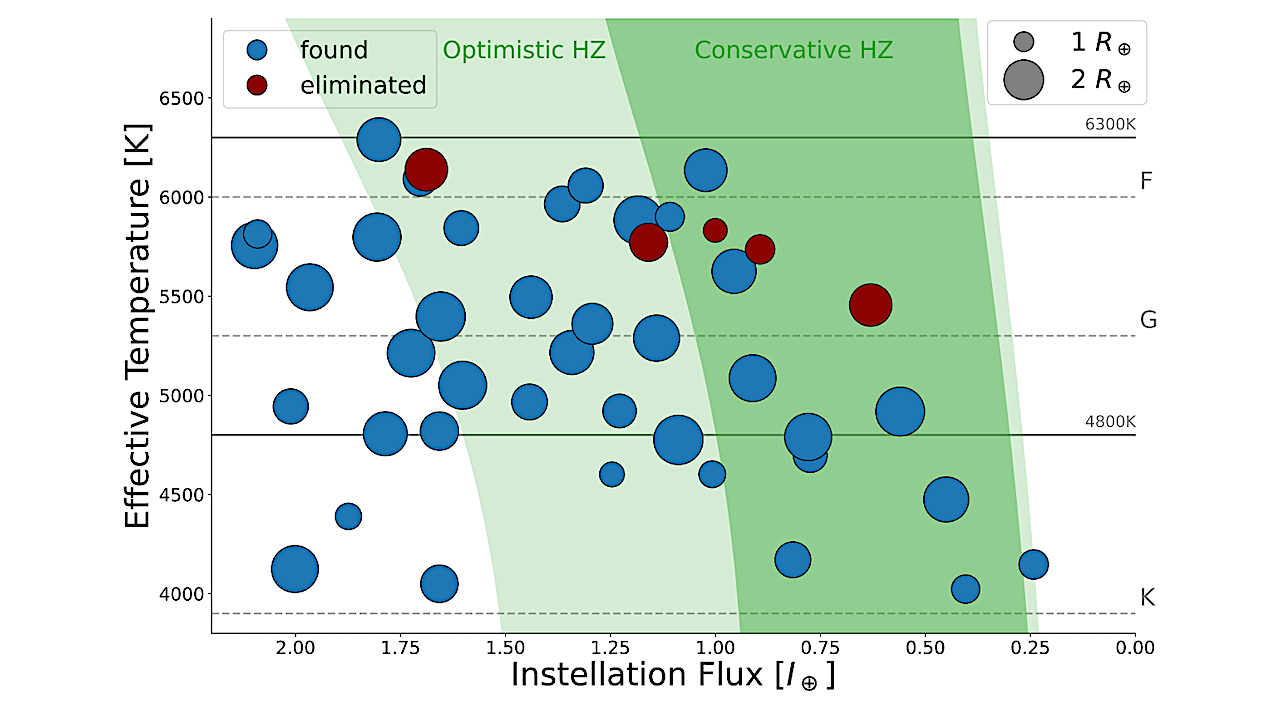
One of the primary mission goals of the Kepler space telescope was to detect Earth-like terrestrial planets in the habitable zone around Sun-like stars. These planets are at the detection limit, where the Kepler detection and vetting pipeline produced unreliable planet candidates.
We present a novel pipeline that improves the removal of localized defects prior to the planet search, improves vetting at the level of individual transits and introduces a Bayes factor test statistic and an algorithm for extracting multiple candidates from a single detection run.
We show with injections in the Kepler data that the introduced novelties improve pipeline’s completeness at a fixed false alarm rate. We apply the pipeline to the stars with previously identified planet candidates and show that our pipeline successfully recovers the previously confirmed candidates, but flags a considerable portion of unconfirmed candidates as likely false alarms, especially in the long period, low signal-to-noise ratio regime.
In particular, several known Earth-like candidates in the habitable zone, such as KOI 8063.01, 8107.01 and 8242.01, are identified as false alarms, which could have a significant impact on the estimates of η⊕, i.e., the occurrence of Earth-like planets in the habitable zone.
Jakob Robnik, Uroš Seljak, Jon M. Jenkins, Steve Bryson
Comments: 16 pages, 15 figures
Subjects: Earth and Planetary Astrophysics (astro-ph.EP)
Cite as: arXiv:2601.07465 [astro-ph.EP] (or arXiv:2601.07465v1 [astro-ph.EP] for this version)
https://doi.org/10.48550/arXiv.2601.07465
Focus to learn more
Submission history
From: Jakob Robnik
[v1] Mon, 12 Jan 2026 12:21:18 UTC (962 KB)
https://arxiv.org/abs/2601.07465
Astrobiology, Exoplanet,