Atmospheric Mass Flux As A Function Of Ionospheric Emission On Unmagnetized Earth
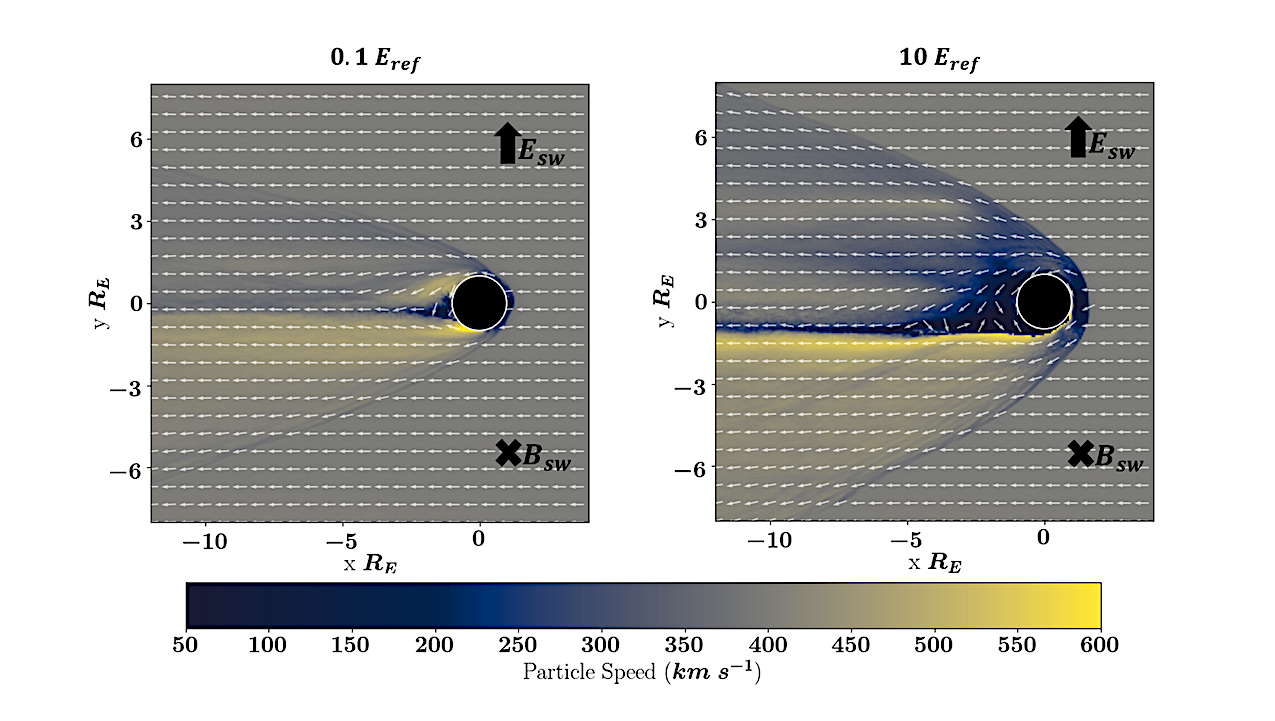
We explore ion escape from, and solar ion deposition to, an unmagnetized Earth-like planet. We use RHybrid, an ion-kinetic electron-fluid code to simulate the global plasma interaction of unmagnetized Earth with the solar wind. We vary the global ionospheric emission rate, and quantify the resultant planetary ion escape rates (O+ and H+) and the solar wind deposition rate (H+).
We use these results to compute the net mass flux to the atmosphere and find that the solar ion deposition rate could be comparable to planetary ion escape rates. For the emission rates simulated, our results show that under typical solar wind conditions (vsw=400 km s−1, nsw=5 cm−3), the mass of the atmosphere would decrease by less than 3% over a billion years, indicating that Earth’s intrinsic magnetic field may be unnecessary for retention of its atmosphere.
Lastly, we present a hypothesis suggesting that ionospheric emission may evolve through time towards a critical emission rate that occurs at a net mass flux of zero.
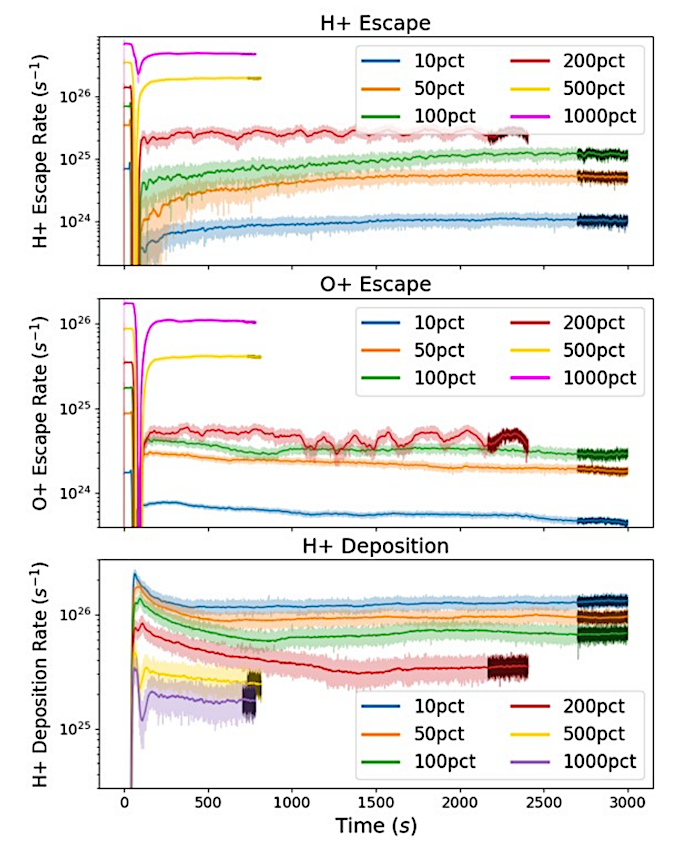
The escape and deposition rates as a function of time are shown for each of the simulations. The top panel shows H+ escape rates, the middle panel shows O + escape rates, and the bottom panel shows H+ deposition rates. Higher production rate simulations require more computational time per real time step but reach equilibrium in less real time. The last 10% of each time series (shown in black) is used to produce the data points in Figure 2. While the 2Eref escape rate data is oscillatory, the sampled data captures an entire period, thus the effect of the oscillation is represented in the error bar of this data point. — astro-ph.EP
P. C. Hinton, D. A. Brain, N. R. Schnepf, R. Jarvinen, J. Cessna, F. Bagenal
Subjects: Earth and Planetary Astrophysics (astro-ph.EP); Solar and Stellar Astrophysics (astro-ph.SR)
Cite as: arXiv:2512.24004 [astro-ph.EP] (or arXiv:2512.24004v1 [astro-ph.EP] for this version)
https://doi.org/10.48550/arXiv.2512.24004
Focus to learn more
Submission history
From: Parker Hinton
[v1] Tue, 30 Dec 2025 05:52:31 UTC (1,741 KB)
https://arxiv.org/abs/2512.24004
Astrobiology,