TOI-7166 b: A Habitable Zone Mini-Neptune Planet Around A Nearby Low-mass Star
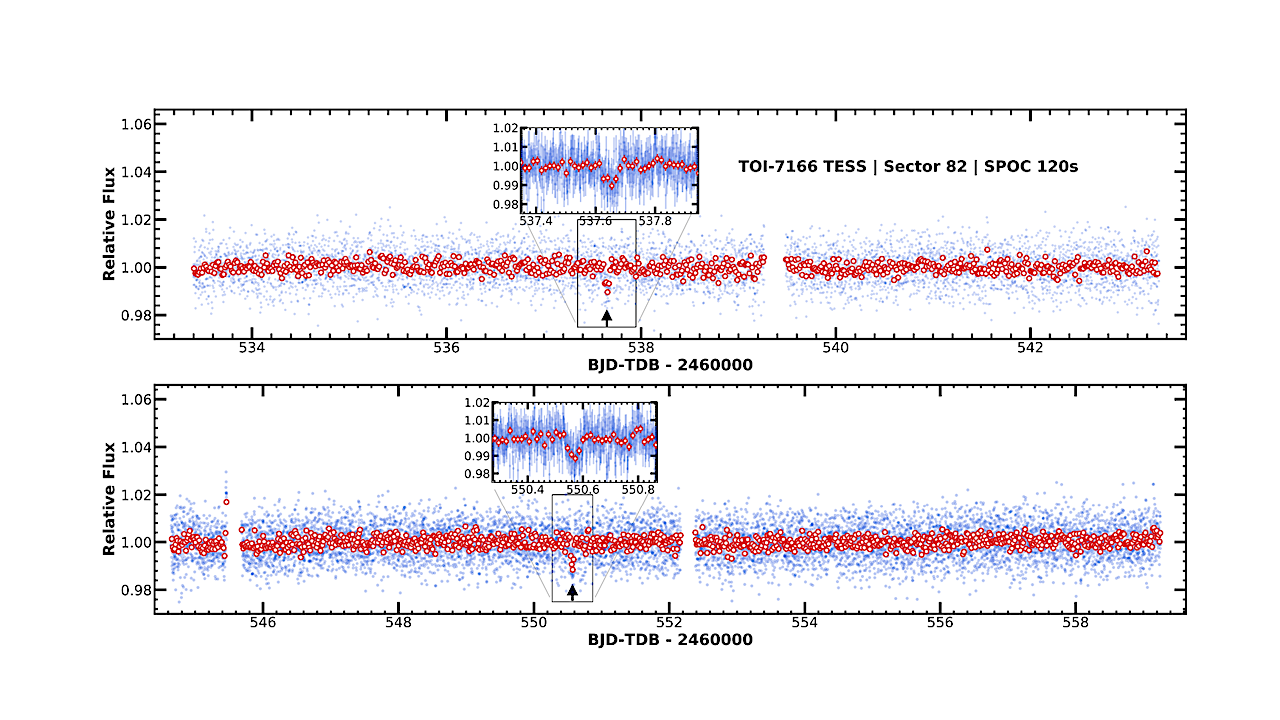
We present the discovery and validation of TOI-7166b, a 2.01+/-0.05R_Earth planet orbiting a nearby low-mass star.
We validated the planet by combining TESS and multi-color high-precision photometric observations from ground-based telescopes, together with spectroscopic data, high-contrast imaging, archival images, and statistical arguments. The host star is an M4-type dwarf at a distance of ~35 pc from the Sun.
It has a mass and a radius of Ms=0.190+/-0.004M_Sun and Rs=0.222+/-0.005R_Sun, respectively. TOI-7166b has an orbital period of 12.9 days, which places it close to the inner edge of the Habitable Zone of its host star, receiving an insolation flux of Sp=1.07+/-0.08S_Earth and an equilibrium temperature of Teq=249+/-5K (assuming a null Bond albedo).
he brightness of the host star makes TOI-7166 a suitable target for radial velocity follow-up to measure the planetary mass and bulk density. Moreover, the physical parameters of the system including the infrared brightness (Kmag = 10.6) of the star and the planet-to-star radius ratio (0.0823+/-0.0012) make TOI-7166b an exquisite target for transmission spectroscopic observations with the JWST, to constrain the exoplanet atmospheric compositions.

Left panel: Stellar effective temperature (𝑇eff) as a function of incident stellar flux (𝑆𝑝) of known transiting exoplanets orbiting host stars cooler than 4000 K. The size of each point corresponds to the planet’s size, and the color indicates its equilibrium temperature. The light green region denotes the optimistic habitable zone, bounded by a solid red line (recent Venus limit) and a solid blue line (Early Mars limit). The dark green region indicates the conservative habitable zone as defined by Kopparapu 2013. Right panel: Transmission spectroscopy metric (Kempton et al. 2018) against the planetary equilibrium temperature for the same sample displayed in the left panel. The points are colored according to the stellar effective temperature. TOI-7166 b is highlighted by the error bars. — astro-ph.EP
Khalid Barkaoui, Francisco J. Pozuelos, Benjamin V. Rackham, Adam J. Burgasser, Amaury H.M.J. Triaud, Miquel Serra-Ricart, Mathilde Timmermans, Selçuk. Yalçınkaya, Abderahmane Soubkiou, Keivan G. Stassun, Karen A. Collins, Pedro J. Amado, Özgur Baştürk, Artem Burdanov, Yasmin T. Davis, Julien de Wit, Brice-Olivier Demory, Sarah Deveny, Georgina Dransfield, Elsa Ducrot, Michaël Gillon, Yilen Gómez Maqueo Chew, Matthew J. Hooton, Keith Horne, Steve B. Howell, Clàudia Janó Muñoz, Emmanuel Jehin, John M. Jenkins, Colin Littlefield, Eduardo L. Martín, Prajwal Niraula, Peter P. Pedersen, Dedier Queloz, Madison G. Scott, Ramotholo Sefako, Avi Shporer, Christopher Stockdale, Emma Softich, Alfredo Sota, Benjamin Tofflemire, Özlem Şimşir, Roberto Varas, Francis Zong Lang, Sebastián S. Zúñiga-Fernández
Comments: 13 Figures and 4 Tables. Published in MNRAS
Subjects: Earth and Planetary Astrophysics (astro-ph.EP)
Cite as: arXiv:2512.06841 [astro-ph.EP] (or arXiv:2512.06841v1 [astro-ph.EP] for this version)
https://doi.org/10.48550/arXiv.2512.06841
Focus to learn more
Journal reference: Monthly Notices of the Royal Astronomical Society, 2025, Volume 544, Issue 2, pp. 2637-2652, 16 pp
Related DOI:
https://doi.org/10.1093/mnras/staf1807
Focus to learn more
Submission history
From: Khalid Barkaoui
[v1] Sun, 7 Dec 2025 13:27:19 UTC (2,254 KB)
https://arxiv.org/abs/2512.06841
Astrobiology, exoplanet,