TEPCat: The Transiting Extrasolar Planet Catalogue
Transiting extrasolar planets are extraordinarily valuable for understanding the characteristics and formation of planets, because they are the only exoplanets whose physical and orbital properties can be measured to high precision.
Thousands are now known, and it is important to maintain a database of them for use by the scientific community. TEPCat performs this task: it is a critical compilation of the physical and observable properties of the known transiting planetary systems. This work introduces the motivation for TEPCat, its scope, contents, and implementation.
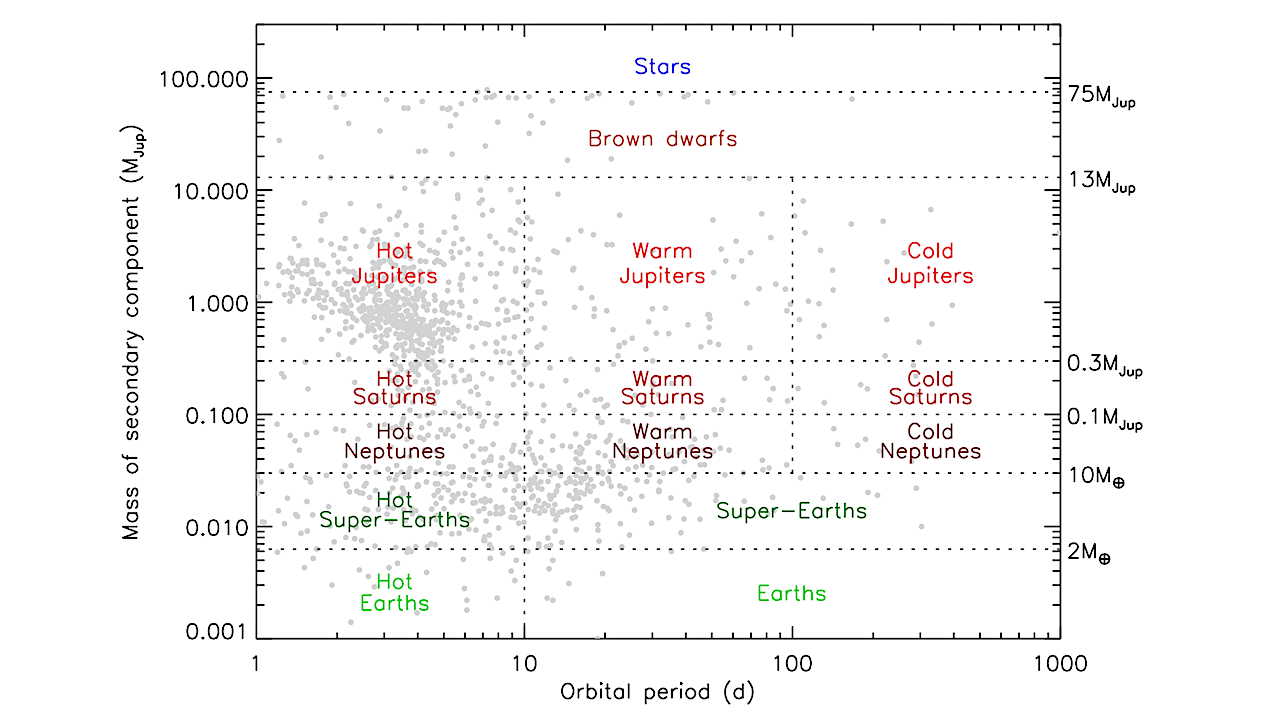
Example plots of interesting quantities are constructed. The classification of planets and of the eclipse features in their light curves is discussed. TEPCat is maintained and freely available online at https://www.astro.keele.ac.uk/jkt/tepcat/*
John Southworth
Comments: Accepted for publication in Universe as part of the special issue “The Royal Road: Eclipsing Binaries and Transiting Exoplanets, 2nd Edition” edited by Dr. Tamás Borkovits and Dr. Szilard Csizmadia. This article is the author-accepted version and is 23 pages, including 4 tables and 9 colour figures
Subjects: Earth and Planetary Astrophysics (astro-ph.EP); Instrumentation and Methods for Astrophysics (astro-ph.IM); Solar and Stellar Astrophysics (astro-ph.SR)
Cite as: arXiv:2602.23102 [astro-ph.EP] (or arXiv:2602.23102v1 [astro-ph.EP] for this version)
https://doi.org/10.48550/arXiv.2602.23102
Focus to learn more
Submission history
From: John Southworth
[v1] Thu, 26 Feb 2026 15:17:13 UTC (6,836 KB)
https://arxiv.org/abs/2602.23102
Astrobiology,
TEPCat
is a catalogue of the physical properties of the known transiting extrasolar planet and brown dwarf systems. All parts of the catalogue are available as HTML tables, with and without errorbars, and machine-readable ASCII and CSV files for detailed analysis. Most of the numbers are a careful compilation of literature results, and the remainder come from my Homogeneous Studies of Transiting Extrasolar Planets papers.