Three eruptions At The Fagradalsfjall Volcano In Iceland Show Rapid And Predictable Microbial Community Establishment
How natural environments transition from uninhabited to inhabited is an incompletely understood question in ecology.
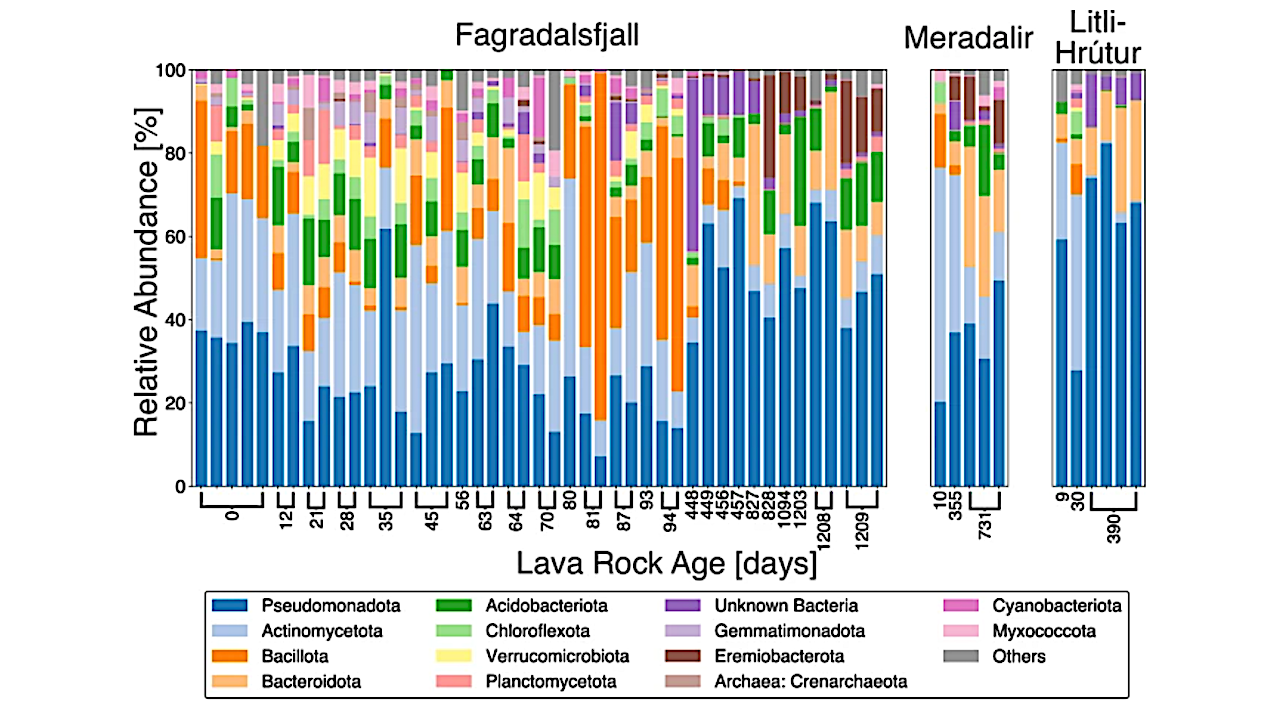
We leverage the 2021–2023 Fagradalsfjall eruptions in Iceland as a natural experiment, tracking microbial colonization on the new lava over three years, including lava that had solidified only hours before collection.
Samples were collected from fixed sites biweekly for the 2021 eruption phase and then at multiple time points over the next three years, resulting in a unique temporal dataset for primary succession.
As the same system erupted again in 2022 and 2023, we were able to monitor a natural ecological triplicate. We use multiple lines of evidence to demonstrate dynamic but predictable community assembly processes.
We use alpha and beta diversity, phylogenetic null modeling, taxa volatility, and Bayesian source tracking to propose a two-stage process: (1) rapid establishment of a variable microbial assemblage, followed by (2) stabilization after winter onset. A random forest regression model, trained on 2021 eruption microbial community data, accurately predicts the successional stage in the 2022 and 2023 eruptions.
This study underscores the dynamic and predictable nature of microbial colonization in harsh environments, offering insights into primary succession and its role in shaping Earth’s ecosystems.
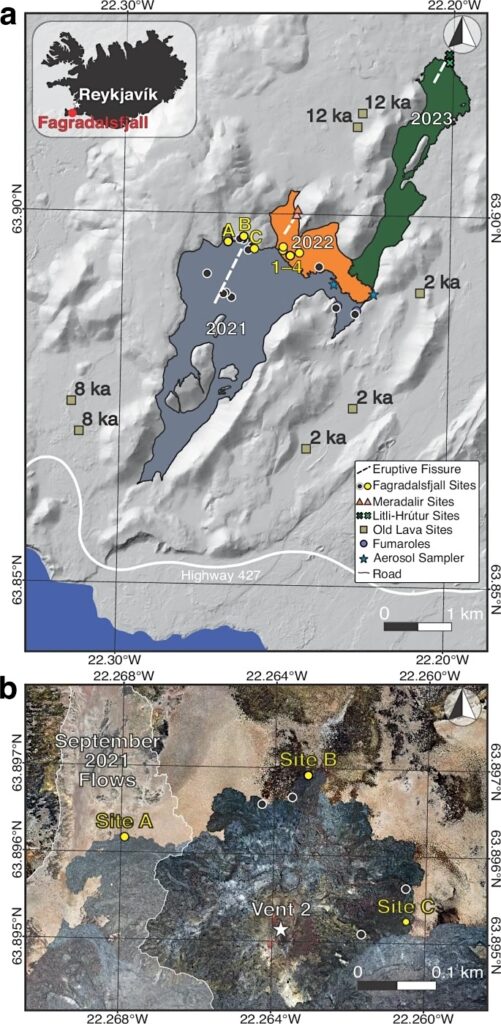
a Fagradalsfjall (blue-gray), 2022 Meradalir (orange), and 2023 Litli-Hrútur (green) eruptions with a background hillshade derived from previous work25,69,70. A total of 18 Fagradalsfjall, 3 Meradalir, 4 Litli-Hrútur sampling sites were established, though some are too closely spaced to be individually resolved on the map. Note that sampling sites 1, 2, 3, and 4 were from Fagradalsfjall, but were later resurfaced by new lava flows from Meradalir. Earlier in the eruption, day 1 sites were established near the eruptive vent but quickly covered. Additional sites were collected in 2024 to determine spatial variability, indicated by the black circles for Fagradalsfjall, pink triangles for Meradalir, and light green × for Litli-Hrútur. b Inset of area around Sites A–C. A late-stage breakout in September of 2021 covered Site A and the area of the flow is shown in transparent white. — Communications Biology
- Three eruptions at the Fagradalsfjall Volcano in Iceland show rapid and predictable microbial community establishment, Communications Biology via PubMed (open access)
- Three eruptions at the Fagradalsfjall Volcano in Iceland show rapid and predictable microbial community establishment, Communications Biology (open access)
Related links
- Lava World Away Team Practice: NASA’s VERITAS Science Team Studies Volcanic Iceland, earlier post
- Away Teams: What Microbes Can Tell Us about Life On Earth And In Space, earlier post
- ESA/NASA Mars Sample Return Away Team Campaign in Iceland, earlier post
Astrobiology,Astrobiology,