The Role Of Polycyclic Aromatic Hydrocarbons In Astrochemical Modeling At Different Evolutionary Stages Of Cold Dense Cloud Cores
Context. Although the role of PAHs have been highlighted in recent years, it is crucial to verify their functions at different evolutionary stages of dark cloud cores.
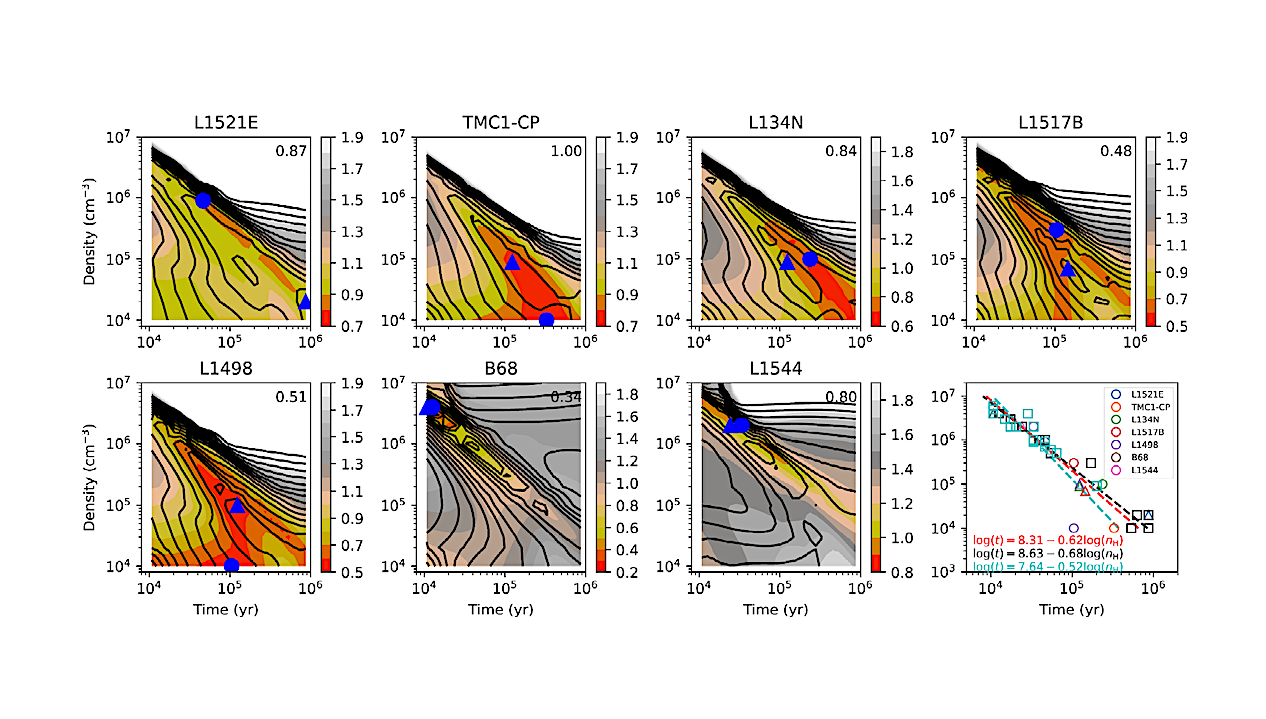
Aims. Fitting molecular abundances with gas-grain chemical models has revealed shorter chemical ages for denser cold dark cloud cores. To deepen the understanding of chemical ages and the functions of PAHs, we investigated the influence of PAHs in our chemical models by fitting observational data.
Methods. We collected observed molecular abundances (at least five species per core) from the literature for 39 cold dense cloud cores (T < 25 K and 104 ≤ nH ≤ 107 cm−3). Using a gas-grain chemical model, we fit the molecular abundances of the 39 samples to determine the best-fit chemical ages and discuss the role of PAHs in an evolutionary view.
Results. We find an anticorrelation between the gas density and the fit chemical age through molecular abundance fitting. The best-fit chemical ages of the low-density cores (<7 × 104 cm−3) are comparable to the dynamical ages, which can be a good alternative indicator of physical age.
However, for high-density cores (>7 × 104 cm−3), the chemical age is far from the physical age and therefore useless. The inclusion of PAHs do not change the estimation of the chemical ages much, which indicates the small effect of PAHs on average. However, we identified molecular tracers that are sensitive to PAHs at different evolutionary stages, thus revealing their diagnostic potential for chemical evolution.
The role of polycyclic aromatic hydrocarbons in astrochemical modeling at different evolutionary stages of cold dense cloud cores, Astronomy & Astrophysics (A&A) (open access)
Astrobiology, Astrochemistry,