Multi-bandpass Photometry for Exoplanet Atmosphere Reconnaissance (MPEAR) with the Habitable Worlds Observatory (HWO) — I. Differentiating Earth from Neptunes During Discovery
As the architecture for the Habitable Worlds Observatory (HWO) is being developed, it is crucial to optimize the observing strategies for a survey to detect and characterize Earth-like planets around Sun-like stars.
Efficient target identification and characterization will help drive mission requirements that can be matched to the planned observations. Current HWO concepts allow simultaneous multi-bandpass observations with the coronagraph instrument, critical for performing a qualitative planetary reconnaissance to optimize observing time for deriving orbital constraints and prioritize characterization of promising targets.
We describe a new algorithm designed to determine the best combination of broadband photometric observations for extracting maximum information from the first visit. It identifies degeneracies in the orbital configurations, fluxes, and noise, and determines optimal secondary photometry bands to reduce these.
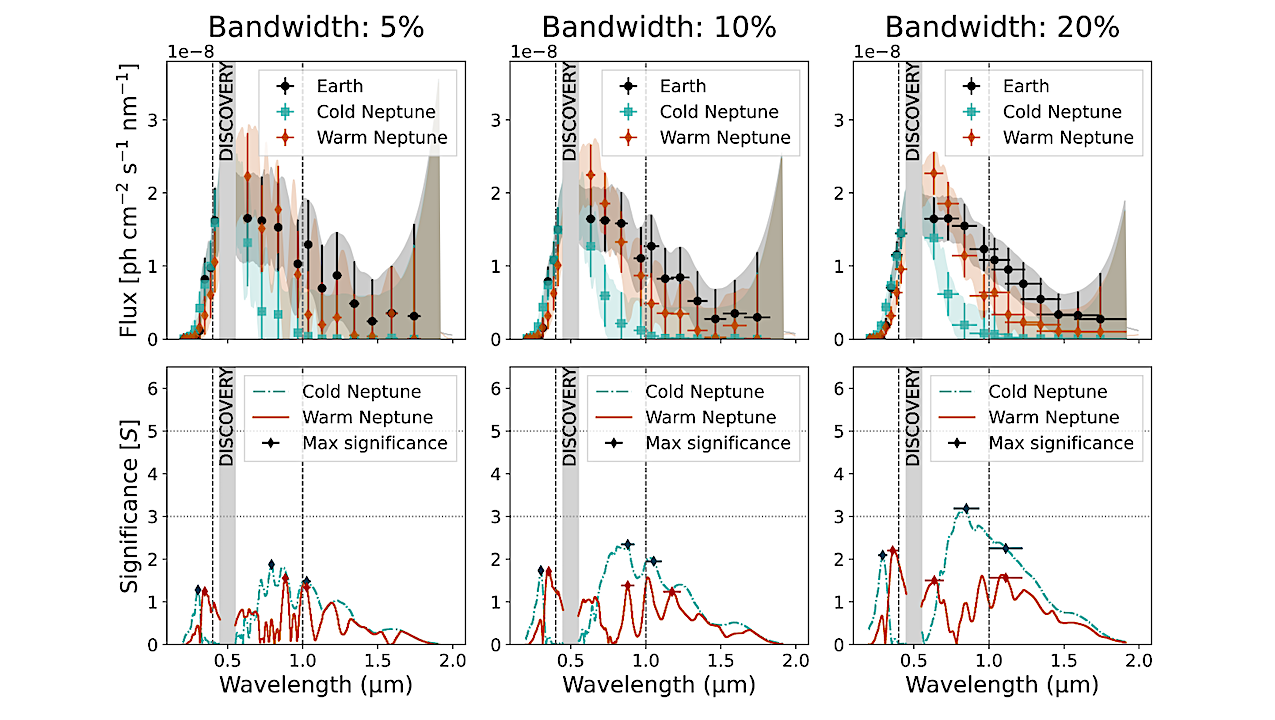
We demonstrate its application by comparing an Earth seen at quadrature with a cold and a warm Neptune at inclined orbits and varying phases, with comparable flux in the discovery bandpass centered at 500 nm (20\% bandwidth). Using the noise and exposure time calculator that we developed for the HWO coronagraph instrument, we find that the baseline S/N=7 (corresponding to 3.2 hours observing time for a planet at 10pc) is only sufficient to marginally differentiate the Earth from a cold Neptune-like planet assuming two parallel bandpasses (550 nm + 850 nm).
However, increasing to S/N=15 (7 hours observing time) and using three parallel bandpasses (360 nm + 500 nm + 1.11 micron) would differentiate the Earth from either a warm or cold Neptune.
Eleonora Alei, Avi M. Mandell, Miles H. Currie, Aki Roberge, Christopher C. Stark, Allison Payne, Vincent Kofman, Geronimo L. Villanueva, Renyu Hu, Amber V. Young
Comments: 28 pages, 11 figures, 3 tables. Accepted for publication to AJ
Subjects: Earth and Planetary Astrophysics (astro-ph.EP); Instrumentation and Methods for Astrophysics (astro-ph.IM)
Cite as: arXiv:2512.05279 [astro-ph.EP](or arXiv:2512.05279v1 [astro-ph.EP] for this version)
https://doi.org/10.48550/arXiv.2512.05279
Focus to learn more
Submission history
From: Eleonora Alei
[v1] Thu, 4 Dec 2025 22:02:12 UTC (7,637 KB)
https://arxiv.org/abs/2512.05279
Astrobiology, Exoplanet,