Large-amplitude Variability Driven By Giant Dust Storms On A Planetary-mass Companion
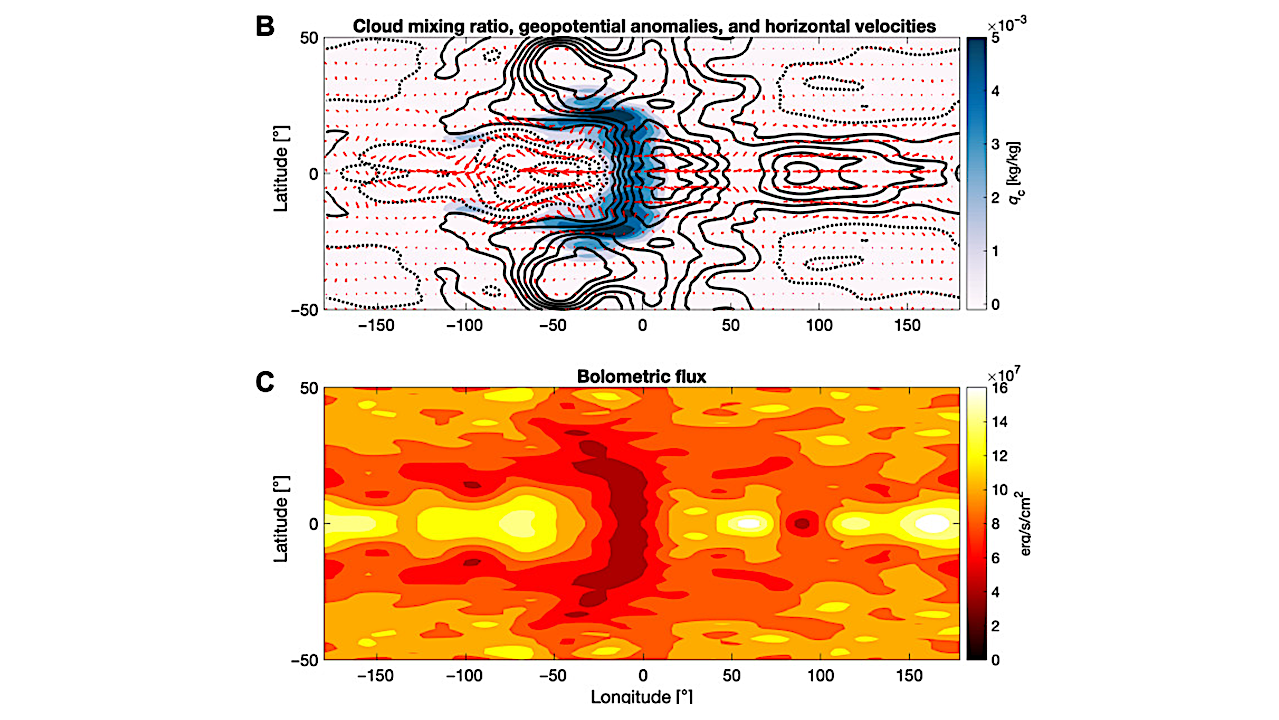
Large-amplitude variations are commonly observed in the atmospheres of directly imaged exoplanets and brown dwarfs. VHS 1256B, the most variable known planet-mass object, exhibits a near-infrared flux change of nearly 40%, with red color and silicate features revealed in recent JWST spectra, challenging current theories.
Using a general circulation model, we demonstrate that VHS 1256B’s atmosphere is dominated by planetary-scale dust storms persisting for tens of days, with large patchy clouds propagating with equatorial waves.
This weather pattern, distinct from the banded structures seen on solar system giants, simultaneously explains the observed spectra and critical features in the rotational light curves, including the large amplitude, irregular evolution, and wavelength dependence, as well as the variability trends observed in near-infrared color-magnitude diagrams of dusty substellar atmospheres.
- Large-amplitude variability driven by giant dust storms on a planetary-mass companion, Science Advances via PubMed (open access)
- Large-amplitude variability driven by giant dust storms on a planetary-mass companion, Science Advances (open access)
Astrobiology,