JWST NIRSpec Finds No Clear Signs Of An Atmosphere On TOI-1685 b
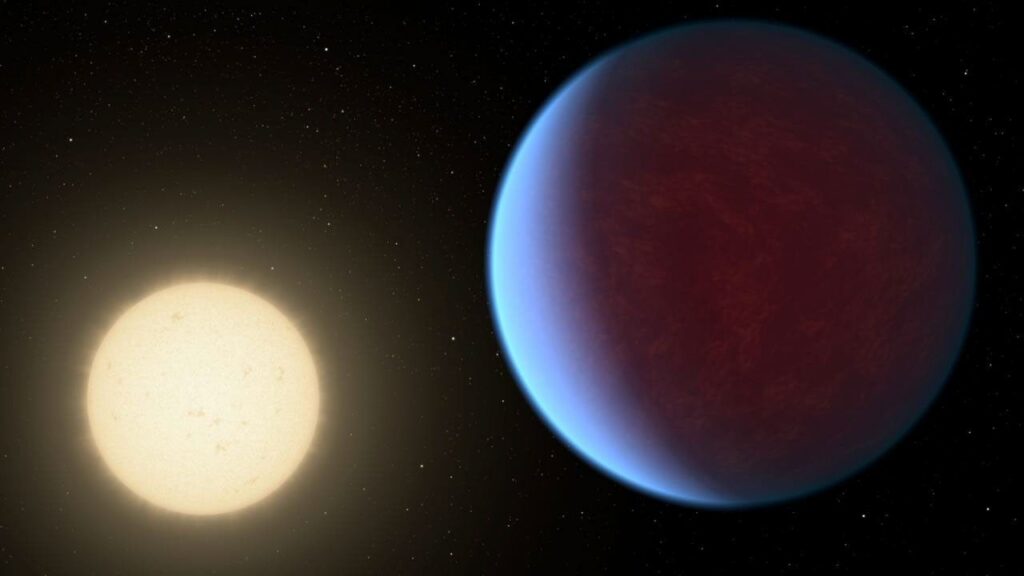
Determining the prevalence of atmospheres on terrestrial planets is a core objective in exoplanetary science. While M dwarf systems offer a promising opportunity, conclusive observations of terrestrial atmospheres have remained elusive, with many yielding flat transmission spectra.
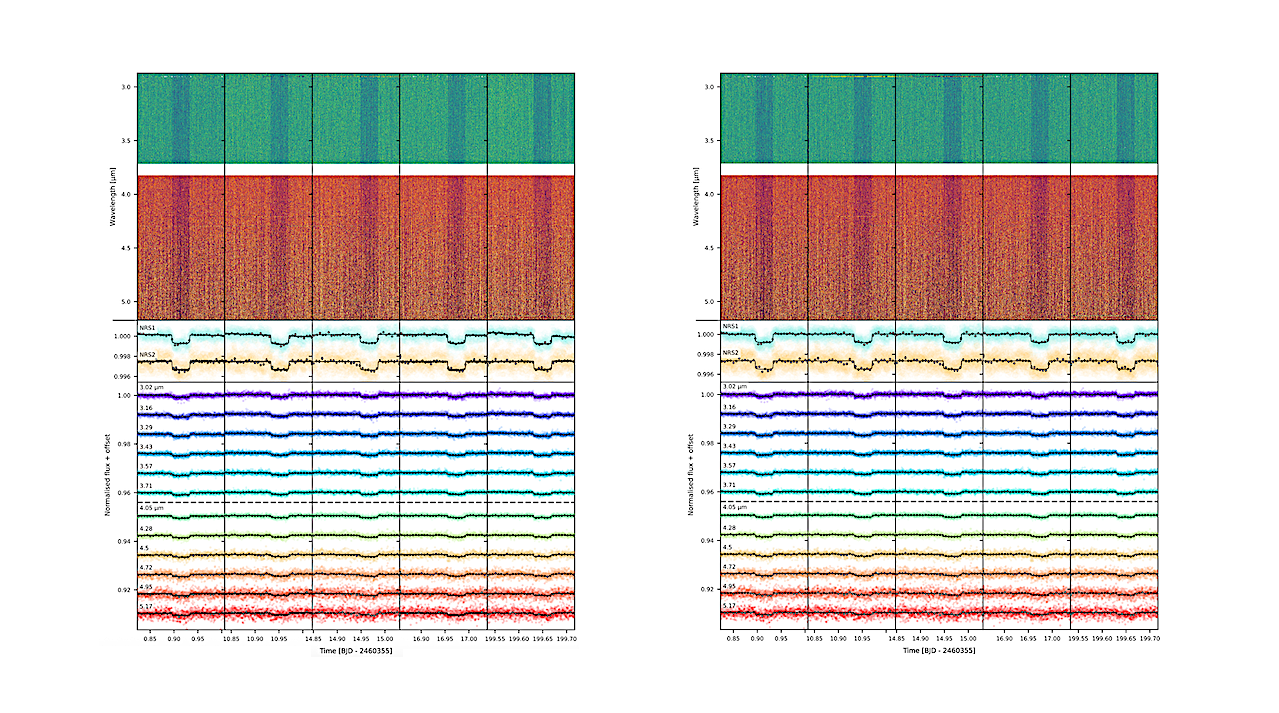
We observe four transits of the hot terrestrial planet TOI-1685 b using JWST’s NIRSpec G395H instrument. Combining this with the transit from the previously-observed phase curve of the planet with the same instrument, we perform a detailed analysis to determine the possibility of an atmosphere on TOI-1685 b.
From our retrievals, the Bayesian evidence favours a simple flat line model, indicating no evidence for an atmosphere on TOI-1685 b, in line with results from the phase curve analysis. Our results show that hydrogen-dominated atmospheres can be confidently ruled out. For heavier, secondary atmospheres we find a lower limit on the mean molecular weight of ~10, at a significance of ~5 sigma.
Pure CO2, SO2, H2O, and CH4 atmospheres, or a mixed secondary atmosphere (CO+CO2+SO2) could explain the data (Delta lnZ < 3). However, pure CH4 atmospheres may be physically unlikely, and the pure H2O and CO2 cases require a high-altitude cloud, which could also be interpreted as a thin cloud-free atmosphere.
We discuss the theoretical possibility for different types of atmosphere on this planet, and consider the effects of atmospheric escape and stellar activity on the system. Though we find that TOI-1685 b is likely a bare rock, this study also highlights the challenges of detecting secondary atmospheres on rocky planets with JWST.
Chloe E. Fisher, Matthew J. Hooton, Amélie Gressier, Merlin Zgraggen, Meng Tian, Kevin Heng, Natalie H. Allen, Richard D. Chatterjee, Brett M. Morris, Nicholas W. Borsato, Néstor Espinoza, Daniel Kitzmann, Tobias G. Meier, Lars A. Buchhave, Adam J. Burgasser, Brice-Olivier Demory, Mark Fortune, H. Jens Hoeijmakers, Raphael Luque, Erik A. Meier Valdés, João M. Mendonça, Bibiana Prinoth, Alexander D. Rathcke, Jake Taylor
Comments: 18 pages, 14 figures, 3 tables; Accepted for publication in MNRAS
Subjects: Earth and Planetary Astrophysics (astro-ph.EP)
Cite as: arXiv:2512.15338 [astro-ph.EP] (or arXiv:2512.15338v1 [astro-ph.EP] for this version)
https://doi.org/10.48550/arXiv.2512.15338
Focus to learn more
Submission history
From: Chloe Fisher
[v1] Wed, 17 Dec 2025 11:36:39 UTC (15,613 KB)
https://arxiv.org/abs/2512.15338
Astrobiology, exoplanet,