APEX Survey Of Interstellar HCl: 35Cl/37Cl Isotopic Ratios In Dense Cores And Outflows
Despite being only the 19th most abundant element in the interstellar medium, chlorine’s reactivity and volatility give rise to a unique interstellar chemistry, favouring the formation of several chlorine-bearing hydrides.
Further, the 35Cl/37Cl ratio probes nucleosynthesis across the Galaxy. Yet, studies of Cl-bearing molecules have remained limited to a few sightlines due to observational challenges.
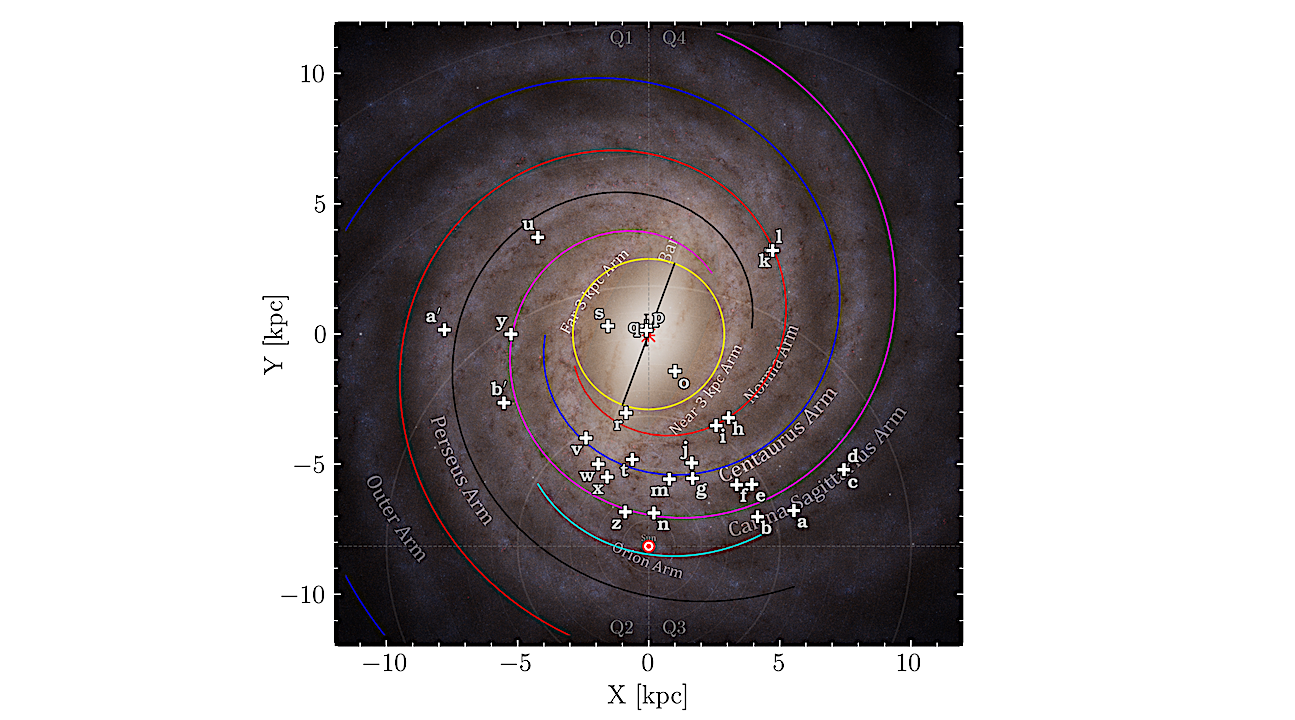
We systematically investigated the Galactic distribution of HCl and the [H35Cl]/[H37Cl] ratio in high-mass star-forming regions. As a probe of a region’s nucleosynthesis history, this ratio may constrain predictions of Galactic chemical evolution models.
We observed the ground-state J=1−0 lines of H35Cl and H37Cl toward 28 high-mass star-forming regions with SEPIA660 on APEX, more than doubling the number of known HCl detections and revealing with XCLASS models emission from both cores and outflows.
H35Cl was detected in all sources, H37Cl in all but two, with spectral line profiles ranging from those with only emission to complex emission-absorption mixtures. We find column densities of the order of 1013cm−2 for H35Cl and isotopic ratios between 1.6 and 3.5 in emission-only sources.
The derived [H35Cl]/[H37Cl] aligns with Galactic chemical evolution models and shows no trend with Galactocentric radius. However, local variations may reflect recent nucleosynthesis. Overall, the results suggest that most Galactic chlorine was synthesized during epochs of lower average metallicity in the Galaxy.
Notably, we detect H35Cl emission arising from outflows – particularly explosive ones – hinting at its presence in a broader range of environments. The present single-dish observations cannot reveal the origin of HCl in outflows; necessitating interferometric follow-up observations.
Lennart M. Böhm, Arshia M. Jacob, Friedrich Wyrowski, Karl M. Menten, Katharina Immer, Ashley T. Barnes
Comments: Accepted for publication in A&A (15 pages, 9 figures, 4 tables)
Subjects: Astrophysics of Galaxies (astro-ph.GA)
Cite as: arXiv:2511.21813 [astro-ph.GA] (or arXiv:2511.21813v1 [astro-ph.GA] for this version)
https://doi.org/10.48550/arXiv.2511.21813
Focus to learn more
Submission history
From: Lennart Böhm
[v1] Wed, 26 Nov 2025 19:00:01 UTC (21,175 KB)
https://arxiv.org/abs/2511.21813
Astrobiology, Astrochemistry,