Condensation Calculations In Planetary Science And Cosmochemistry
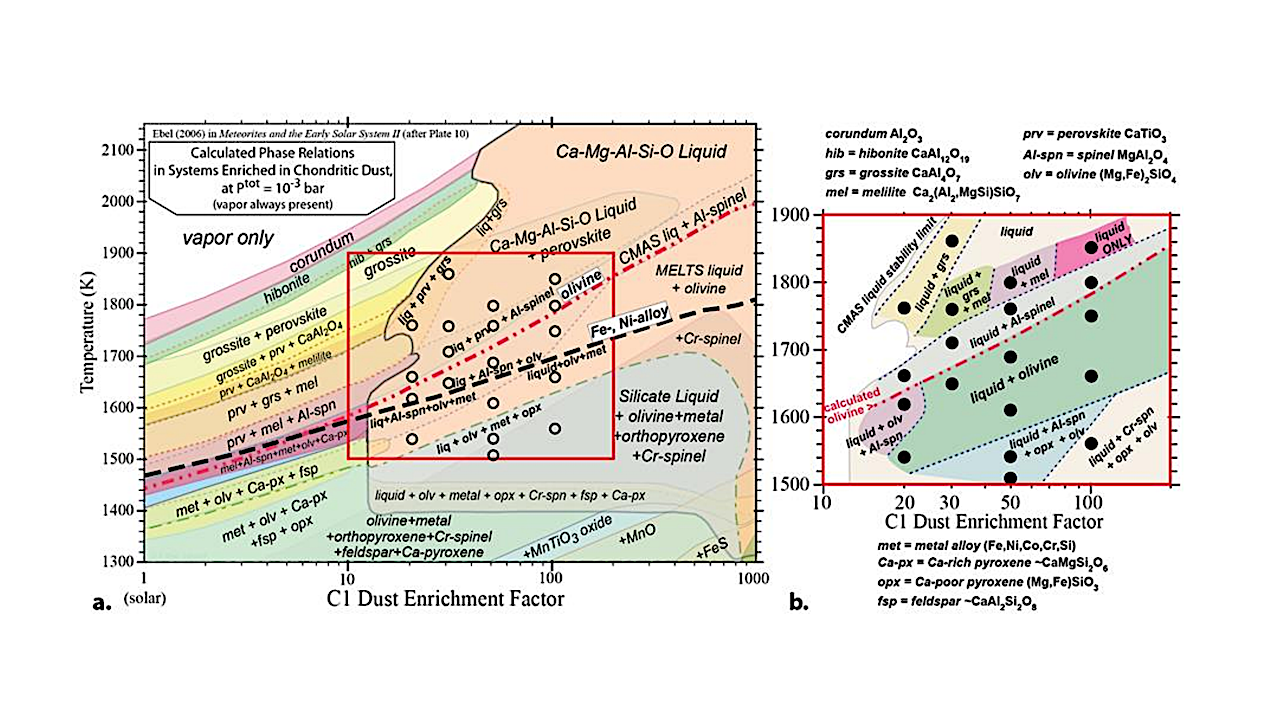
Cool a piece of the Sun to 1000 K at one millibar pressure to yield a mineral assemblage consistent with those found in the most primitive meteorites. This is an equilibrium or fractional condensation experiment simulated by calculations using equations of state for hundreds of gaseous molecules, condensed mineral solids, and silicate liquids, the products of a century of experimental measurements and theoretical studies. Such calculations have revolutionized our understanding of the chemistry of the cosmos.
The mid-20th Century realization that meteorites are fossil records of the early Solar System made chemistry central to understanding planetary origins. Thus “condensation”, the distribution of elements and isotopes between vapor and condensed solids and/or liquids at or approaching chemical equilibrium, deeply informs discussion of how meteor/comet compositions bear on planets.
Condensation calculations have been applied to disks around young stars, to the mineral “rain” of mineral grains expected to form in cool dwarf star atmospheres, to the expanding envelopes of giant stars, to the vapor plumes that form in planetary impacts, and to the chemically and isotopically distinct “shells” computed and observed to exist in supernovae. As with all sophisticated calculations, there are inherent caveats, subtleties, and computational difficulties.
Local chemistry has yet to be consistently integrated into dynamical astrophysical simulations so that effects like the blocking of radiation by grains, absorption and reemission of light by grains, and buffering of heat by grain evaporation/condensation feed back into the physics at each node of a gridded calculation over time. A deeper integration of thermochemistry with physical models makes the prospect of a general protoplanetary disk model as hopeful now as a general circulation model for global climate was in the early 1970’s.
Denton S. Ebel
Comments: Review for Oxford Encyclopedia
Subjects: Earth and Planetary Astrophysics (astro-ph.EP); Solar and Stellar Astrophysics (astro-ph.SR)
Cite as: arXiv:2306.12645 [astro-ph.EP] (or arXiv:2306.12645v1 [astro-ph.EP] for this version)
Related DOI:
https://doi.org/10.1093/acrefore/9780190647926.013.201
Focus to learn more
Submission history
From: Denton Ebel
[v1] Thu, 22 Jun 2023 03:07:45 UTC (950 KB)
https://arxiv.org/abs/2306.12645
Astrobiology, Astrochemistry,