The Role of Intrinsic Temperature and Vertical Mixing in Characterizing Sub-Neptune Atmospheres
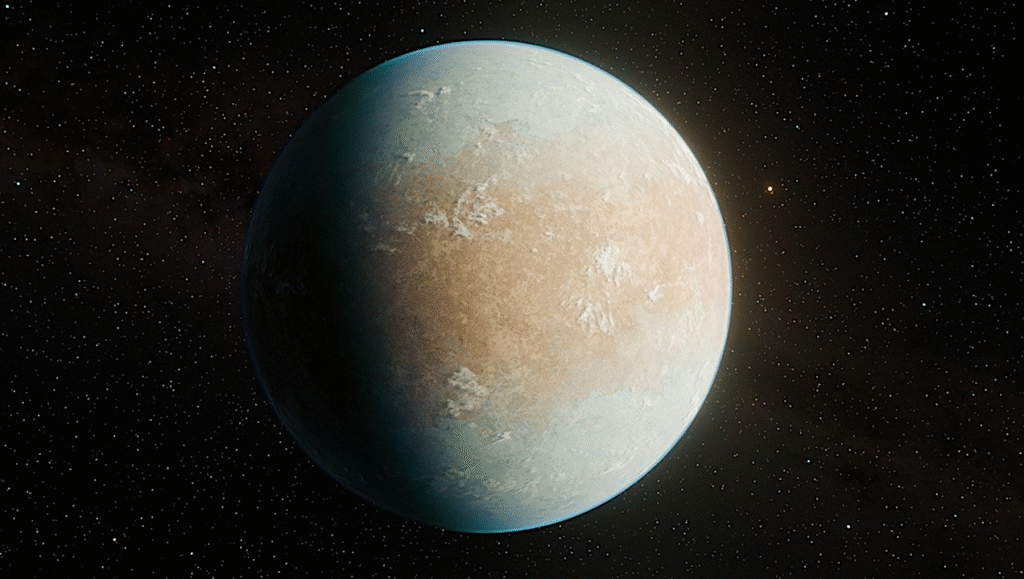
Sub-Neptune planets are often modeled with a dense rocky or metal-rich interior beneath a thick hydrogen/helium (H/He) atmosphere; though their bulk densities could also be explained by a water-rich interior with a thin H/He atmosphere.
Atmospheric composition provides a key mechanism to break this degeneracy between competing interior models. However, the overall composition of subNeptunes inferred from spectra obtained with the James Webb Space Telescope, remains debated in part due to differences in modeling assumptions.
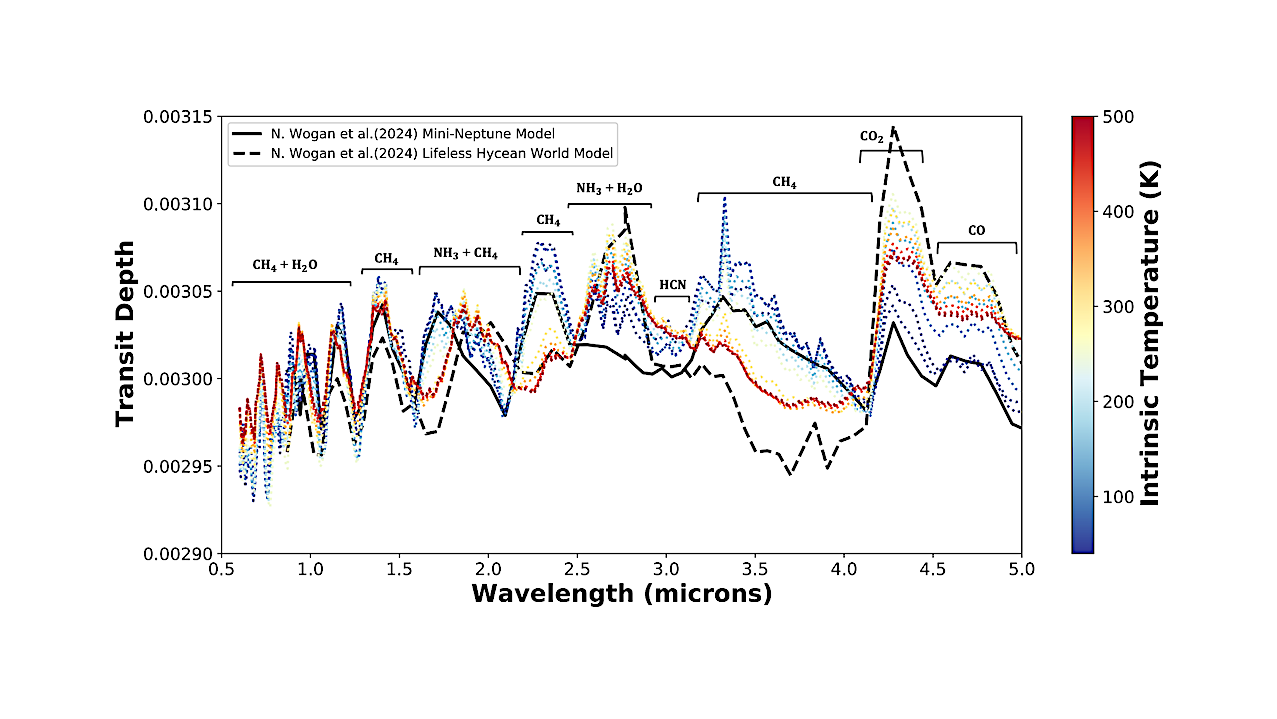
While previous studies explored parameter spaces such as stellar spectra, atmospheric metallicities, and carbon-to-oxygen ratios, they often assumed fixed intrinsic temperatures (Tint) and vertical eddy diffusion coefficients (Kzz) – two critical, yet poorly constrained, drivers of atmospheric chemistry. To address this, we present a self-consistent grid of models that covers the full plausible range of Tint (60 – 450 K) and Kzz (105 – 1012 cm2/s) using the open-source PICASO and VULCAN packages to better characterize sub-Neptune atmospheres.
Focusing on K2-18b analogs, we demonstrate that Tint and Kzz significantly impact CH4, CO2, CO, NH3 and HCN abundances, with H2O being largely unaffected. Our work demonstrates that comprehensive parameter space exploration of thermal and mixing parameters is essential for accurate interpretation of sub-Neptune spectra, and that single-parameter assumptions can lead to misclassification of planetary interiors.
We provide a diagnostic framework using multi-molecule observations to distinguish between competing atmospheric models and advance robust characterization of sub-Neptunes.
Neha Dushyantha Kumar, Jessica E. Libby-Roberts, Caleb I. Canas, Nicholas F. Wogan, Suvrath Mahadevan, Sagnick Mukherjee
Comments: Submitted to AAS Journals (26 pages)
Subjects: Earth and Planetary Astrophysics (astro-ph.EP)
Cite as: arXiv:2601.18769 [astro-ph.EP] (or arXiv:2601.18769v1 [astro-ph.EP] for this version)
https://doi.org/10.48550/arXiv.2601.18769
Focus to learn more
Submission history
From: Jessica Libby-Roberts
[v1] Mon, 26 Jan 2026 18:38:20 UTC (1,712 KB)
https://arxiv.org/abs/2601.18769
Astrobiology,