Dynamical Interactions and Habitability in the TOI-700 Multi-Planet System
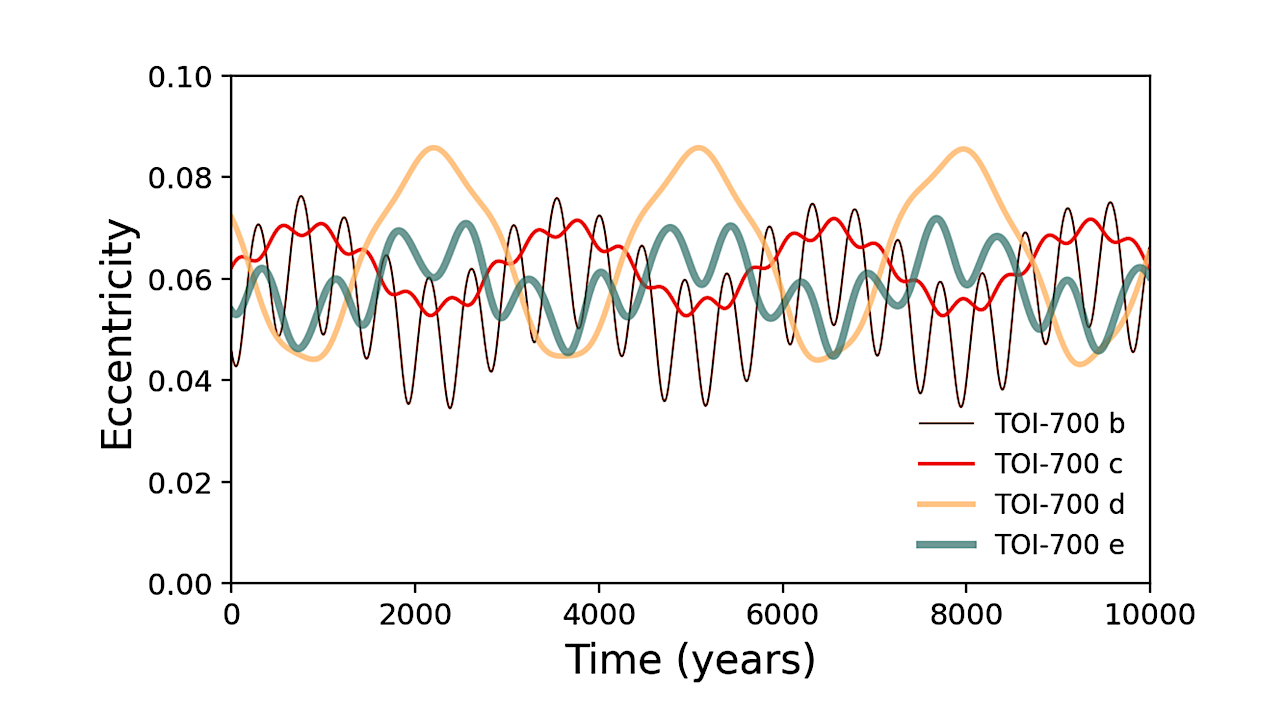
The discovery of a second earth sized planet (TOI-700e) interior to the habitable candidate TOI-700d has prompted further research into this system, as the additional planet makes the TOI-700 system a tightly packed multi-planet system with multiple planets in the habitable zone, like TRAPPIST-1.
In this work, we use the planetary evolution code VPLanet to assess the potential habitability of TOI-700d and TOI-700e. We first examine their orbital dynamics to evaluate the influence of planet-planet interactions on the planet spin, obliquity, and eccentricity.
We then investigate whether these interactions are sufficient to cause either TOI-700d or e to be perturbed out of a habitable state, and whether we expect either planet could retain surface oceans over Gyr timescales. Together, these analyses allow us to assess the long-term habitability prospects of both TOI-700d and TOI-700e.
We find that multi-planet interactions in the TOI-700 system do not prevent either planet from potentially retaining habitable conditions; however, we find that TOI-700e is located very near the boundary of the tidally locked habitable zone (arXiv:1705.10362), suggesting further work is needed to determine whether it is truly habitable.
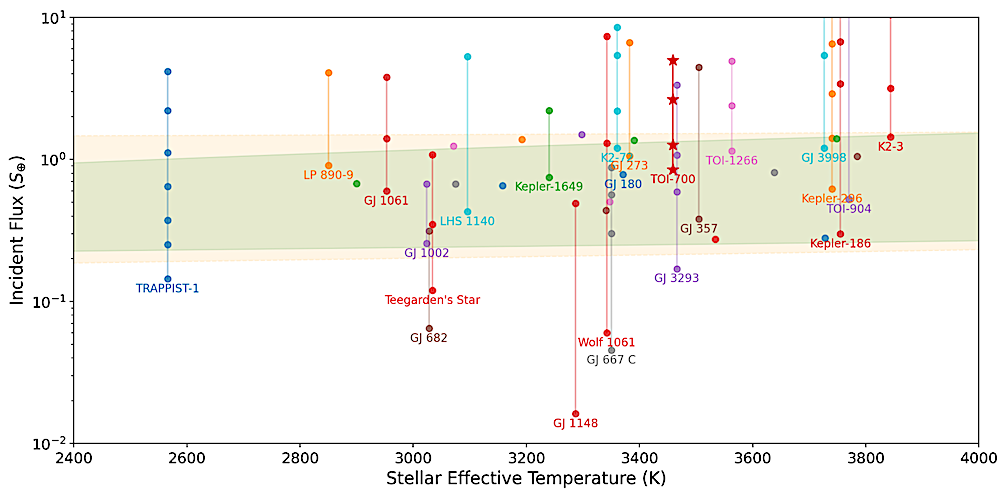
Incident flux in S⊕ received by planets orbiting M-dwarfs in systems where at least one planet resides in the habitable zone as a function of their host star’s effective temperature. Each vertical line connects planets within the same system. Systems with at least one planet in the optimistic habitable zone (shaded orange) or conservative habitable zone (shaded green) are included. Multi-planet systems are labeled with the system name. The optimistic habitable zone (orange shading) is bounded by the Recent Venus and Early Mars 1D limits from Kopparapu et al. (2014). The conservative habitable zone (green shading) uses a more restrictive definition: its inner boundary is set by the stellar insolation shown by the 3D models of Kopparapu et al. (2017) to trigger a runaway greenhouse effect for tidally locked planets around M-dwarfs, while its outer boundary follows the maximum greenhouse limit assumed by Kopparapu et al. (2014). While the location of the inner edge was computed using 3D models, the outer edge relies solely on 1D models and may therefore be systematically offset from its true position (Leconte et al. 2013, e.g.,). Tightly packed multi-planet systems with multiple planets in the habitable zone include TRAPPIST-1, GJ 3293, and TOI-700. Data obtained 6/7/2025 from the IPAC Exoplanet Archive (Christiansen et al. 2025).– astro-ph.EP
Coleman Nelson, Juliette Becker
Comments: 11 pages, 5 figures, 2 tables
Subjects: Earth and Planetary Astrophysics (astro-ph.EP)
Cite as: arXiv:2602.00332 [astro-ph.EP] (or arXiv:2602.00332v1 [astro-ph.EP] for this version)
https://doi.org/10.48550/arXiv.2602.00332
Focus to learn more
Submission history
From: Coleman Nelson
[v1] Fri, 30 Jan 2026 21:35:08 UTC (1,276 KB)
https://arxiv.org/abs/2602.00332
Astrobiology