Microbes From Ambient-pressure Analogues Offer Insights Into Possible Life In Europa’s High-pressure Subsurface Ocean
Under its thick ice layer, Europa contains a shielded liquid water ocean where habitable conditions may exist. To effectively assess the habitability of this environment and the implications on putative biosignature formation, it is essential to integrate our understanding of the physicochemical conditions of the sub-surface ocean with ground-truth analysis on Earth, using both natural analogue sites and laboratory simulation experiments.
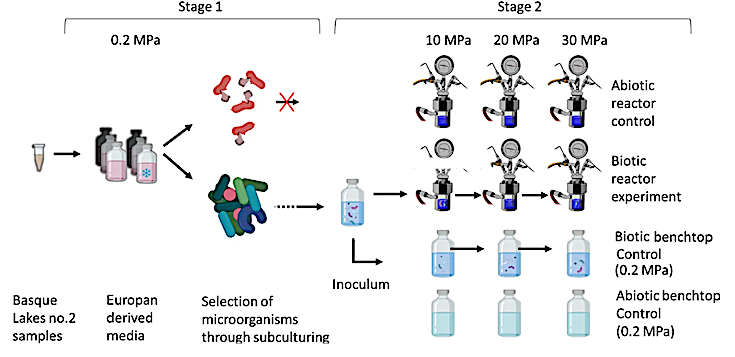
An overview of the experimental design. Stage 1 corresponds to the preparation of the microbial inoculum through eight sequential culturing steps. Stage 2 corresponds to the simulation experiment where the pressure was gradually increased from the initial 0.2 MPa (ambient pressure) to 30 MPa (cells were grown for 12 days at each pressure). Under its thick ice layer, Europa contains a shielded liquid water ocean where habitable conditions may exist. To effectively assess the habitability of this environment and the implications on putative biosignature formation, it is essential to integrate our understanding of the physicochemical conditions of the sub-surface ocean with ground-truth analysis on Earth, using both natural analogue sites and laboratory simulation experiments. — Frontiers
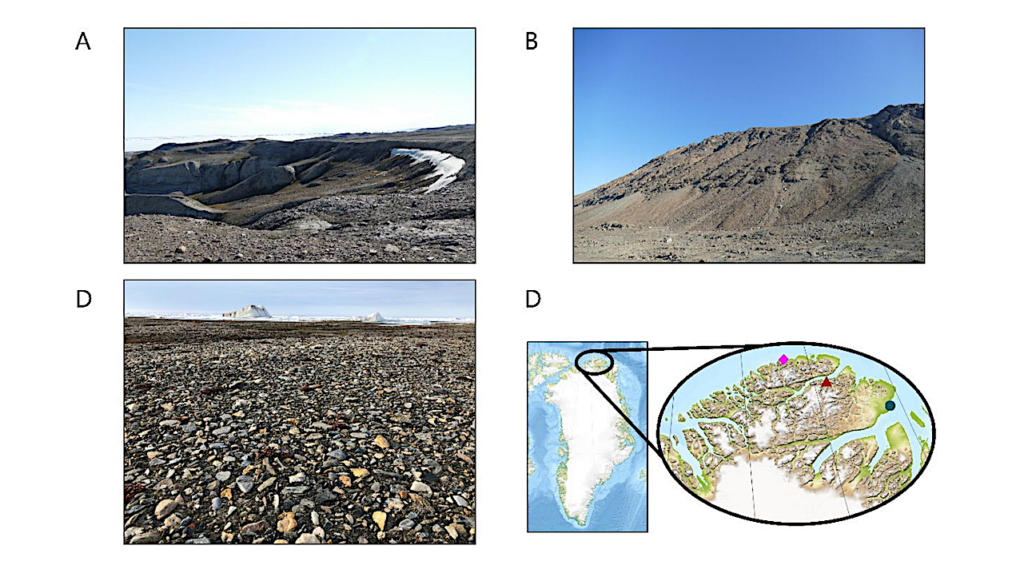
This combined approach is particularly prudent for Europa, as locations proposed as natural analogues for the chemistry of Europa’s ocean are predominantly located at ambient pressure (~0.1 MPa), which differs even from the shallowest depths of Europa’s ocean (e.g., 20 to 30 MPa). Basque Lake No. 2, British Columbia, Canada, was used as geochemical analogue for the ice shell-ocean interface and sub-ice environment of Europa due to the Mg-Na-SO4 chemistry (maximum 30 to 40% salinity in the summer) and temperature extremes [can reach −45 °C at night in the winter.
In this study, microorganisms from the site were grown at elevated pressures in fluid medium based on a model of Europa’s ocean chemistry, mimicking the conditions at Europa’s upper ocean. Following incubation at successively higher pressures, (0.2, 10, 20 and 30 MPa) a microorganism with 99.1% 16S rRNA gene sequence homology to Pseudodesulfovibrio aespoeensis was isolated at 30 MPa (designated Pseudodesulfovibrio sp. OU_01).
To our knowledge, this is the first study to demonstrate that microorganisms from an analogue site located at ambient pressure can grow at elevated pressures associated with Europa’s upper ocean.
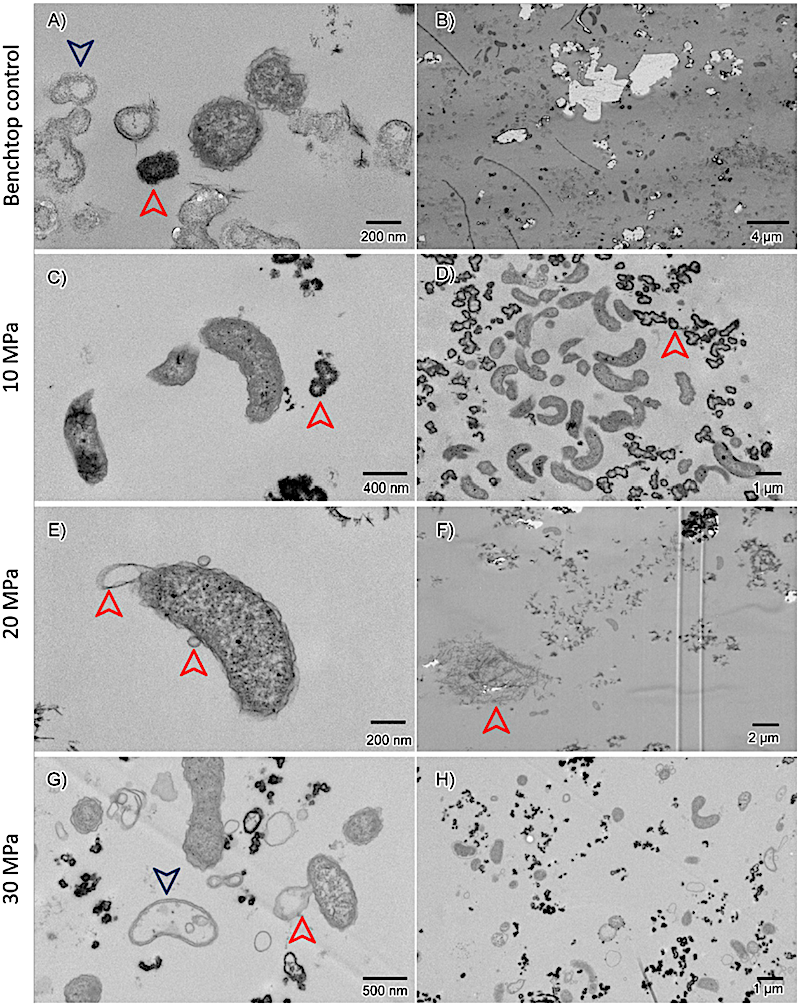
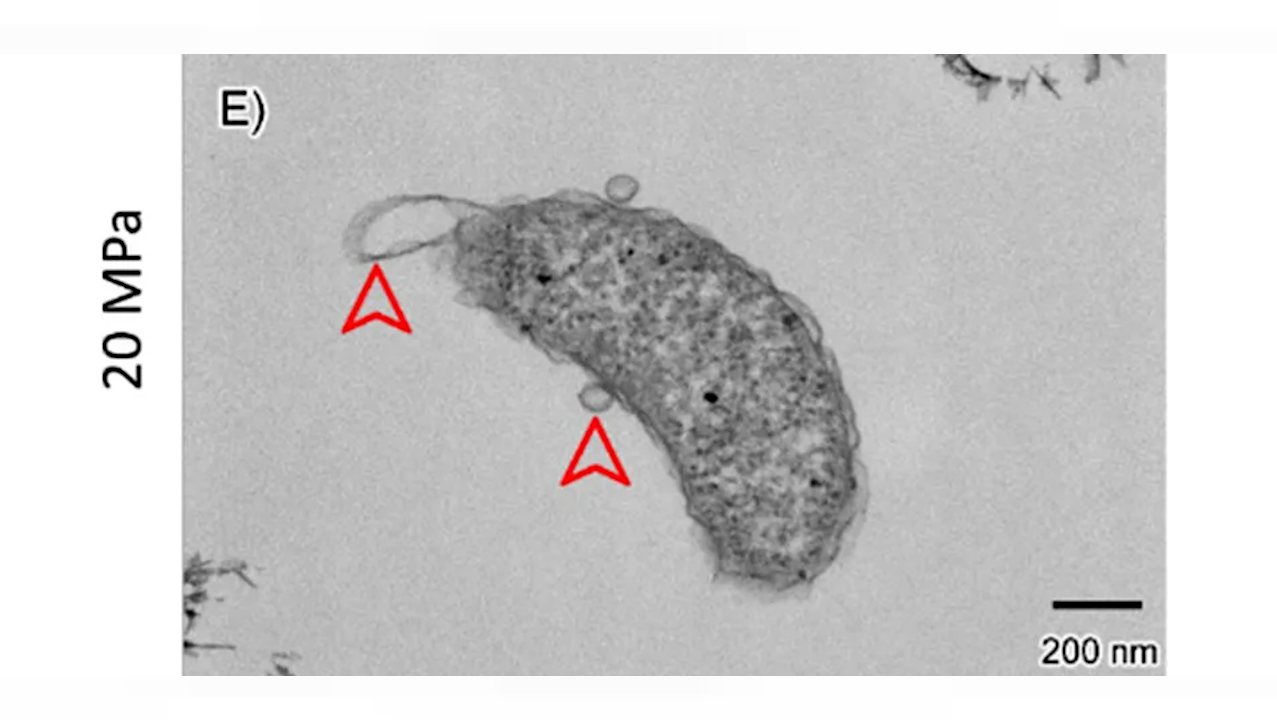
Transmission electron microscope images at low and high magnifications of cells grown under different pressures (A,B) belong to the room pressure control experiment (0.2 MPa); (C,D) to the 10 MPa experiment; (E,F) to the 20 MPa experiment; (G,H) to the 30 MPa experiment. Red and blue arrows point structures discussed in the text. — Frontiers
- Microbes from ambient-pressure analogues offer insights into possible life in Europa’s high-pressure subsurface ocean, Frontiers via PubMed (open access)
- Microbes from ambient-pressure analogues offer insights into possible life in Europa’s high-pressure subsurface ocean, Frontiers (open access)
Astrobiology