Spinning Out Of Focus: The Challenge Of Rotational Line Broadening In Exoplanet Reflection Spectroscopy
Detecting light reflected off the dayside of an exoplanet in high-resolution spectroscopic data has proved to be a notoriously difficult endeavour. Despite several attempts, the faint signal has yet to be detected.
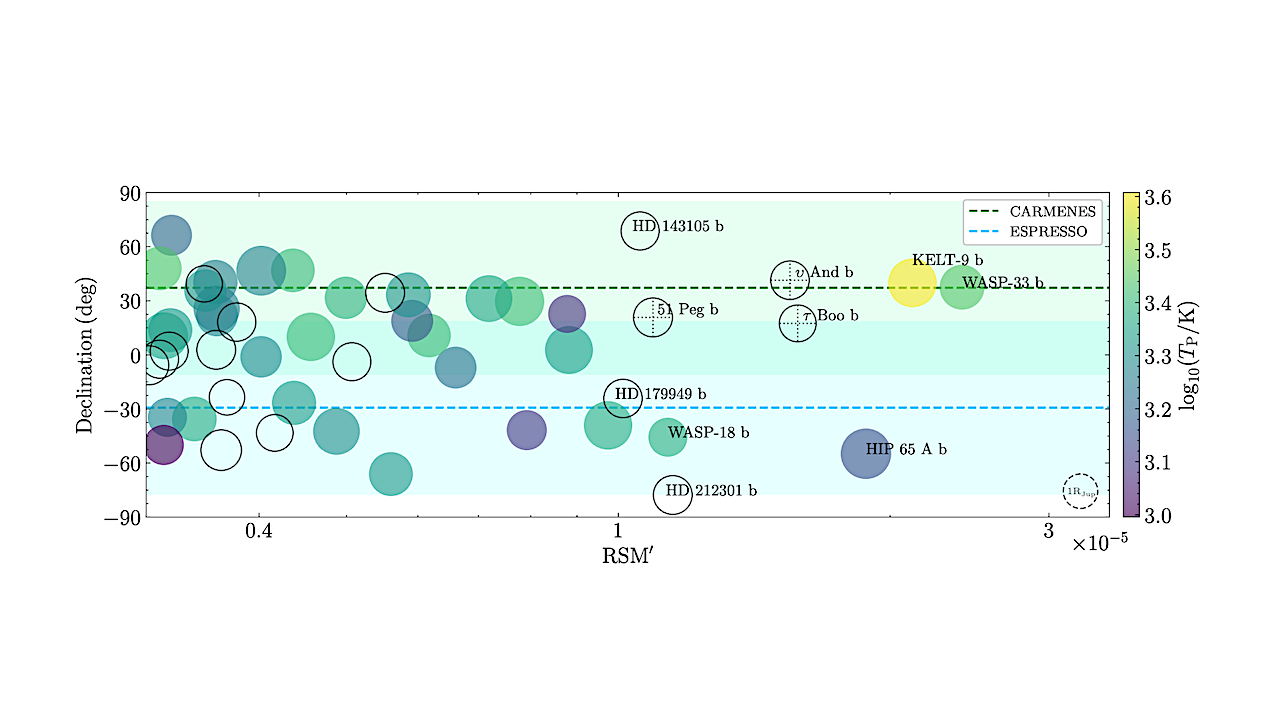
We present a new effort at finding reflection signatures and show how a strong rotational broadening of the reflected spectrum can complicate this objective. We introduce a new figure of merit that quantifies the favourability of different systems for a reflection study, the reflection spectroscopy metric.
Applying this metric, we identify the KELT-9 system, which features a highly misaligned, rapidly rotating host star, as the target for a case study based on a spectroscopic time series obtained by CARMENES. We also perform an injection-recovery test to determine the detectability of the signal in our data and demonstrate its sensitivity to rotational line broadening.
The search for a genuine reflection signal in our data resulted in a non-detection. The injection-recovery test puts this finding into context by revealing the critical importance of taking rotational broadening into account when dealing with systems featuring rapidly rotating stars and large spin-orbit misalignments.
The case study presented here underscores the need to incorporate stellar rotation and spin-orbit misalignment into assessments of a given planet’s favourability to reflection studies.
T. O. Winterhalder, K. Molaverdikhani, D. Cont, F. Yan, E. Nagel, A. Kaminski, L. Nortmann, P. J. Amado, V. J. S. Béjar, G. Bergond, J. A. Caballero, S. Czesla, Th. Henning, G. Morello, D. Montes, E. Palle, A. Quirrenbach, A. Reiners, I. Ribas, A. Schweitzer
Comments: Accepted for publication in Astronomy and Astrophysics
Subjects: Earth and Planetary Astrophysics (astro-ph.EP)
Cite as: arXiv:2605.16491 [astro-ph.EP] (or arXiv:2605.16491v1 [astro-ph.EP] for this version)
https://doi.org/10.48550/arXiv.2605.16491
Focus to learn more
Submission history
From: Thomas Winterhalder
[v1] Fri, 15 May 2026 18:00:01 UTC (4,987 KB)
https://arxiv.org/abs/2605.16491
Astrobiology, exoplanet,