With Evo 2, AI Can Model And Design The Genetic Code For All Domains Of Life
The DNA foundation model Evo 2, first released in February 2025 as a preprint, is now published in the journal Nature. Trained on the DNA of over 100,000 species across the entire tree of life, Evo 2 can identify patterns in gene sequences across disparate organisms that experimental researchers would need years to uncover. The machine learning model can accurately identify disease-causing mutations in human genes and is capable of designing new genomes that are as long as the genomes of simple bacteria.
Evo 2 was developed by scientists from Arc Institute and NVIDIA, convening collaborators across Stanford University, UC Berkeley, and UC San Francisco. The model’s code is publicly accessible from Arc’s GitHub, and is also integrated into the NVIDIA BioNeMo framework, as part of a collaboration between Arc Institute and NVIDIA to accelerate scientific research. Arc Institute also worked with AI research lab Goodfire to develop a mechanistic interpretability visualizer that uncovers the key biological features and patterns the model learns to recognize in genomic sequences. The Evo team has shared its training data, training and inference code, and model weights, making it the largest-scale, fully open source AI model to date.
Building on its predecessor Evo 1, which was trained entirely on single-cell genomes, Evo 2 is the largest artificial intelligence model in biology to date, trained on over 9.3 trillion nucleotides—the building blocks that make up DNA or RNA—from over 128,000 whole genomes as well as metagenomic data. In addition to an expanded collection of bacterial, archaeal, and phage genomes, Evo 2 includes information from humans, plants, and other single-celled and multi-cellular species in the eukaryotic domain of life.
“Our development of Evo 1 and Evo 2 represents a key moment in the emerging field of generative biology, as the models have enabled machines to read, write, and think in the language of nucleotides,” says Patrick Hsu, Arc Institute Co-Founder, Arc Core Investigator, an Assistant Professor of Bioengineering and Deb Faculty Fellow at University of California, Berkeley, and a co-senior author on the paper. “Evo 2 has a generalist understanding of the tree of life that’s useful for a multitude of tasks, from predicting disease-causing mutations to designing potential code for artificial life. We’re excited to see what the research community builds on top of these foundation models.”
Evolution has encoded biological information in DNA and RNA, creating patterns that Evo 2 can detect and utilize. “Just as the world has left its imprint on the language of the Internet used to train large language models, evolution has left its imprint on biological sequences,” says co-senior author Brian Hie, an Assistant Professor of Chemical Engineering at Stanford University, the Dieter Schwarz Foundation Stanford Data Science Faculty Fellow, and Arc Institute Innovation Investigator in Residence. “These patterns, refined over millions of years, contain signals about how molecules work and interact.”
Evo 2 was trained for several months on the NVIDIA DGX Cloud AI platform via AWS, utilizing over 2,000 NVIDIA H100 GPUs and bolstered by collaboration with NVIDIA researchers and engineers. The model can process genetic sequences of up to 1 million nucleotides at once, enabling it to understand relationships between distant parts of a genome. Achieving this technical feat required the research team to reimagine how an AI model could quickly ingest and make inferences about this scale of data. The resulting AI architecture, called StripedHyena 2, enabled Evo 2 to be trained with 30 times more data than Evo 1 and reason over 8 times as many nucleotides at a time.
The model already shows enough versatility to identify genetic changes that affect protein function and organism fitness. For example, in tests with variants of the breast cancer-associated gene BRCA1, Evo 2 achieved over 90% accuracy in predicting which mutations are benign versus potentially pathogenic. Insights like this could save countless hours and research dollars needed to run cell or animal experiments, by finding genetic causes of human diseases and accelerating the development of new medicines.
In the year since its preprint release, researchers have applied the model to a range of scientific problems, from predicting genetic disease risk in Alzheimer’s patients to assessing variant effects across domesticated animal species. Arc researchers have also used Evo 2 to design functional synthetic bacteriophages, demonstrating potential applications for treating antibiotic-resistant bacteria.
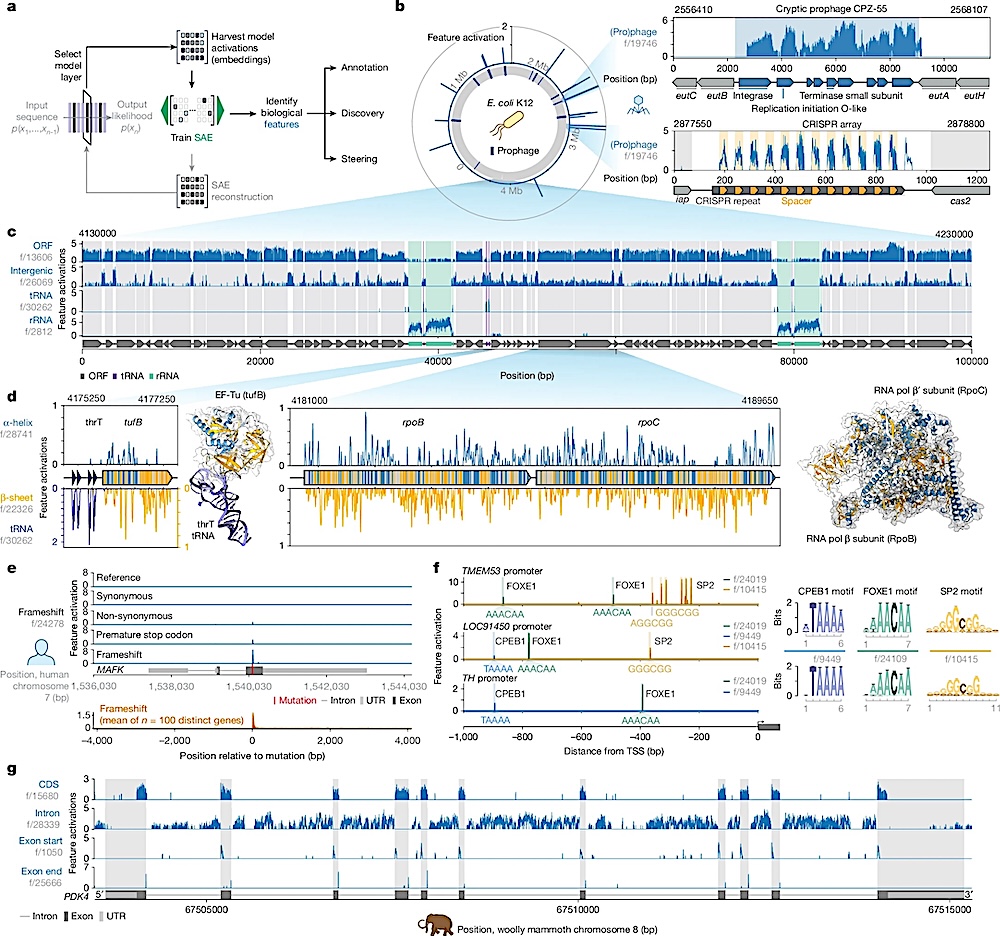
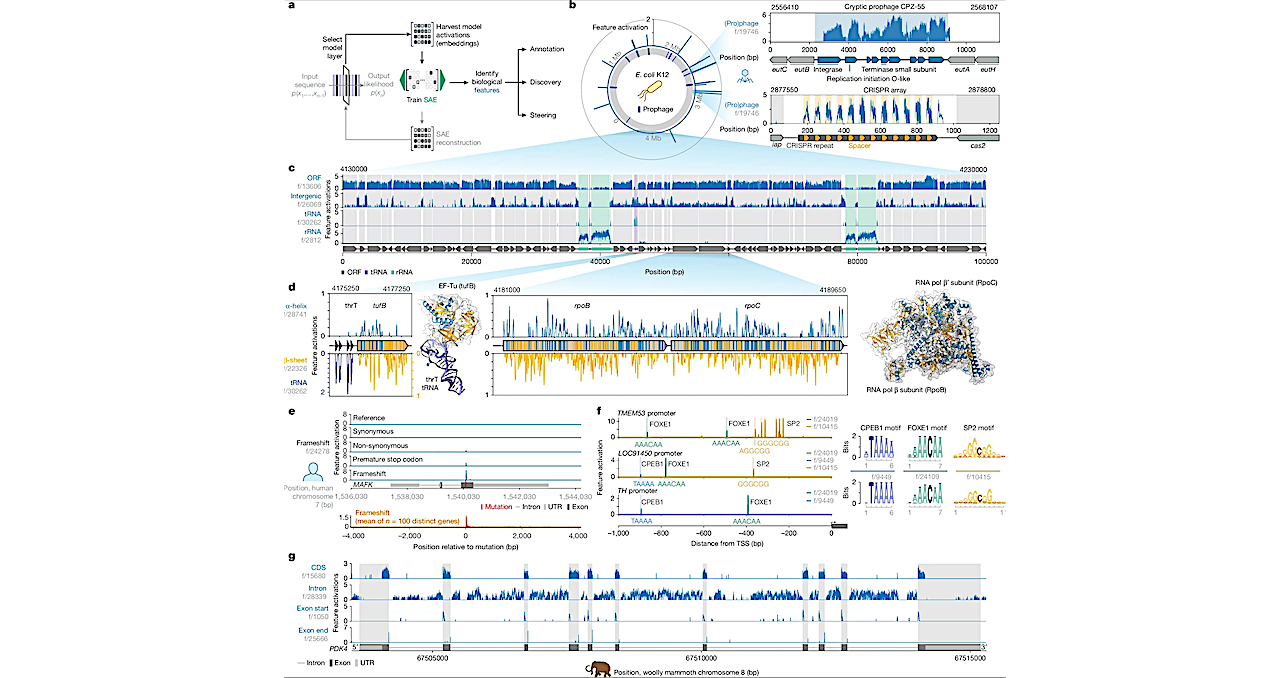
a, SAEs were trained on Evo 2 to extract SAE features associated with interpretable biological function that can be used for annotation, discovery and steering of sequence generations. b, Phage-associated feature activates preferentially on RefSeq-annotated prophages (left and top right) in the E. coli K12 MG1655 genome and fires on phage-derived spacer sequences within CRISPR arrays (bottom right). c, Activations of features associated with ORFs, intergenic loci, tRNAs and rRNAs, in a 100-kb region in E. coli K12 MG1655. d, Activations of features associated with α-helices, β-sheets and tRNAs at an E. coli K12 MG1655 locus containing tufB and a tRNA array ending with thrT (left) and the rpoB–rpoC locus (right). AlphaFold 3 (AF3) structure predictions with feature activations overlaid, of EF–Tu in complex with the tRNA (left) and of RpoB and RpoC in complex (right). e, A feature in the human genome with preferential activation immediately after frameshift mutations over other less deleterious mutation types. f, Features with activation on DNA motifs in the human genome that correspond to transcription factor-binding motifs. g, Features associated with exons, introns and their boundaries in the human genome generalize to a segment of the woolly mammoth genome. — Nature
In addition to genetic analysis, Evo 2 could be useful for engineering new biological tools or treatments. “If you have a gene therapy that you want to turn on only in neurons to avoid side effects, or only in liver cells, you could design a genetic element that is only accessible in those specific cells,” says co-author and computational biologist Hani Goodarzi, an Arc Core Investigator and an Associate Professor of Biochemistry and Biophysics at the University of California, San Francisco. “This precise control could help develop more targeted treatments with fewer side effects.”
The research team envisions that more specific AI models could be built with Evo 2 as a foundation. “In a loose way, you can think of the model almost like an operating system kernel—you can have all of these different applications that are built on top of it,” says Arc’s Chief Technology Officer Dave Burke, a co-author on the paper. “From predicting how single DNA mutations affect a protein’s function to designing genetic elements that behave differently in different cell types, as we continue to refine the model and researchers begin using it in creative ways, we expect to see beneficial uses for Evo 2 we haven’t even imagined yet.”
In consideration of potential ethics and safety risks, the scientists excluded pathogens that infect humans and other complex organisms from Evo 2’s base data set, and ensured that the model would not return productive answers to queries about these pathogens. Co-author Tina Hernandez-Boussard, a Stanford Professor of Medicine, and her lab members assisted the team to implement responsible development and deployment of this technology.
“Evo 2 has fundamentally advanced our understanding of biological systems,” says Anthony Costa, director of digital biology at NVIDIA. “By overcoming previous limitations in the scale of biological foundation models with a unique architecture and the largest integrated dataset of its kind, Evo 2 generalizes across more known biology than any other model to date — and by releasing these capabilities broadly, Arc Institute has given scientists around the world a new partner in solving humanity’s most pressing health and disease challenges.”
Genome modeling and design across all domains of life with Evo 2, Nature
Brixi, G., Durrant, M.G., Ku, J., Naghipourfar, M., Poli, M., Brockman, G., Chang, D., Fanton, A., Gonzalez, G.A., King, S.H., Li, D.B., Merchant, A.T., Nguyen, E., Ricci-Tam, C., Romero, D.W., Schmok, J.C., Sun, G., Taghibakhshi, A., Vorontsov, A., Yang, B., Deng, M., Gorton, L., Nguyen, N., Wang, N.K., Pearce, M.T., Simon, E., Adams, E., Amador, Z.J., Ashley, E.A., Baccus, S.A., Dai, H., Dillmann, S., Ermon, S., Guo, D., Herschl, M.H., Ilango, R., Janik, K., Lu, A.X., Mehta, R., Mofrad, M.R.K., Ng, M.Y., Pannu, J., Ré, C., St. John, J., Sullivan, J., Tey, J., Viggiano, B., Zhu, K., Zynda, G., Balsam, D., Collison, P., Costa, A.B., Hernandez-Boussard, T., Ho, E., Liu, M.-Y., McGrath, T., Powell, K., Pinglay, S., Burke, D.P., Goodarzi, H., Hsu, P.D., & Hie, B.L. (2026). Genome modeling and design across all domains of life with Evo 2. Nature. https://doi.org/10.1038/s41586-026-10176-5
See Genome Modeling And Design Across All Domains Of Life With Evo 2, 21 Feb 2025
Arc Institute is an independent nonprofit research organization based in Palo Alto, California, that aims to accelerate scientific progress and understand the root causes of complex diseases. Arc’s investigators are supported by long-term funding and freedom to pursue bold ideas. Its Technology Centers leverage multi-omics, genome engineering, and cellular, mammalian and computational models to advance discoveries at the intersection of biology and artificial intelligence. Founded in 2021, Arc partners with Stanford, UC Berkeley, and UCSF.
Astrobiology, genomics, omics, bioinformatics, evolution,