Resonant Lunar Tides Of Earth’s Core And Basal Magma Ocean
Earth’s magnetic field is generated by fluid motion in the liquid-metal core and has been active for billions of year.
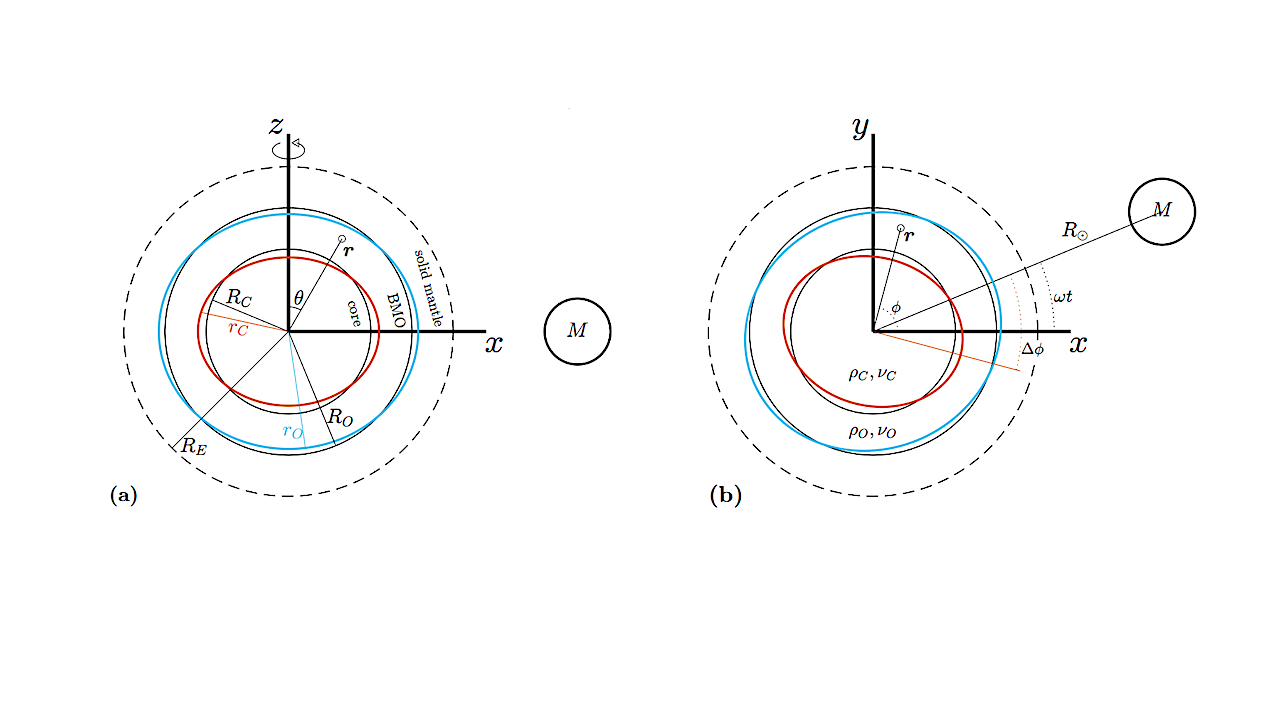
However, prior to the onset of inner-core growth, the sources of mechanical power that drove the geodynamo remain uncertain. During this period, the core may have been overlain by a basal magma ocean (BMO), creating two immiscible fluid layers separated by a density interface, beneath the solid mantle.
We develop a theory for lunar tides in this core–BMO system, in which the tidal potential acts on the density contrast between the two layers rather than through deformation of a bounding envelope. The resulting dynamics differ fundamentally from previous models of tidally driven core flow.
In the inviscid limit, the response transitions from an equilibrium tide to an inertia–self-gravity wave as forcing frequency increases. The two regimes are separated by a resonance that occurs when the forcing frequency matches the natural frequency of the interfacial mode. The inviscid core flow is formally identical to the canonical elliptical vortex, linking the problem to the theory of elliptical instability.
Finite viscosity regularises the resonance, introduces phase lag and generates oscillatory boundary layers. Combined with parameterised models of lunar recession and BMO crystallisation, the theory predicts enhanced core-boundary ellipticity, core-flow speed, magnetic Reynolds number and instability metrics, particularly near resonance.
These results identify a previously unexplored mechanism for tidally driven flow in differentiated planetary bodies and show that a BMO can enhance tidal coupling to the core, potentially contributing to dynamo action.
Murray B.C. Kiernan, Hamish C.F.C. Hay, David W. Rees Jones, James F.J. Bryson, Richard F. Katz
Subjects: Geophysics (physics.geo-ph); Earth and Planetary Astrophysics (astro-ph.EP); Fluid Dynamics (physics.flu-dyn)
Cite as: arXiv:2606.16340 [physics.geo-ph](or arXiv:2606.16340v1 [physics.geo-ph] for this version)
https://doi.org/10.48550/arXiv.2606.16340
Focus to learn more
Submission history
From: Richard Katz
[v1] Mon, 15 Jun 2026 07:44:25 UTC (2,666 KB)
https://arxiv.org/abs/2606.16340
Astrobiology, Astrogeology,