


We present the KOALA database, a new set of LTE, line-blanketed model atmospheres calculated with the code ATLAS9, together with the corresponding Opacity Distribution Functions and emergent fluxes.
GALEX

Posted inExoplanets, -moons, -comets, Habitable Zones, Space Weather & Heliophysics, Status Report, Stellar Cartography
Evolution of Stellar Activity and Habitable zone: I. Ultraviolet Emission of Dwarfs in Open Clusters and Field Stars
Near-ultraviolet (NUV) radiation from dwarf stars plays a critical role in shaping the habitability of planetary systems, yet its long-term evolution across different spectral types remains poorly investigated.

Posted inAstronomy & Telescopes, Biosignatures & Paleobiology, Habitable Zones, Imaging & Spectroscopy, Status Report, Stellar Cartography
Ultraviolet Photometry and Habitable Zones of Over 2700 Planet-Hosting Stars
The ongoing discovery of exoplanets has sparked significant interest in finding suitable worlds that could potentially support life. Stellar ultraviolet (UV; 100-3000 Å) radiation may play a crucial role in […]
Posted inAtmospheres, Climate, Weather, Exoplanets, -moons, -comets, Habitable Zones, Press Release, Radiation, Space Weather & Heliophysics
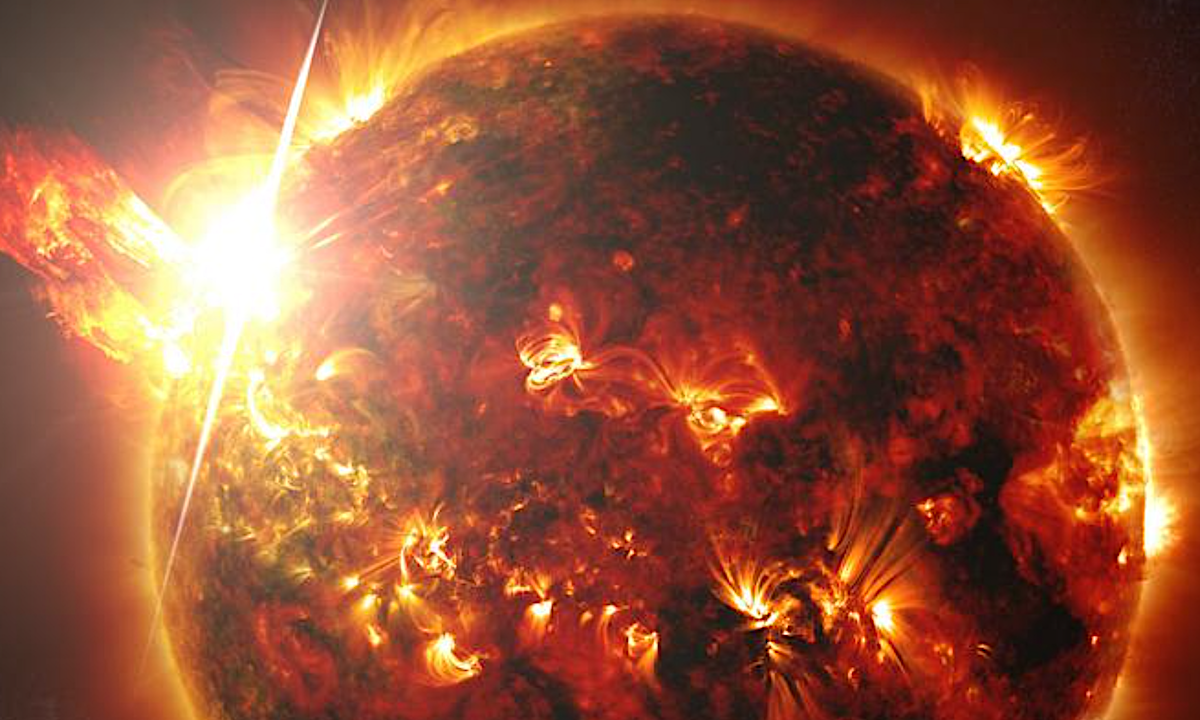
Understanding The Stellar Flare Risks To Planets That Could Host Life
A groundbreaking study has revealed that red dwarf stars can produce stellar flares that carry far-ultraviolet (far-UV) radiation levels much higher than previously believed. This discovery suggests that the intense […]

Posted inAstronomy & Telescopes, Biosignatures & Paleobiology, Exoplanets, -moons, -comets, Imaging & Spectroscopy, Status Report, Water/Hycean Worlds & Oceanography
Setting The Stage For The Search For Life With The Habitable Worlds Observatory: Properties Of 164 Promising Planet-survey Targets
The Decadal Survey on Astronomy and Astrophysics 2020 has recommended that NASA realize a large IR/optical/UV space telescope optimized for high-contrast imaging and spectroscopy of ∼25 exo-Earths and transformative general […]
![Comparison of flare rates from young planet host stars with respect to a comparable sample with respect to age [Myr] and Teff [K]. Circles represent the flare rate of the host star (name along the x-axis); vertical bars represent the lower 16th and upper 84th percentiles for the comparable sample. The majority of young planet host stars have comparable flare rates to the lower end of the comparison sample. A handful of hosts have more flares, including HIP 67522, AU Mic, DS Tuc A, and TOI 451. We find no correlation with spectral type or age which may indicate why these host stars are relatively flare quiet. The measured flare rates are presented in Table 2. -- astro-ph.SR](https://i0.wp.com/astrobiology.com/wp-content/uploads/2024/05/Evolution-of-Flare-Activity-in.png?resize=1200%2C716&ssl=1)
Posted inAstronomy & Telescopes, Atmospheres, Climate, Weather, Exoplanets, -moons, -comets, Habitable Zones, Imaging & Spectroscopy, Radiation, Space Weather & Heliophysics, Status Report, Stellar Cartography
Evolution of Flare Activity in GKM Stars Younger than 300 Myr over Five Years of TESS Observations
Stellar flares are short-duration (< hours) bursts of radiation associated with surface magnetic reconnection events. Stellar magnetic activity generally decreases as a function of both age and Rossby number, R0, […]