Physiological Trade-offs Drive The archaeal Dominance And Carbon Turnover In Deep Subsurface
Marine sediments host a vast deep biosphere, yet how microorganisms persist under severe energy limitation and govern long-term organic carbon (OC) preservation remains poorly understood.
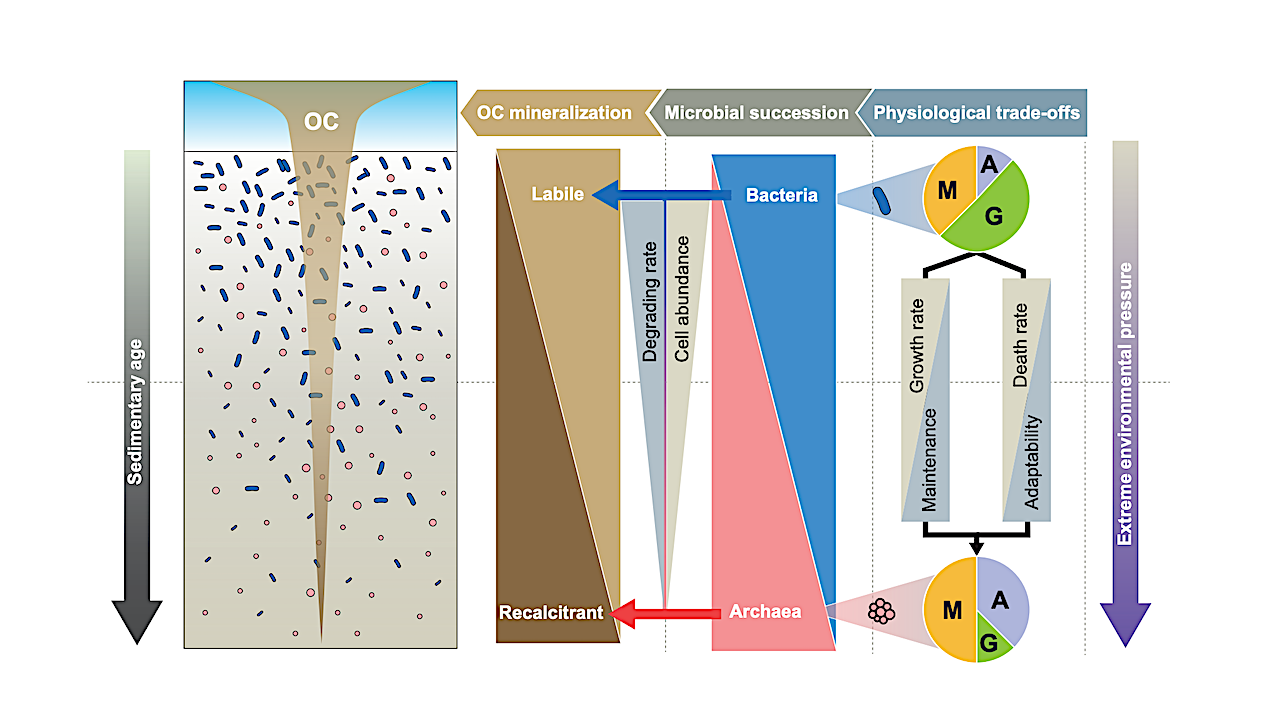
Here we show that archaea, primarily Bathyarchaeia, systematically displace bacteria with depth and form net growth zones across East China Sea shelf deep sediments. Multi-omics analyses and bioenergetic modelling reveal that this transition is driven by sustained archaeal metabolism of diverse recalcitrant OC compounds, and a physiological trade-off that prioritizes cellular maintenance over growth, minimizing mortality in deep sediments.
This strategy triggers a fundamental shift in sedimentary carbon turnover: from rapid bacterial degradation of labile OC near the surface to persistent archaea-driven turnover of recalcitrant OC at depth. We estimate that Bathyarchaeia mediate ~77% of total OC degradation after 1,000 years of burial, corresponding to ~18% (~11.4 Pg C) of millennial OC degradation in global shelf sediments.
These findings identify subsurface archaea as key microbial regulators of long-term OC preservation and reveal how physiological trade-offs sustain life and carbon turnover in the energy-limited deep biosphere.
Physiological trade-offs drive the archaeal dominance and carbon turnover in deep subsurface, biorxiv.org
Astrobiology,