The Microbial Inhabitants of the Corona Lava Tube: Astrobiological Insights from a Mars Analog Environment
Lava tubes are recognized as strategic targets in the search for life on Mars. The Corona Lava Tube System in Lanzarote serves as a terrestrial analog for martian subsurface environments and an astronaut training site for the European Space Agency’s (ESA) Planetary Analogue Geological and Astrobiological Exercise for Astronauts (PANGAEA) program.
Here, we report the scientific outcomes of ESA’s PANGAEA-X campaign, which combined in situ and laboratory-based analyses to investigate the biosignature potential of a black, sticky, organic-rich coating (CLT1), and white cotton-like mineral deposits (CLT3).
The microbial diversity captured in real time using the MinION Nanopore device was validated and expanded through Illumina MiSeq and complementary laboratory techniques that included microscopy, mineralogy (X-ray powder diffraction, X-ray fluorescence), and organic geochemistry (gas chromatography/mass spectrometry, 13C NMR spectroscopy, thermogravimetry).
Sample CLT1, enriched in organic matter derived from Euphorbia balsamifera milky juice fluid (latex) seepage, hosted halotolerant bacterial genera such as Salinisphaera and hydrocarbon-degrading Alcanivorax, supported by the presence of lipid biomarkers such as squalene, alkyl nitriles, and triterpenoids. CLT3, composed predominantly of gypsum with minor halite, exhibited scarce organic content but revealed acidophilic taxa such as Alicyclobacillus.
This study demonstrates the effectiveness of integrating astronaut-led on-site DNA sequencing and geochemical fingerprinting, and traditional laboratory methods for astrobiological exploration.
Our findings offer key insights into the microbial colonization, organic matter transformation, and biosignature preservation within lava tubes, with direct implications for future life detection missions on Mars and other planetary bodies.
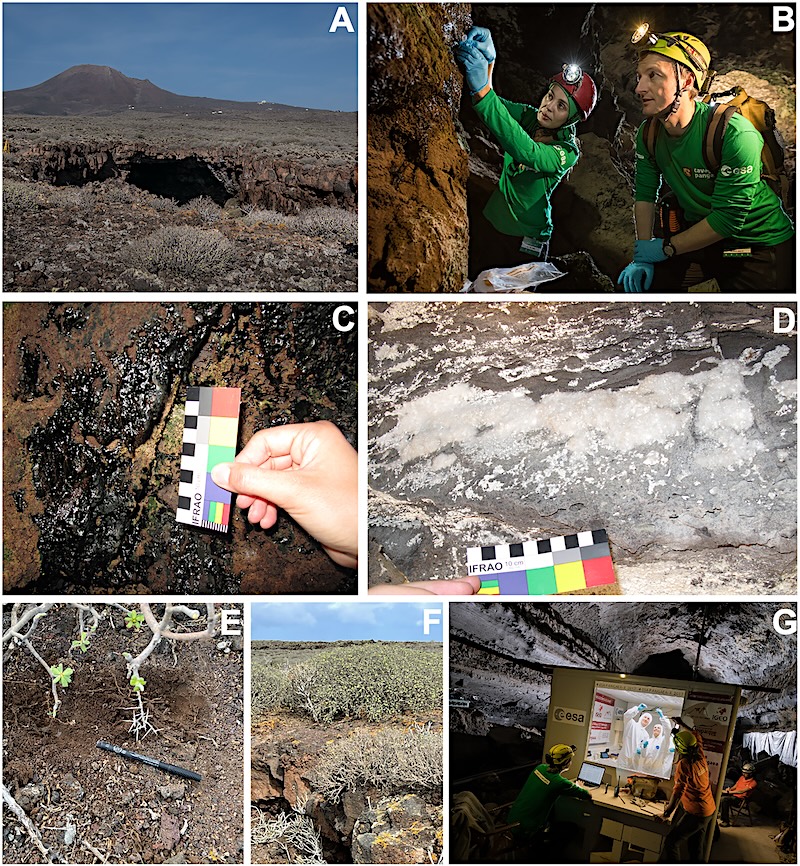
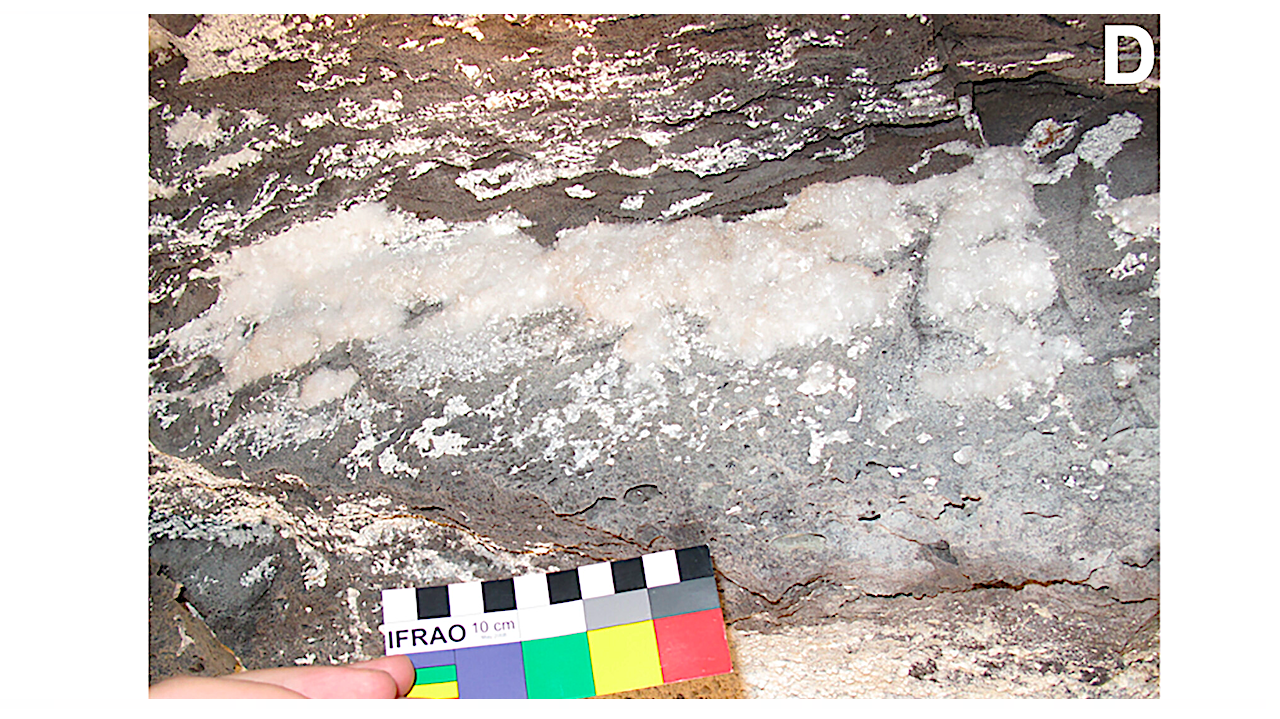
Sampling strategy in the Corona Lava Tube System during the European Space Agency’s Planetary Analogue Geological and Astrobiological Exercise for Astronauts (ESA PANGAEA-X) campaign. (A) Surface view of the Jameo de la Puerta Falsa entrance. (B) Instructional fieldwork during sample collection at site CLT1. Credit: Robbie Shone—ESA. (C) Black sticky coating (sampling site CLT1, twilight zone; scale bar = 10 cm). (D) White cotton-like secondary mineral deposits on the wall–ceiling interface (sampling site CLT3, dark zone; scale bar = 10 cm). (E) Collection of topsoil (sample SCLT) directly above the lava tube entrance to compare surface and subsurface microbial communities. (F) Euphorbia balsamifera, the dominant vegetation above the cave, sampled for molecular and biogeochemical analysis (sample PCLT). (G) Geodynamic laboratory module, installed in the Corona Lava Tube by the Cabildo de Lanzarote, where real-time DNA analysis using the MinION platform was performed. Credit: Robbie Shone—ESA.
- The Microbial Inhabitants of the Corona Lava Tube: Astrobiological Insights from a Mars Analog Environment, Astrobiology via PubMed
- The Microbial Inhabitants of the Corona Lava Tube: Astrobiological Insights from a Mars Analog Environment, Astrobiology via Sage (open access)
Astrobiology,