Signs Of Ancient Life Turn Up In An Unexpected Place
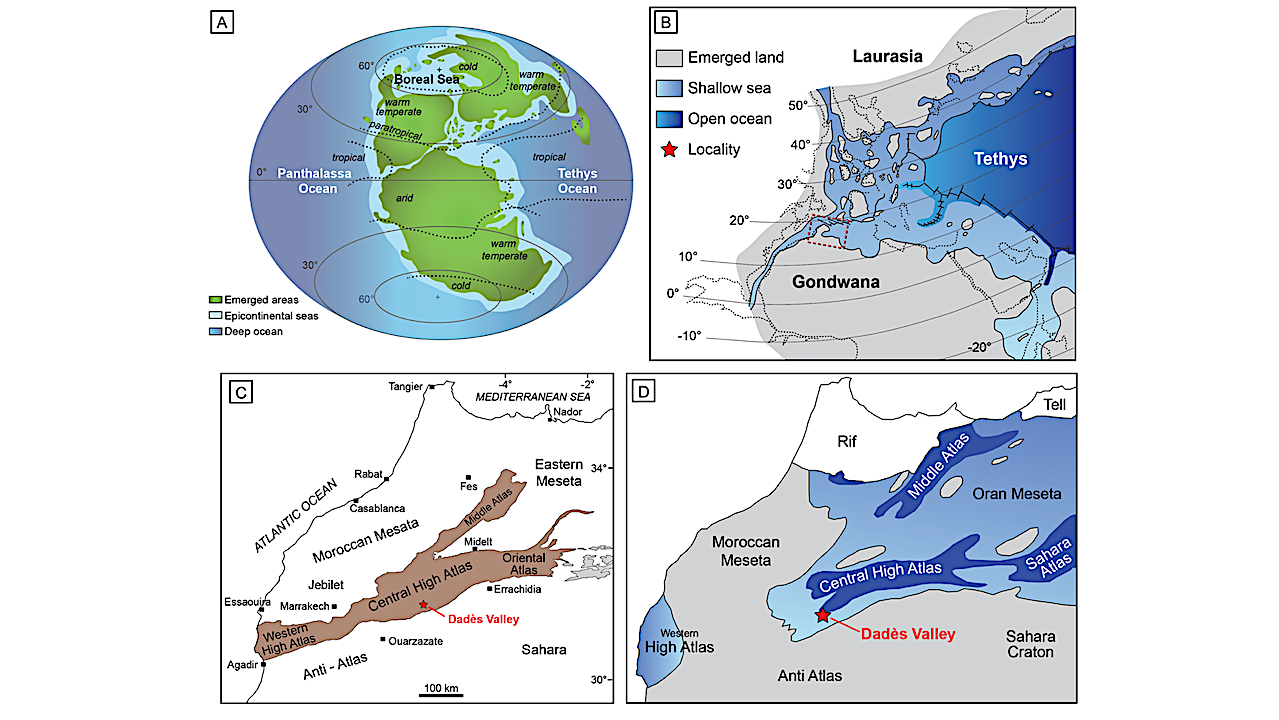
Dr. Rowan Martindale, a paleoecologist and geobiologist at the University of Texas at Austin, was walking through the Dadès Valley in the Central High Atlas Mountains of Morocco when she saw something that literally stopped her in her tracks.
Martindale and her colleagues, including Stéphane Bodin of Aarhus University, were trekking through the rocky valley to study the ecology of the ancient reef systems that once sat below sea level there. To get to the reefs, they first had to traverse through layers and layers of turbidites—deposits made by thick submarine debris flows. Ripple marks are common on turbidites, but Martindale had spotted crenulations superimposed on the ripples that seemed out of place.
“As we’re walking up these turbidites, I’m looking around and this beautifully rippled bedding plane caught my eye,” says Martindale. “I said, ‘Stéphane, you need to get back here. These are wrinkle structures!’”
Wrinkle structures are millimeter- to centimeter-scale ridges and pits that can form on sandy beds when algal and microbial communities form mats or aggregates. Wrinkles are usually obliterated by animal activity, and so they’re rare in rocks younger than 540 million years ago, when there was an explosion of animal evolution. Today, wrinkle structures are commonly found in shallow tidal areas where photosynthetic algae thrive.
But the turbidites Martindale was walking across were deposited too deep in the water for light to reach, at least 180 meters below the surface, meaning the wrinkles couldn’t have been made by the same type of algae that form them today. In fact, the few previous studies proposing wrinkle structures in ancient turbidite deposits were contested. Additionally, the rocks were only about 180 million years old, when animals were tearing up the delicate seafloor all over the world. By all accounts, the wrinkle structures shouldn’t have been there. Martindale realized she needed to get to work to make sure she could trust her instinct.
“Let’s go through every single piece of evidence that we can find to be sure that these are wrinkle structures in turbidites,” says Martindale, because wrinkle structures, usually photosynthetic in origin, “shouldn’t be in this deep-water setting.”
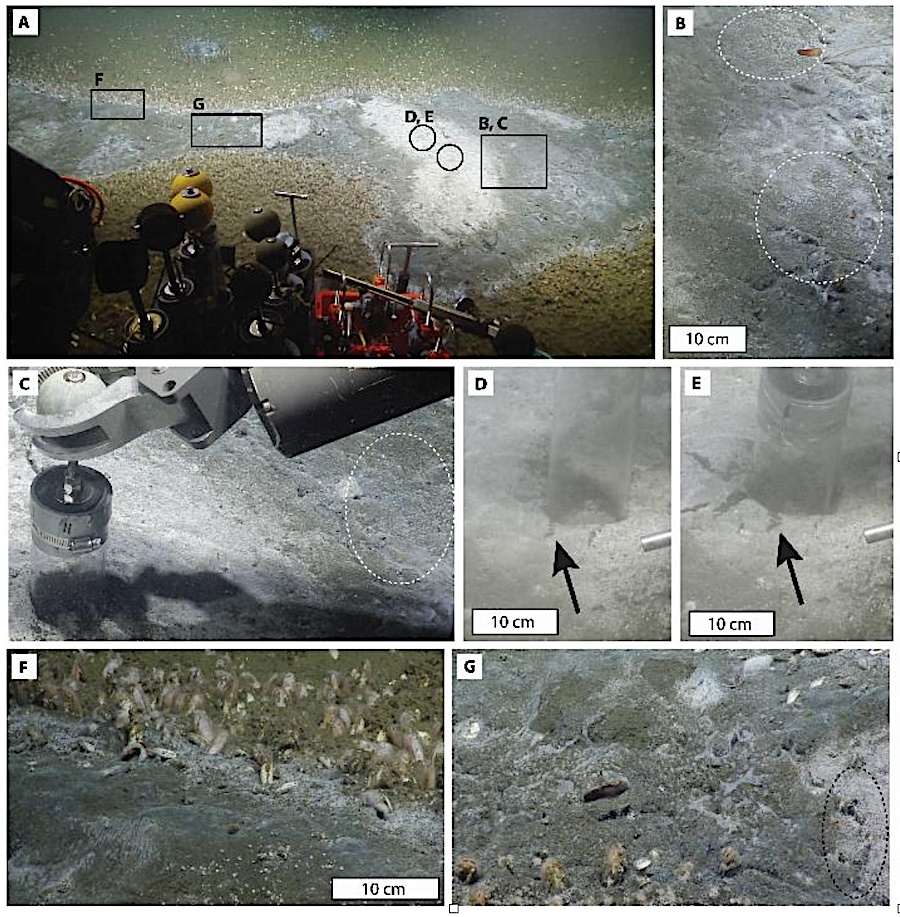
Chemosynthetic communities from ca. 730 meters water depth (NA084 dives, 2017, 8 km off Point Dume, CA, 33.941389°, -118.845556°). A) wide view of the sampled site, the “Yellow Brick Road” with the approximate locations of the subsequent images and core sites (circles). B, C) Wrinkly textures to right of the thickest part of the mat (circled with dashed white line). D, E) Coring site, with arrows showing the cohesiveness of the mats, note the stretched connection of the mat top as the sediment underneath separates (arrows). F) Wrinkly textures on the edge of the mat. G) Wrinkly textures on the thin area of the mat with filamentous structures binding the mat together (circled on right).
When the team closely examined the geologic evidence and determined that the sediment layers were indeed turbidites, the next step was to make sure the textures they observed were definitely biotic wrinkles. Analysis revealed the layers just below the wrinkles contained elevated levels of carbon—a signature of biotic origin. Furthermore, videos from remotely operated submersibles taken of the seafloor well below the photic zone showed that microbial mats could form from chemosynthetic bacteria—bacteria that get energy from chemical reactions rather than light.
Combining the evidence from the geologic setting, chemistry, and modern analogs satisfied the team that they had documented chemosynthetic wrinkle structures in the rock record. They determined that the turbidites bring nutrients and organic matter with them, reducing oxygen levels and creating conditions ripe for chemosynthetic life. Then, in the calm periods between turbidite deposition, those bacteria form mats atop the sediment that subsequently wrinkle into the distinctive texture Martindale observed in Morocco. Usually, the next turbidite erodes away the mat, but every once in a while, the mats and their wrinkles are preserved.
Going forward, Martindale hopes to conduct laboratory experiments to explore how these structures might form within turbidites. She also hopes that these findings spur other researchers to incorporate chemosynthetic mats in a paradigm that previously included only a photosynthetic mat origin for wrinkle structures. Then geologists could look for wrinkle structures in new places that were previously written off as fruitless settings in the search for early life on Earth.
“Wrinkle structures are really important pieces of evidence in the early evolution of life,” says Martindale. By ignoring their possible presence in turbidites, “we might be missing out on a key piece of history of microbial life.”
Chemosynthetic microbial communities formed wrinkle structures in ancient turbidites, Geology (open access)
Astrobiology,