Modeling the Impact of Unresolved Stellar Companions on Detection Sensitivity in Kepler’s Small Planet Occurrence Rates
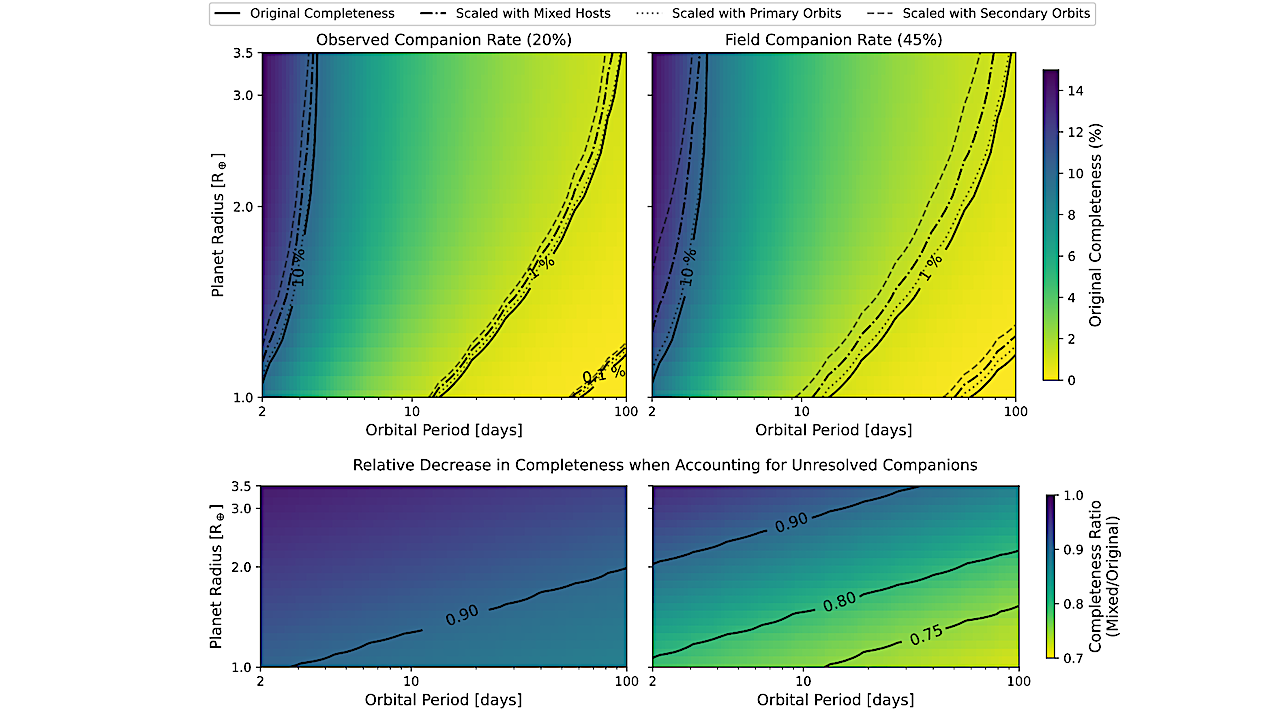
Unresolved stellar companions can cause both under-estimations in the radii of transiting planets and over-estimations of their detectability, affecting our ability to reliably measure planet occurrence rates.
To quantify the latter, we identified a control sample of 198 Kepler stars with sensitivity to Earth-like planets if they were single stars, and imaged them with adaptive optics. In 20% of systems, we detected stellar companions that were close enough to go unresolved in Kepler observations.
We calculated the distribution of planet radius correction factors needed to adjust for these observed companions, along with simulations of undetected companions to which our observations were not sensitive. We then used these correction factors to optimize an occurrence rate model for small close-in planets while correcting Kepler’s detection efficiency for the presence of unresolved companions, and quantified how this correction affects occurrence estimates.
Median occurrence rates for small planets between 2−100 days increased by an average factor of 1.08−1.19 (depending on statistical treatments), with the largest differences found for smaller planets at larger orbital periods. We found that the frequency of Earth-sized planets in the habitable zone (η⊕) increased by a factor of 1.18+0.43−0.66−1.46+0.53−0.83 when accounting for the effect of unresolved companions on Kepler’s detection sensitivity.
Galen J. Bergsten, David R. Ciardi, Jessie L. Christiansen, Catherine A. Clark, Ilaria Pascucci, Courtney D. Dressing, Kevin K. Hardegree-Ullman, Michael B. Lund
Comments: 20 pages, 7 figures, 6 tables; accepted for publication in AJ
Subjects: Earth and Planetary Astrophysics (astro-ph.EP)
Cite as: arXiv:2601.16031 [astro-ph.EP] (or arXiv:2601.16031v1 [astro-ph.EP] for this version)
https://doi.org/10.48550/arXiv.2601.16031
Focus to learn more
Submission history
From: Galen Bergsten
[v1] Thu, 22 Jan 2026 15:00:02 UTC (836 KB)
https://arxiv.org/abs/2601.16031
Astrobiology,