The Pan-Pacific Planet Search — IX. A Menagerie Of Companions Orbiting Evolved Stars
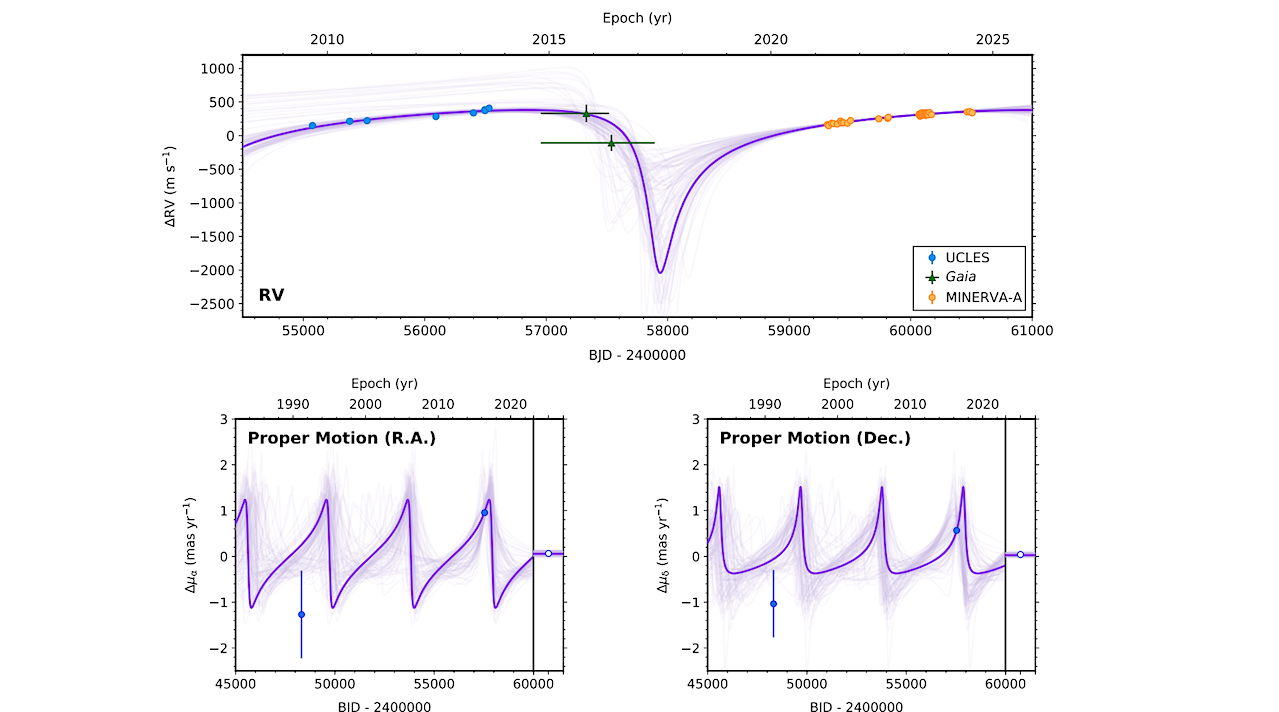
We present resolutions as to the nature of six speculative candidate companions proposed in the final data release of the Pan-Pacific Planet Search, a 6-year radial-velocity survey of 164 southern evolved stars using the now-decommissioned UCLES spectrograph on the 3.9m Anglo-Australian Telescope.
New radial-velocity observations, TESS asteroseismology, and Hipparcos-Gaia astrometry are incorporated to refine the companion and host-star parameters. We confirm that HD 126105b is a giant planet (P=524.0±2.9 d, m sin i=1.67+0.19−0.17MJup), and that HD 205577B is a massive, eccentric brown dwarf (P∼11.2 yr, m=77+11−9MJup, e=0.68).
HD 115066B and HD 121156B are low-mass stellar companions, while HD 114899 and HD 159743 are shown to be unadorned by any detectable companions whatsoever. This demonstrates the utility of astrometric information to help overcome the temporal limitations of incomplete radial-velocity data sets and elucidate the true nature of suspected companion bodies.
Robert A. Wittenmyer, Alexander Venner, Tyler Fairnington, George Zhou, Duncan J. Wright, Evan Curtin, Timothy R. Bedding, Courtney L. Crawford, Yaguang Li, Dennis Stello, Marc Hon, Daniel Huber, Frank Grundahl, M. Skakke Fredslund, Pere L. Palle, Tianjun Gan, Jonathan Horner, John Kielkopf, Stephen R. Kane, Peter Plavchan, Avi Shporer, C.G. Tinney, Hui Zhang, Matthew W. Mengel, Jack Okumura
Comments: Accepted for publication in MNRAS
Subjects: Earth and Planetary Astrophysics (astro-ph.EP); Solar and Stellar Astrophysics (astro-ph.SR)
Cite as: arXiv:2606.00787 [astro-ph.EP] (or arXiv:2606.00787v1 [astro-ph.EP] for this version)
https://doi.org/10.48550/arXiv.2606.00787
Focus to learn more
Submission history
From: Robert Wittenmyer
[v1] Sat, 30 May 2026 16:08:51 UTC (2,200 KB)
https://arxiv.org/abs/2606.00787
Astrobiology, Astronomy, exoplanet,