Photochemical CS2 Gas Detected On A 20-Myr-old Exoplanet
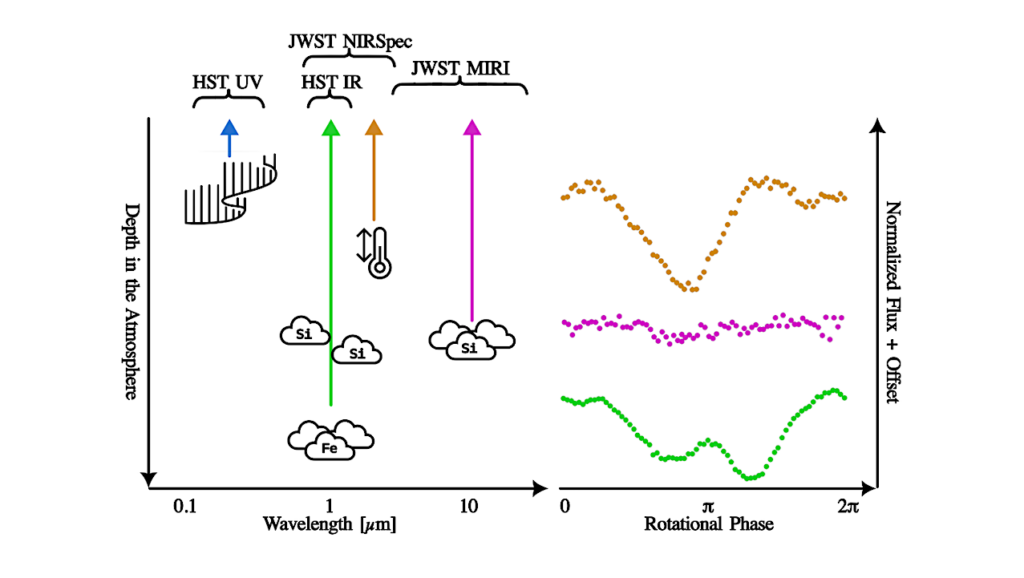
Probing the atmospheres of young exoplanets offers a powerful window into how planetary systems evolve and the physical and chemical processes that drive those early evolutions.
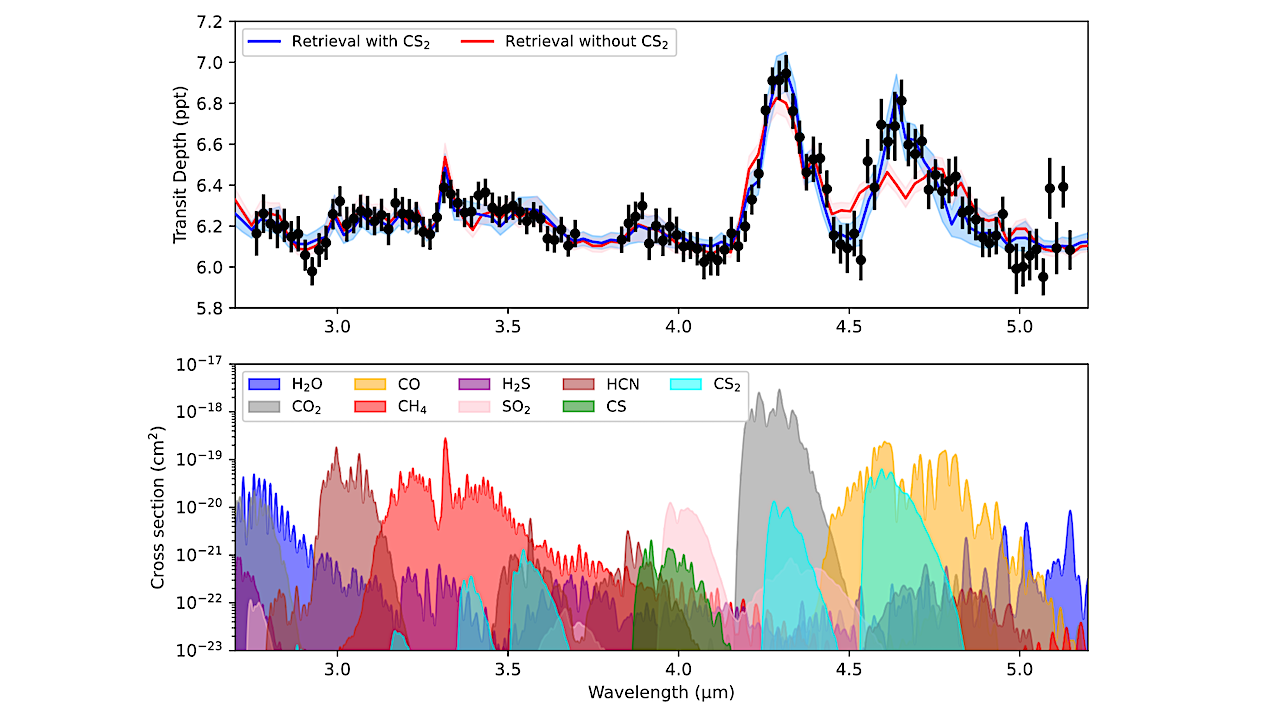
We present JWST/NIRSpec transmission spectroscopy of V1298 Tau e, a ∼20-Myr-old, ∼15-M⊕ planet with a Jupiter-like radius orbiting a young Sun-like star.
We identified carbon disulfide (CS2) in its atmosphere at >8σ significance based on spectral features between 4.3 and 4.7~μm. Photochemical forward models show that the inferred CS2 abundance is physically plausible in an H/He-dominated atmosphere exposed to intense ultraviolet irradiation.
The atmosphere of V1298 Tau e is strikingly different from its nearest neighboring planet b, whose atmosphere shows SO2 rather than CS2. These observations demonstrate that even planets within the same system can occupy distinct photochemical regimes.
Our results further provide empirical evidence for complex sulfur photochemistry in exoplanet atmospheres in general and may also point to divergent formation or evolutionary pathways within the same planetary system.
Fei Dai, Erik Petigura, John Livingston, Nicholas Wogan, Sagnick Mukherjee, Zhecheng Hu, Ian J. M. Crossfield, James Owen, Kento Masuda
Comments: Manuscript under review. ArXiv posting was encouraged by the editor
Subjects: Earth and Planetary Astrophysics (astro-ph.EP)
Cite as: arXiv:2606.00974 [astro-ph.EP] (or arXiv:2606.00974v1 [astro-ph.EP] for this version)
https://doi.org/10.48550/arXiv.2606.00974
Focus to learn more
Submission history
From: Fei Dai
[v1] Sun, 31 May 2026 03:12:17 UTC (30,974 KB)
https://arxiv.org/abs/2606.00974
Astrobiology, Astrochemistry,