Optical Transmission Spectrum Of HAT-P-47b: Evidence For Aerosols And Tentative TiO Absorption
Transmission spectroscopy enables the characterization of exoplanet atmospheres by probing absorption features in their terminator regions.
In the optical, it is particularly sensitive to metal oxides and atomic species that can strongly influence atmospheric energy balance and thermal structure. We aim to investigate the atmospheric properties of the hot Jupiter HAT-P-47b through optical transmission spectroscopy. Thirteen TESS transits were analyzed to refine the planetary ephemeris and system parameters.
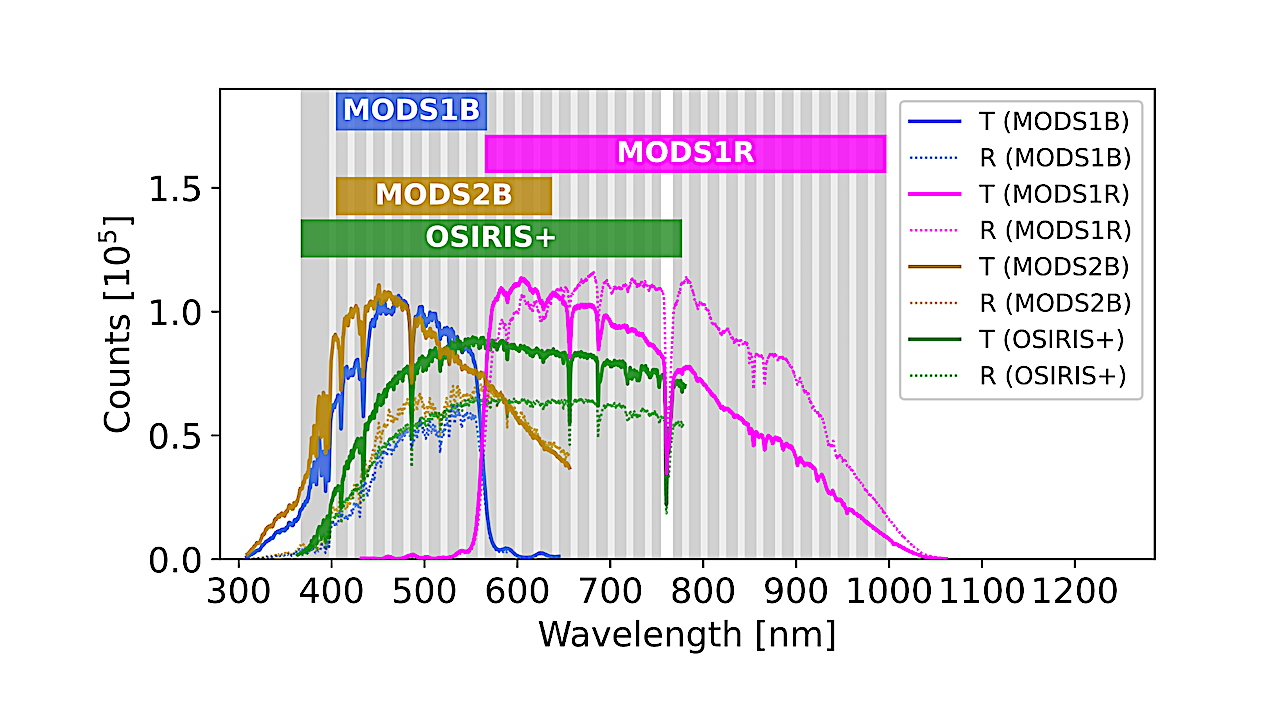
Two ground-based transits were observed with LBT/MODS and GTC/OSIRIS+. Chromatic transit light curves were modeled to derive instrument-specific transmission spectra and multiple Bayesian spectral retrievals were performed to characterize the atmospheric properties. The MODS transmission spectrum provides moderate Bayesian evidence (Δln=2.68) for TiO absorption, whereas the OSIRIS+ spectrum does not yield statistically significant evidence for any specific opacity source.
Both datasets exhibit a wavelength-dependent slope indicative of enhanced aerosol scattering. The MODS and OSIRIS+ joint free-chemistry retrieval, dominated by the higher signal-to-noise MODS data, yields moderate evidence (Δln=3.44) for TiO with a log mass fraction of −6.86+0.64−0.63 dex.
The same model indicates an aerosol contribution to the optical scattering opacity approximately 5000× larger than pure H2 Rayleigh scattering. HAT-P-47b appears to host a cloudy atmosphere with evidence for aerosols and tentative evidence for TiO absorption.
Future high-precision observations will be essential to confirm the presence of TiO and further characterize its atmospheric structure.
Wan-Hao Wang, Guo Chen, Fei Yan, Chengzi Jiang, Luigi Mancini, Enric Pallé, Felipe Murgas, Hannu Parviainen
Comments: 18 pages, 10 figures, accepted for publication in A&A Subjects: Earth and Planetary Astrophysics (astro-ph.EP); Solar and Stellar Astrophysics (astro-ph.SR)
Cite as: arXiv:2605.29445 [astro-ph.EP] (or arXiv:2605.29445v1 [astro-ph.EP] for this version)
https://doi.org/10.48550/arXiv.2605.29445
Focus to learn more
Submission history
From: Wan-Hao Wang
[v1] Thu, 28 May 2026 06:37:43 UTC (1,843 KB)
https://arxiv.org/abs/2605.29445
Astrobiology,