Digging Into The Massive Protostar S255IR NIRS3: A Study of Nitrogen-Bearing Molecules and Their Prebiotic Chemistry
The study of complex nitrogen (N)-bearing molecules is essential for probing the physical and chemical evolution of star-forming regions.
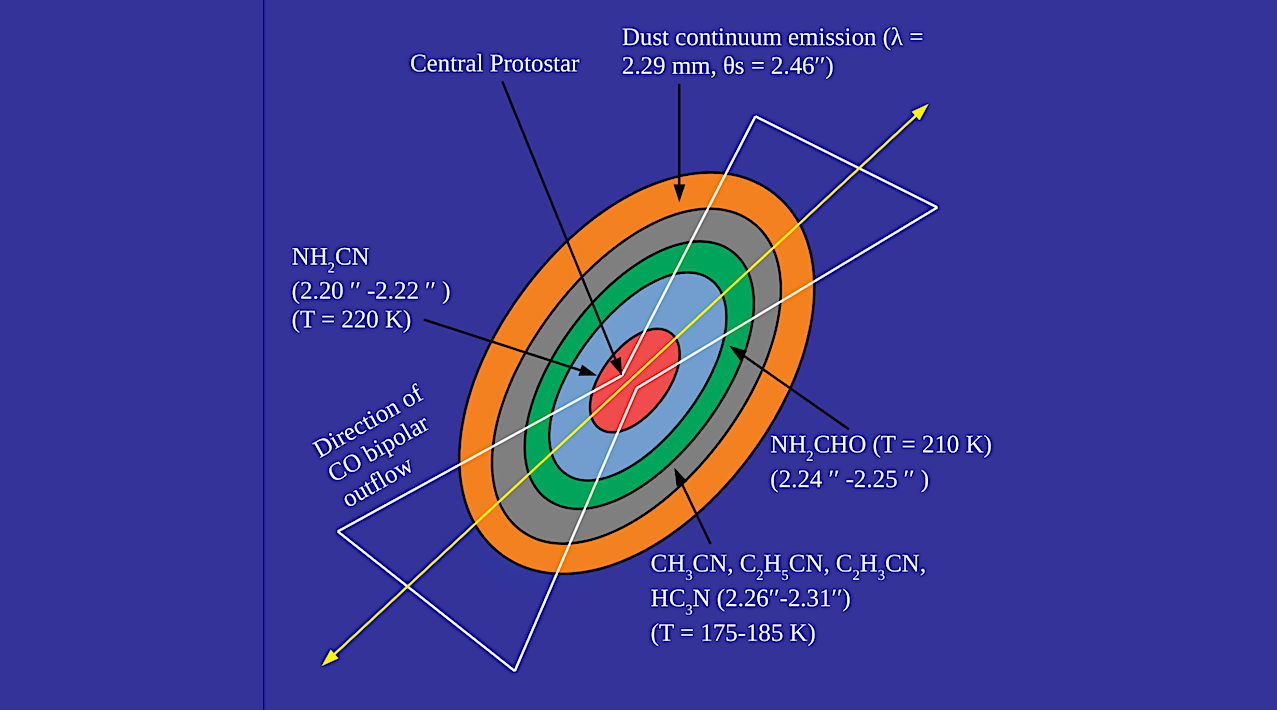
In this paper, we present the identification of rotational emission lines from several complex N-bearing species such as methyl cyanide (CH3CN), ethyl cyanide (C2H5CN), vinyl cyanide (C2H3CN), cyanamide (NH2CN), and formamide (NH2CHO) toward the high-mass protostar S255IR NIRS3 using ALMA band 4 observations. In addition, the vibrationally excited transitions of cyanoacetylene (HC3N, ν7 = 2) were detected.
The column densities and excitation temperatures of these molecules were derived through LTE spectral modelling, yielding excitation temperatures in the range of 175−220 K. The high excitation temperatures (175−220 K) indicate that the identified N-bearing molecules arise from the warm inner regions (T≥100 K) of the source. The fractional abundances were further estimated relative to H2, CH3OH, and CH3CN.
A Pearson correlation heat map of the abundances reveals a strong positive correlation (r>0.7) among three molecules in the cyanide family, such as CH3CN, C2H3CN, and C2H5CN, suggesting that these N-bearing molecules may be chemically linked. Comparison with three-phase warm-up chemical models shows that the observed abundances of CH3CN, C2H5CN, C2H3CN, NH2CN, NH2CHO, and HC3N (ν7 = 2) relative to H2 are consistent with model predictions within factors of 1.04, 0.67, 1.28, 0.76, 0.72, and 0.96, respectively.
Finally, we discuss the potential formation pathways of the identified N-bearing molecules in the context of gas-grain chemistry within S255IR NIRS3.
Arijit Manna, Sabyasachi Pal, Tapas Baug, Ariful Hoque, Sandip Dutta, Sekhar Sinha, Sushanta Kumar Mondal
Comments: Published in The Astronomical Journal (AJ)
Subjects: Astrophysics of Galaxies (astro-ph.GA); Chemical Physics (physics.chem-ph)
Cite as: arXiv:2605.27177 [astro-ph.GA] (or arXiv:2605.27177v1 [astro-ph.GA] for this version)
https://doi.org/10.48550/arXiv.2605.27177
Focus to learn more
Journal reference: AJ, Volume 368, Page 171, 2026
Related DOI:
https://doi.org/10.3847/1538-3881/ae64f2
Focus to learn more
Submission history
From: Arijit Manna
[v1] Tue, 26 May 2026 15:30:52 UTC (4,006 KB)
https://arxiv.org/abs/2605.27177
astrobiology, astrochemistry,