Modeling Volcanic Plume Heights Across Exoplanet Atmospheres: Insights from TRAPPIST-1
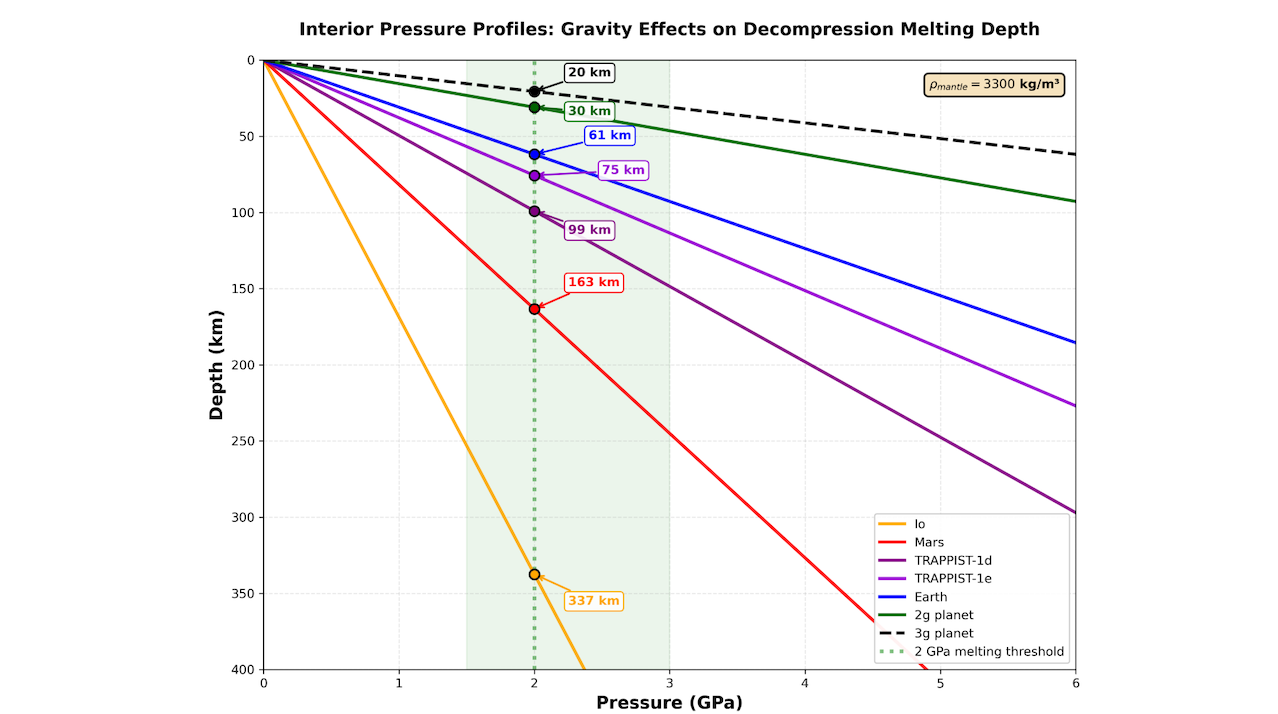
Explosive volcanic eruptions play a fundamental role in the evolution and observability of rocky exoplanets, serving as a key mechanism for injecting volatiles into planetary atmospheres and potentially modifying their climate and composition.
This process may be particularly important for close-in exoplanets where tidal forcing can drive substantial internal heating, analogous to (but often exceeding) Io’s volcanism. In this work, we adapt and extend a classic 1D volcanic plume model originally developed in IDL by Glaze and Baloga for Venus and Mars applications, and port it into a flexible, open Python framework suitable for exoplanet studies.
The model explicitly couples vent thermodynamics, buoyant entrainment, and vertically varying static stability to predict plume rise, neutral-buoyancy height, and overshoot for a wide range of planetary and atmospheric conditions. We first benchmark the Python implementation against the original IDL code and analytic scaling laws to ensure adequate momentum budgets and strict mass conservation.
We then apply the model to a suite of exoplanet-relevant background states, including CO2-rich atmospheres under strong irradiation and diverse surface conditions. A systematic sensitivity analysis explores how plume height depends on surface gravity, bulk atmospheric composition (and mean molecular weight), background temperature and stratification, vent overpressure, and volatile loading.
We identify regions of parameter space where plumes routinely penetrate to low-pressure levels, maximizing their potential detectability in transmission or emission. These results provide a physically grounded framework for predicting whether and how volcanic emissions might be detected on rocky exoplanets, including-but not limited to-those experiencing strong tidal heating.
Prabal Saxena, Thomas Fauchez
Comments: In Press at ApJ, Glaze-Baloga Plume code available at this https URL
Subjects: Earth and Planetary Astrophysics (astro-ph.EP)
Cite as: arXiv:2605.04423 [astro-ph.EP] (or arXiv:2605.04423v1 [astro-ph.EP] for this version)
https://doi.org/10.48550/arXiv.2605.04423
Focus to learn more
Submission history
From: Prabal Saxena
[v1] Wed, 6 May 2026 02:29:21 UTC (3,448 KB)
https://arxiv.org/abs/2605.04423
Astrobiology, Astrogeology,