Earth And Mars Interior Structures Set By Re-melting Of The First Solid Mantle
Magma ocean crystallisation sets up the early structure and long-term evolution of terrestrial planets. Recent seismic evidence signals the presence of a silicate layer at the base of Mars’ mantle.
Magma-ocean crystallisation and subsequent overturn has been invoked as a hypothesis for this layer’s origin. However, while a magma ocean existed in both Earth and Mars, there is no seismic evidence for a basal layer in present-day Earth. In this study, we apply a parameterized-convection model to study whether the effect of partial melting in the growing mantle on overlying magma ocean composition can explain this discrepancy.
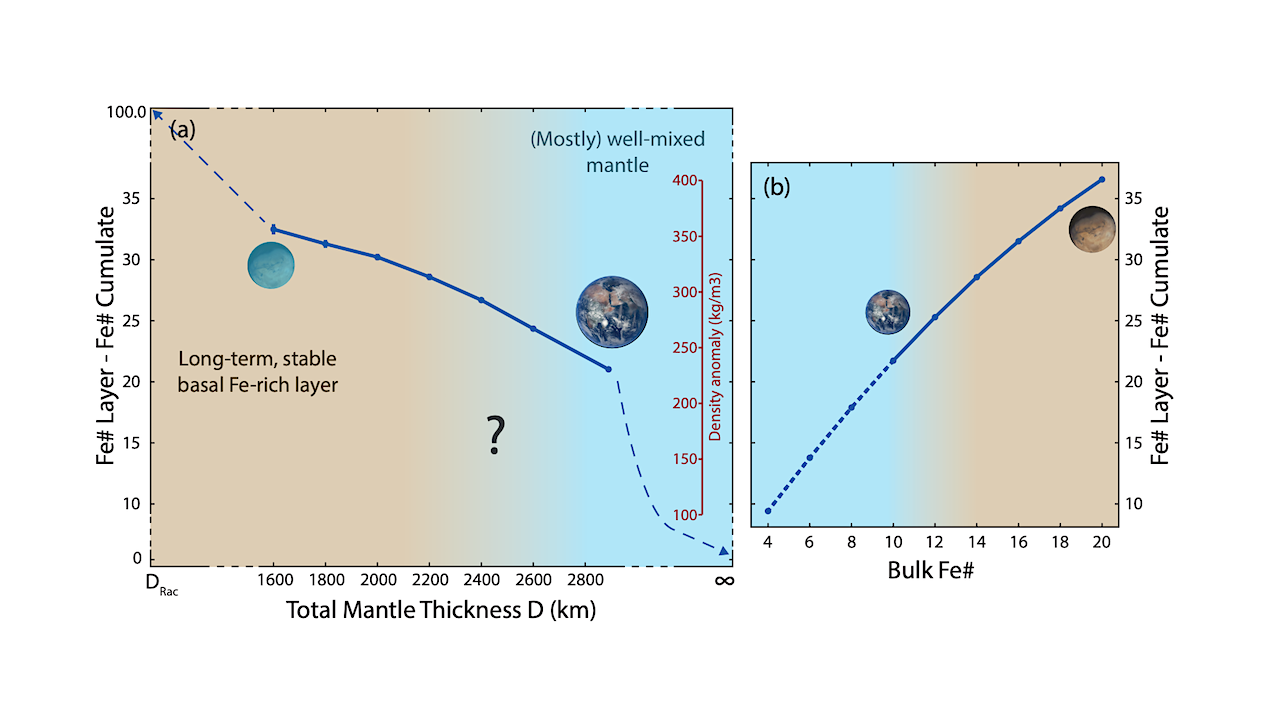
Melts from the mantle buffer the crystallising magma ocean, limiting progressive differentiation, iron enrichment and the density anomaly of the overturned layer. This buffering is more efficient for larger planets with more vigorous mantle convection and for planets that are originally less enriched in iron.
Consequently, a shallow magma ocean is more iron enriched and denser on Mars than on Earth, providing an explanation for the Mars-Earth difference in present-day structure of the mantle. We also predict a dichotomy in terrestrial-exoplanet interior structures, with a population with small, stratified mantles and another with large, mostly-homogeneous mantles.
Antonio Manjón-Cabeza Córdoba, Maxim D. Ballmer, Oliver Shorttle
Comments: Main text: 7 Pages, 3 Figures. 3 Appendixes: 5 Pages, 5 Figures. References: 2 Pages (Total 14 Pages) Submitted to Astrophysical Journal Letters
Subjects: Earth and Planetary Astrophysics (astro-ph.EP); Geophysics (physics.geo-ph)
Cite as: arXiv:2605.04840 [astro-ph.EP] (or arXiv:2605.04840v1 [astro-ph.EP] for this version)
https://doi.org/10.48550/arXiv.2605.04840
Focus to learn more
Submission history
From: Antonio Manjon Cabeza Cordoba
[v1] Wed, 6 May 2026 12:37:07 UTC (26,734 KB)
https://arxiv.org/abs/2605.04840
Astrobiology, Astrogeology,