Impact of Clouds on the Atmosphere-Mantle Interface of Sub-Neptunes
Sub-Neptunes are among the most common type of close-in planets found in our galaxy, yet their bulk composition remains largely uncertain; H-rich envelopes overlaying rocky cores, volatile-rich planets, and carbon-rich interiors all remain viable configurations for members of this population.
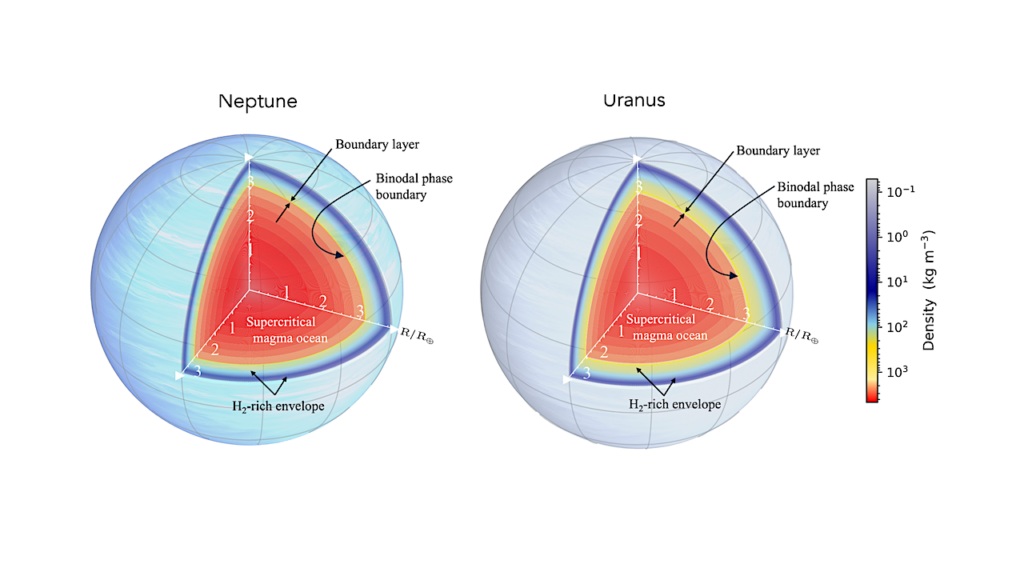
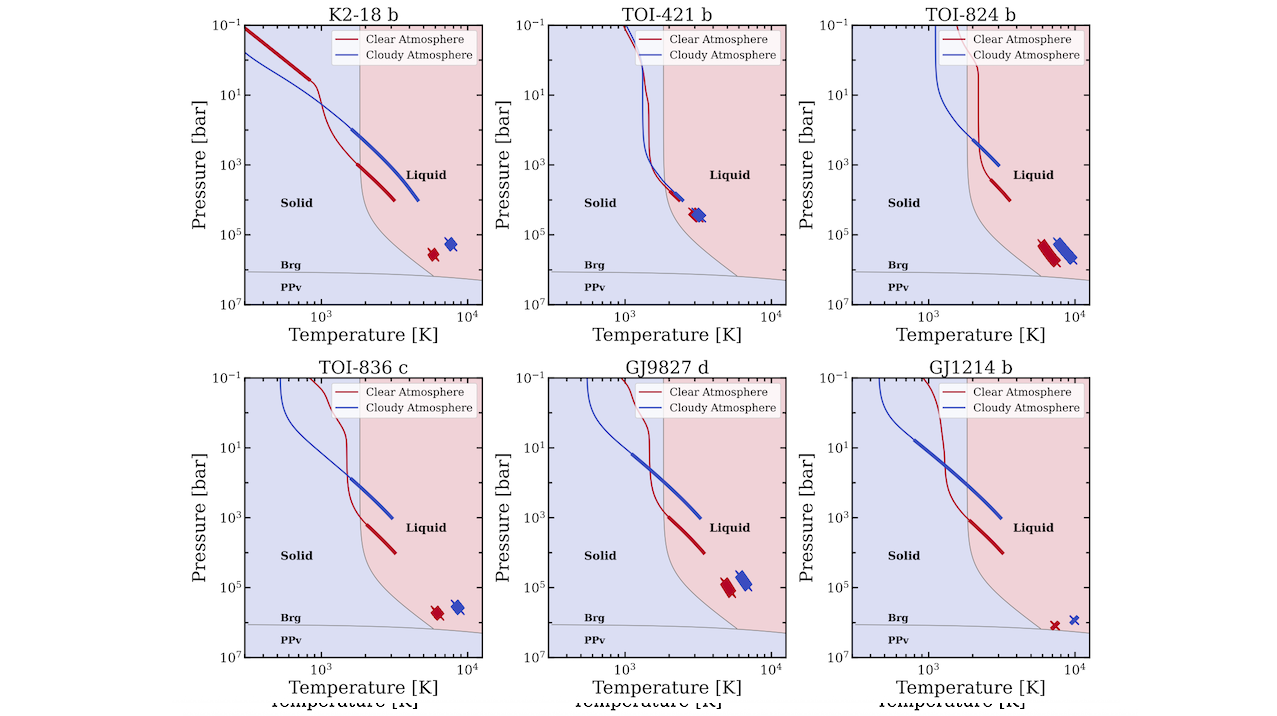
Atmospheric characterization has been proposed as a means of distinguishing between these scenarios, but growing evidence suggests that sub-Neptunes may host molten atmosphere-mantle interfaces which could alter the composition of their atmosphere. We use the PICASO 1D climate model, coupled to interior-structure and magma-atmosphere chemistry frameworks to quantify how clouds alter the atmospheric and interior structure of sub-Neptunes.
For temperate sub-Neptunes like TOI-270 d, we find that clouds can lead to ≥1000 K heating at depth (∼104 bar) and ∼600 K cooling at shallow pressures (∼1 bar). This heating is very sensitive to the cloud sedimentation efficiency and, to a lesser extent, to metallicity. Most sub-Neptunes in our sample should have a molten atmosphere-mantle interface, except TOI-1231 b and GJ 1214 b.
For these two planets, cloudy models have a molten interface whereas clear models can allow a solid boundary. Clouds can heat the atmosphere-mantle interfaces by a temperature difference between ∼1400−2600 K for most sub-Neptunes in our sample.
Such cloud-driven heating can substantially change the composition of the interface with abundances of O2, SiH4, and SiO showing a ≥36% increase between cloudy and clear models of TOI-270 d.
We discuss the implications of our results for the thermal evolution and measurements of intrinsic heat flux for this population.
Sagnick Mukherjee, Matthew C. Nixon, Luis Welbanks, James Mang, Nicholas F. Wogan, Natasha E. Batalha, Michael R. Line
Comments: Accepted for publication in The Astrophysical Journal Letters, Main Text: Pages 1 to 15, 8 Figures, 1 Table, Appendix: Pages 16 to 22, 4 Figures
Subjects: Earth and Planetary Astrophysics (astro-ph.EP)
Cite as: arXiv:2605.27353 [astro-ph.EP] (or arXiv:2605.27353v1 [astro-ph.EP] for this version)
https://doi.org/10.48550/arXiv.2605.27353
Focus to learn more
Submission history
From: Sagnick Mukherjee
[v1] Tue, 26 May 2026 17:52:52 UTC (1,627 KB)
https://arxiv.org/abs/2605.27353
Astrobiology, exoplanet,