EAI Seminar: Testing A Rock-RNA World To Create Early Life

by Dieter Braun, LMU Munich, May 5th 2026, 16:00 CEST (UTC + 02:00)
Abstract:
We are pursuing lab experiments to assemble a hypothesis for the emergence of Life. We will review the lessons we have learned in recent years. Many experiments challenge preconceptions often taken for granted such as:
- Life emerged in the liquid state
- Activation is at the 5’ end of RNA
- Life emerged at pH 7
- RNA is unstable and does not hybridize at high pH
- Amino acids to not play an early role
- RNA is only catalytic in the form of Ribozymes
- Chirality has to be solved at the nucleotide level
- Activated molecules are sufficient to drive early evolution
- Early life needs cells
- Early life required constant molecule synthesis
- Origin of Life is slow
The hypothesis that emerged from these experiments can be summarized as follows:
The polymerising molecules are exponentially amplified by geological flow non-equilibria in microscale porous rock matrices.
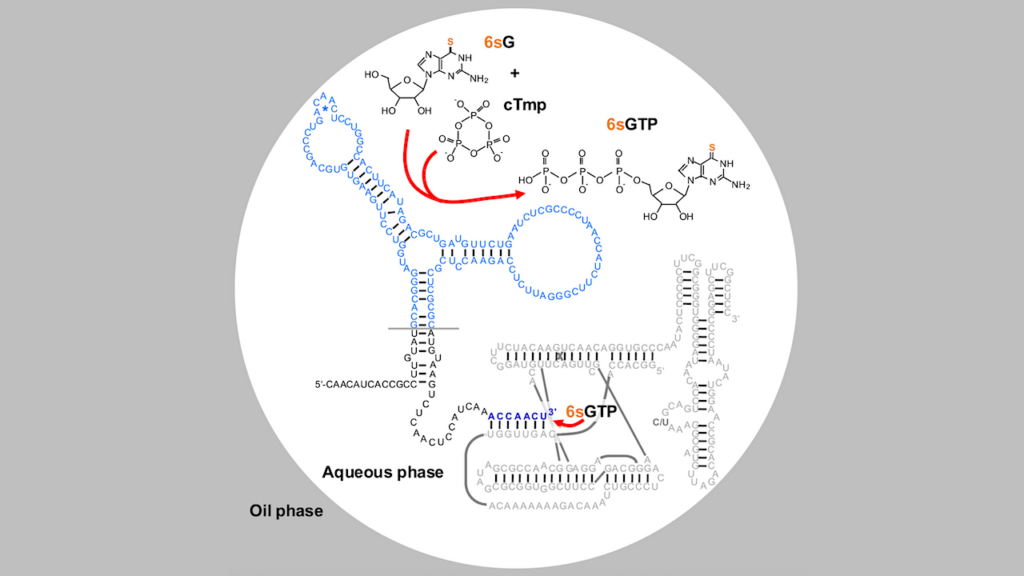
2′,3′-cyclic nucleotides polymerize to RNA in the dry state at the pH of 9–10 that is found on volcanic islands even today.
Templated ligation in liquid state at the same pH will form autocatalytic replication networks.
While wet-dry cycles can grow these networks, the dynamics of replication is enhanced when the RNA oligomers are pinned, fed, and self-selected for replication speed and increasing length by local geological flows.
RNA polymerization and replication will self-select left- or right-handed RNA strands. The right-handed strands were likely selected by evolution later.
Modern biochemistry in the form of the PURE system is accumulated and fed by the same geological flow settings, demonstrating long-term evolution. In the present of lipids, these pinned molecule distributions are autonomously encapsulated and accumulated into giant vesicles, creating a bridge towards lateral gene transfer and the evolution of modern cells.
Astrobiology