Dynamical Stability and Habitability in the HD 20794 System
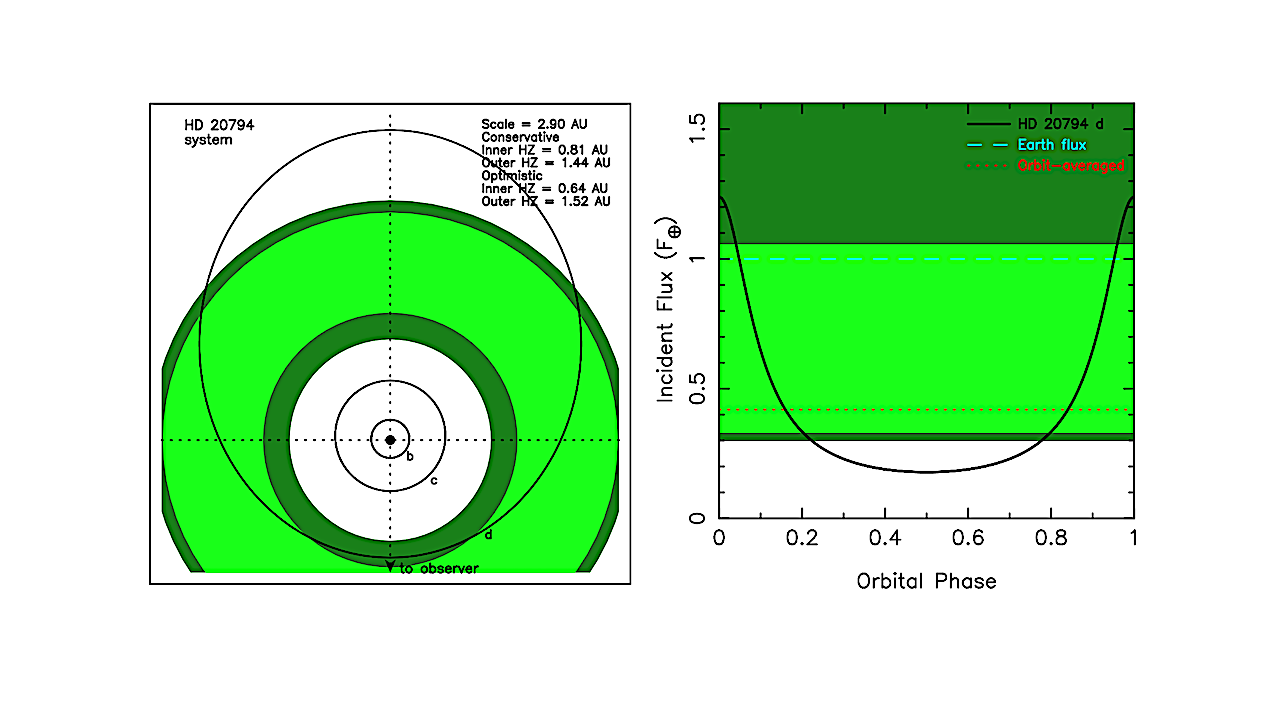
The Keplerian orbit of a terrestrial planet can be a significant driver in the evolution of surface conditions, as well as influencing the overall dynamics of the system.
The HD 20794 system harbors three confirmed planets orbiting a nearby G-type star, including HD 20794 d, a ∼5.82 M⊕ (minimum mass) planet on a highly eccentric (e = 0.45) orbit that passes through the Habitable Zone (HZ).
Here, we present a dynamical analysis of the HD 20794 system. We calculate the HZ boundaries and quantify the fraction of the orbital period that planet d spends within the conservative and optimistic HZ limits. Using N-body simulations, we explore the long-term orbital stability across inclinations spanning ∼5– 90◦ . The system remains dynamically stable over the full 107 year integration for all tested inclinations, including i = 5◦ (Md ≈ 67 M⊕).
The secular eccentricity oscillations share a common eigenperiod that scales inversely with the total system mass, consistent with Laplace-Lagrange secular theory. We examine the origin of the eccentricity of planet d, including planet-planet scattering and secular excitation from an unseen eccentric outer companion.
HD 20794 d is the lowest-mass confirmed planet with e > 0.4 whose orbit crosses the HZ of its host star, and its periastron passage deep within the HZ makes it a likely dynamical disruptor for additional terrestrial planets, reinforcing its status as the dominant habitability prospect in the system.
The proximity of HD 20794 and its inclusion on the Habitable Worlds Observatory precursor target list make this a high-priority system for understanding the interplay between orbital dynamics and planetary habitability.
Stephen R. Kane
Comments: 13 pages, 6 figures, 2 tables, accepted for publication in PASP
Subjects: Earth and Planetary Astrophysics (astro-ph.EP)
Cite as: arXiv:2605.26217 [astro-ph.EP] (or arXiv:2605.26217v1 [astro-ph.EP] for this version)
https://doi.org/10.48550/arXiv.2605.26217
Focus to learn more
Submission history
From: Stephen Kane
[v1] Mon, 25 May 2026 18:00:03 UTC (353 KB)
https://arxiv.org/abs/2605.26217
Astrobiology, exoplanet,