A Theoretical Study of the Structure and Elemental Abundances of HD 20794
HD-20794 is a nearby, bright, metal-poor G-type dwarf hosting a compact planetary system, including a super-Earth near the habitable zone.
Its low stellar activity and the availability of precise radial-velocity and photometric data make it an excellent benchmark for studying stellar structure and chemical abundances in low-metallicity planet-hosting stars.
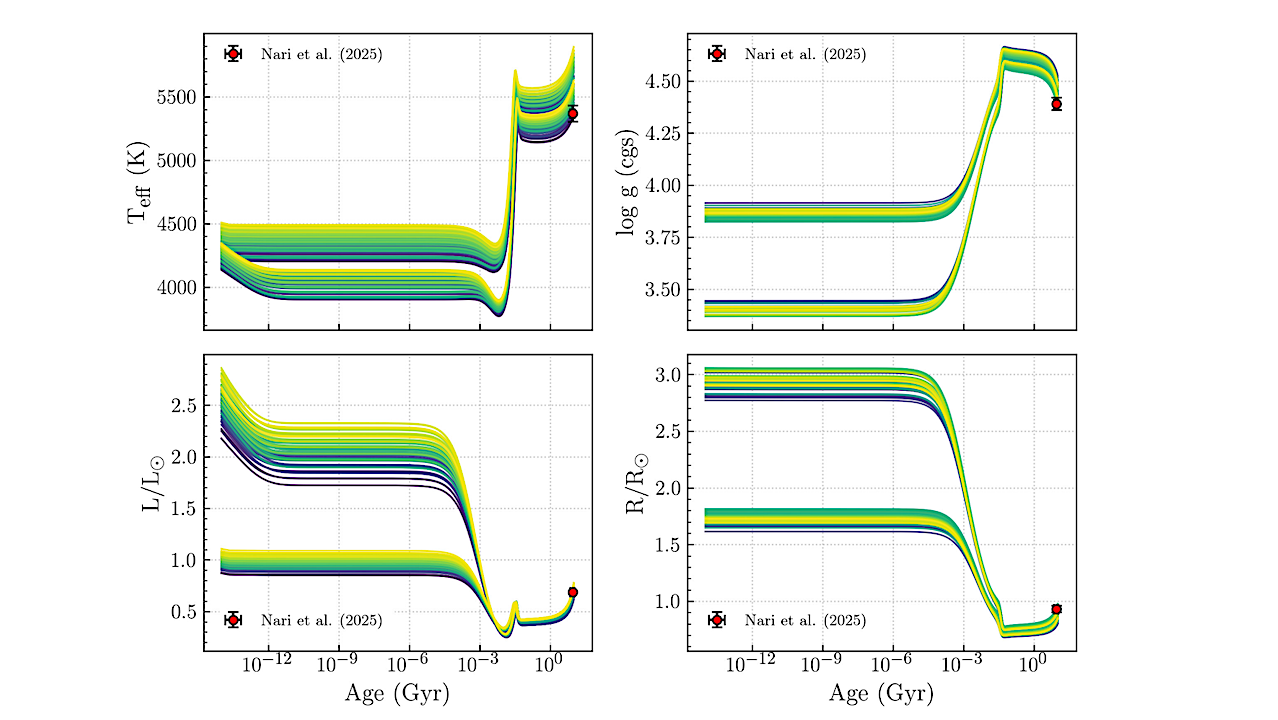
We present, to our knowledge, the first grid-based stellar evolution analysis of HD-20794 using MESA, focusing on its main-sequence and late main-sequence evolution. A set of 252 stellar models was computed for initial masses between 0.78 and 0.80M⊙, varying convective efficiency, numerical resolution, and atmospheric boundary conditions.
Models were selected through χ2 minimization using observed constraints on effective temperature, surface gravity, luminosity, radius, and age. The best-fit models favor a mass of 0.80M⊙ and an age of about 9~Gyr, reproducing all observed stellar properties within uncertainties. They also successfully recover the observed surface abundance pattern over a wide range of elements, including light elements, α-elements, and the odd-Z species phosphorus and chlorine.
Comparison with nucleosynthesis yields from massive stars suggests that the measured phosphorus and chlorine abundances are compatible with enrichment from core-collapse supernovae and have remained preserved during stellar evolution.
Our results support standard stellar evolution theory, indicating that low-mass, metal-poor G dwarfs such as HD-20794 can retain their natal chemical signatures over Gyr timescales.
This highlights their importance as probes of stellar evolution, Galactic chemical enrichment, and the chemical environments associated with long-lived planetary systems.
Mrinmay Medhi, Mami Deka, Krishna Saha, Vivek Baruah Thapa, Upakul Mahanta
Comments: 10 pages, 4 figures. Accepted for publication in MNRAS
Subjects: Solar and Stellar Astrophysics (astro-ph.SR); Earth and Planetary Astrophysics (astro-ph.EP)
Cite as: arXiv:2604.24596 [astro-ph.SR](or arXiv:2604.24596v1 [astro-ph.SR] for this version)
https://doi.org/10.48550/arXiv.2604.24596
Focus to learn more
Submission history
From: Vivek Baruah Thapa
[v1] Mon, 27 Apr 2026 15:20:58 UTC (3,208 KB)
https://arxiv.org/abs/2604.24596
Astrobiology, exoplanet,