Neptune’s Obliquity Was Likely Engendered By Triton’s Tidal Evolution
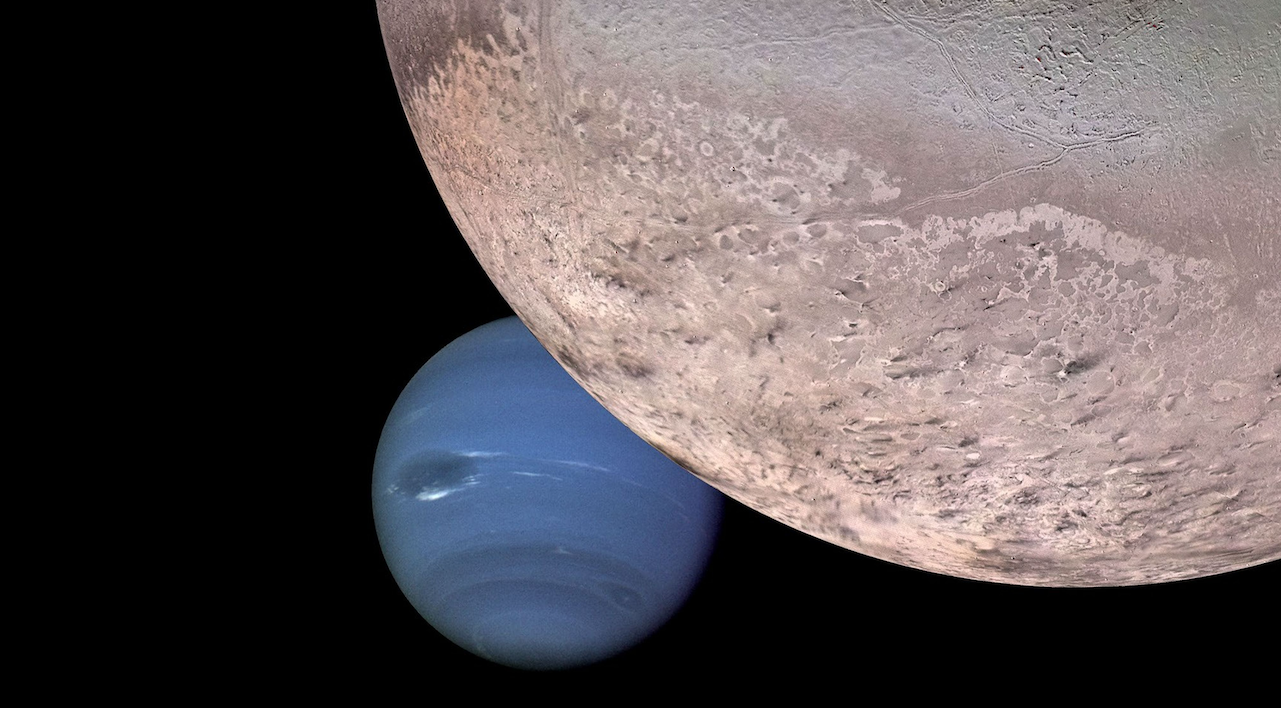
Neptune’s present axial tilt of approximately 28 deg. with respect to its orbital plane can be explained by collisions that its primordial core may have experienced with surrounding planetary embryos during the final stages of its formation.
Alternatively, Neptune could have attained its present mass solely through pebble accretion, without the formation of nearby planetary embryos. The embryo-collision scenario has the advantage of naturally explaining the large axial tilts observed in the ice giants.
To account for these tilts without invoking late-stage catastrophic collisions, an alternative mechanism must be considered. In this work, I propose that Neptune’s current axial tilt could result from the interaction between Triton’s tidally evolving orbit and Neptune’s spin axis, causing it to resonate with the solar system eigenfrequency s_8.
Starting from a Triton-mass satellite captured via the binary planetesimal disruption mechanism, I show that orbital evolutions bringing the satellite near Triton’s present orbit can induce a spin-s_8 resonance capable of producing a significant axial tilt of Neptune’s spin axis. I develop a model for planetary spin-axis evolution using Euler’s equations for a rigid body, which is incorporated into classical numerical integrations of the Newtonian equations of motion.
I also include a tidal model to account for the satellite’s semimajor-axis decay and orbital circularization. Several numerical simulations are performed with this model, including Neptune as the central body, the newly captured satellite, the Sun and the three other giant planets.
Increases in Neptune’s obliquity are observed, exceeding 50 deg. in some cases. An obliquity above 20 deg. is obtained for roughly 1/3 of the cases. If Neptune initially had a near-zero obliquity, its current value could therefore have been naturally engendered by the tidal evolution of Triton.
Rodney Gomes
Subjects: Earth and Planetary Astrophysics (astro-ph.EP)
Cite as: arXiv:2603.19035 [astro-ph.EP](or arXiv:2603.19035v1 [astro-ph.EP] for this version)
https://doi.org/10.48550/arXiv.2603.19035
Focus to learn more
Submission history
From: Rodney Gomes
[v1] Thu, 19 Mar 2026 15:33:00 UTC (1,924 KB)
https://arxiv.org/abs/2603.19035
Astrobiology,