Icelandic Hot Springs as a Prebiotic Analog: Wet-Dry Cycling Effects on the Stability of Nucleotides and Nucleic Acids
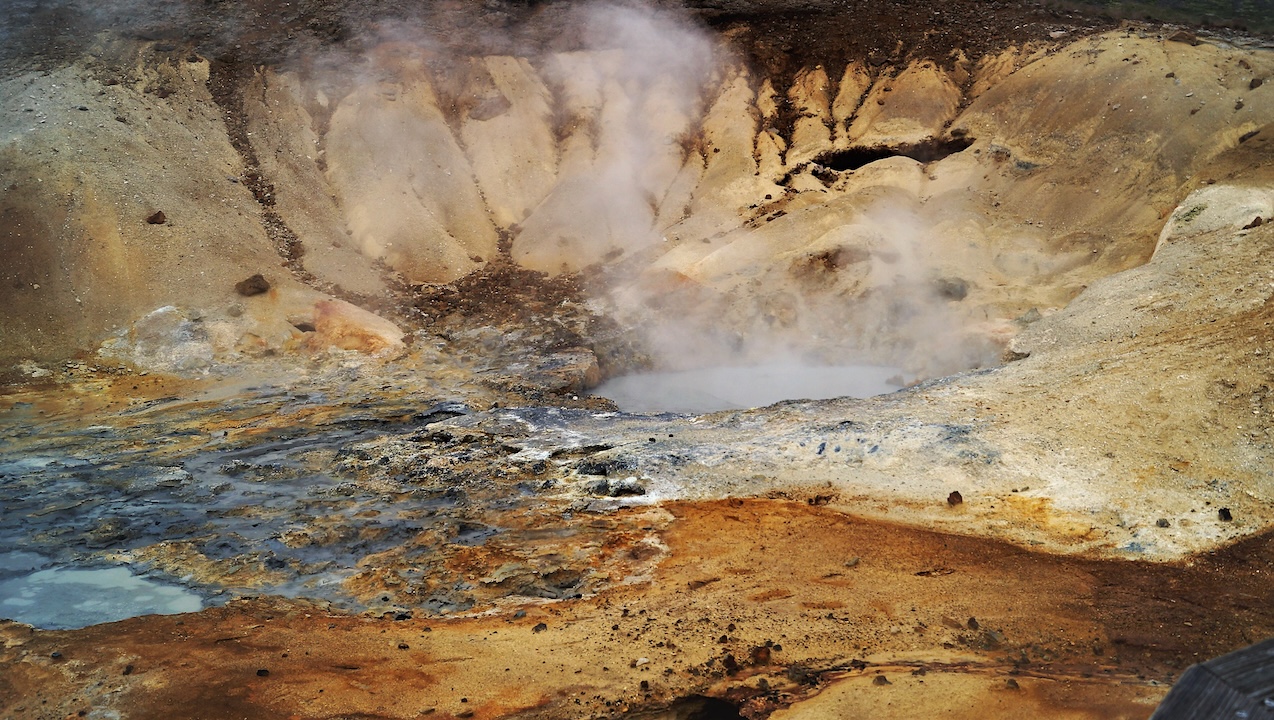
The hot spring hypothesis for the origin of life proposes that naturally occurring wet-dry cycles in small bodies of water could have driven condensation reactions on prebiotic Earth.
Mononucleotides exposed to wet-dry cycles in the laboratory have been shown to generate RNA oligomers. We tested whether similar reactions occur after wet-dry cycling in the laboratory of mononucleotides mixed with natural hot spring waters. Nucleotide solutions were prepared in the laboratory with effluent samples collected from hot springs of the Seltún (SE) and Hveradalir (HV) geothermal areas in Iceland.
Sixteen wet-dry cycles with water collected from SE resulted in degradation of adenosine-5′-monophosphoric acid (95%), uridine 5′-monophosphate (63%) mononucleotides, while four wet-dry cycles were enough to destroy around 90% of both A10 and U10; thus, they displayed uniquely destructive properties for both purine and pyrimidine bases.
Meanwhile, mononucleotides suspended in water collected from the HV hot spring were as stable as in nuclease-free water. Exposure of these solutions to wet-dry cycles also resulted in the synthesis of uridine dimers, cyclic mononucleotides, and other promising macromolecules.
- Icelandic Hot Springs as a Prebiotic Analog: Wet-Dry Cycling Effects on the Stability of Nucleotides and Nucleic Acids, Astrobiology via PubMed
- Icelandic Hot Springs as a Prebiotic Analog: Wet–Dry Cycling Effects on the Stability of Nucleotides and Nucleic Acids, Astrobiology (open access)
Astrobiology, genomics,