Growth Of Microorganisms In A Martian Regolith Simulant At Reduced Water Activity
Water activity (aw) quantifies the free water available for microbial growth. At the cellular level, liquid water is paramount for replication and proliferation. Research on Earth-like life suggests that microbial replication is limited by an aw threshold of ≥ 0.585, below which replication ceases.
On Mars, liquid water is typically unstable, but gaseous water exchanges between the atmosphere and the upper regolith are substantial. A variety of salts widespread across the Martian surface are capable of hydration and deliquescence, including sulfates that can undergo hydration–dehydration changes when exposed to different levels of aw.
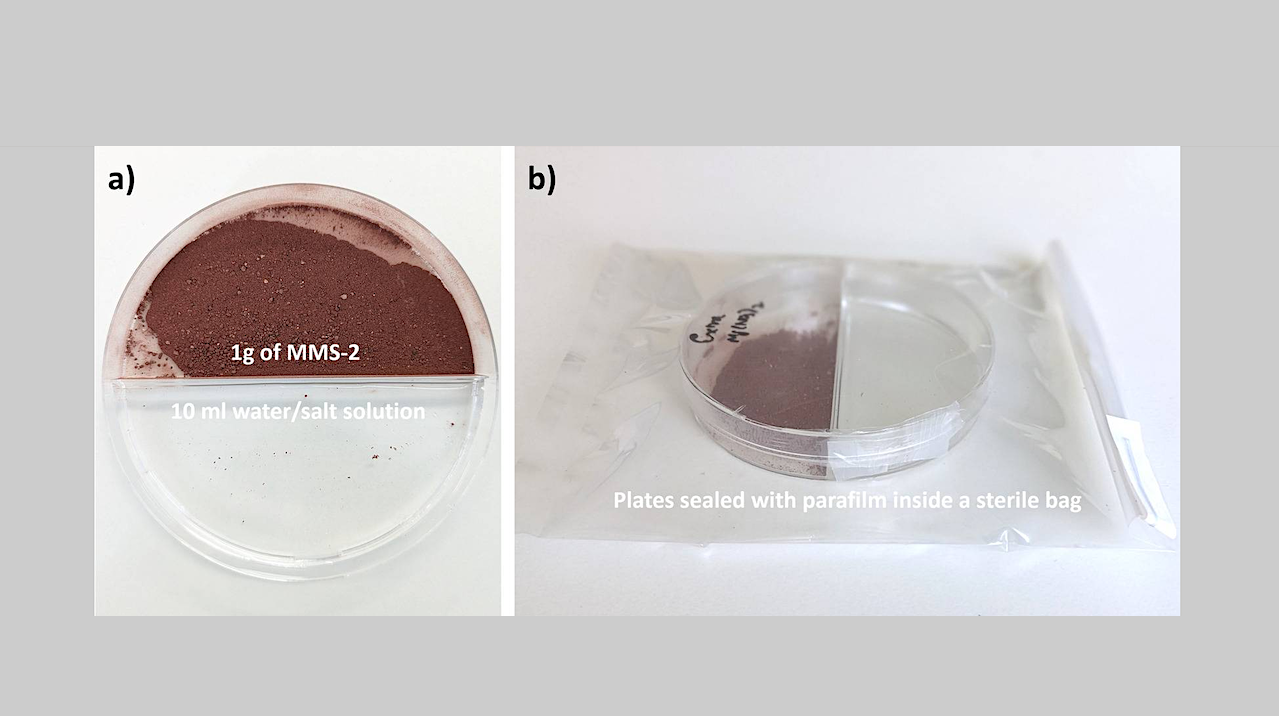
This study investigates microbial growth at different aw levels in a commercially available Mojave Mars Simulant 2 (MMS-2), a fine-grade basaltic soil modified with 2-4 wt% calcium sulfate and oxides (Fe2O3, SiO2, MgO, CaO) to mimic Martian regolith composition.
Growth was monitored by quantifying extracted deoxyribonucleic acid (DNA) from samples incubated at aw 1, 0.75, 0.65, 0.34 and 0.12 under Earth-like conditions (30 °C, ≈1 bar). At aw = 1, DNA mass from MMS-2 and Bacillus subtilis-spiked MMS-2 peaked on day 15 and day 3, respectively. At lower aw levels (0.75±0.02 and 0.65±0.02), DNA mass reached its peak after 20 and 30 days, respectively.
Samples incubated at aw = 0.34±0.02 exhibited reduced DNA yields, with a maximum on day 30, whereas no detectable increase in DNA occurred at aw = 0.12 ± 0.02 over 60 days. Statistical comparisons with the aw = 0.12 control were significant (e.g., aw = 0.34 ± 0.02, cleanroom vs. aw = 0.12 ± 0.02 at day 30: p = 0.0098; Benjamini–Hochberg (BH) False Discovery Rate across day 20, 30, 45: q = 0.0153).
These findings suggest that atmospheric water can be adsorbed into regolith grains and salts, supporting microbial persistence and DNA accumulation consistent with possible replication at reduced water activity under Earth ambient conditions.
- Growth of microorganisms in a Martian regolith simulant at reduced water activity, Scientific Reports via PubMed (open access)
- Growth of microorganisms in a Martian regolith simulant at reduced water activity, Scientific Reports (open access)
Astrobiology