Hot And cloudy: High Temperature Clouds In Super-Earths And Sub-Neptunes
JWST observations provide for the first time evidence for an atmosphere on a rocky exoplanet – 55 Cnc e. The atmosphere of 55 Cnc e is hot with Teq>2000K and shows strong variability, for which cloud formation above a molten crust could be one possible explanation.
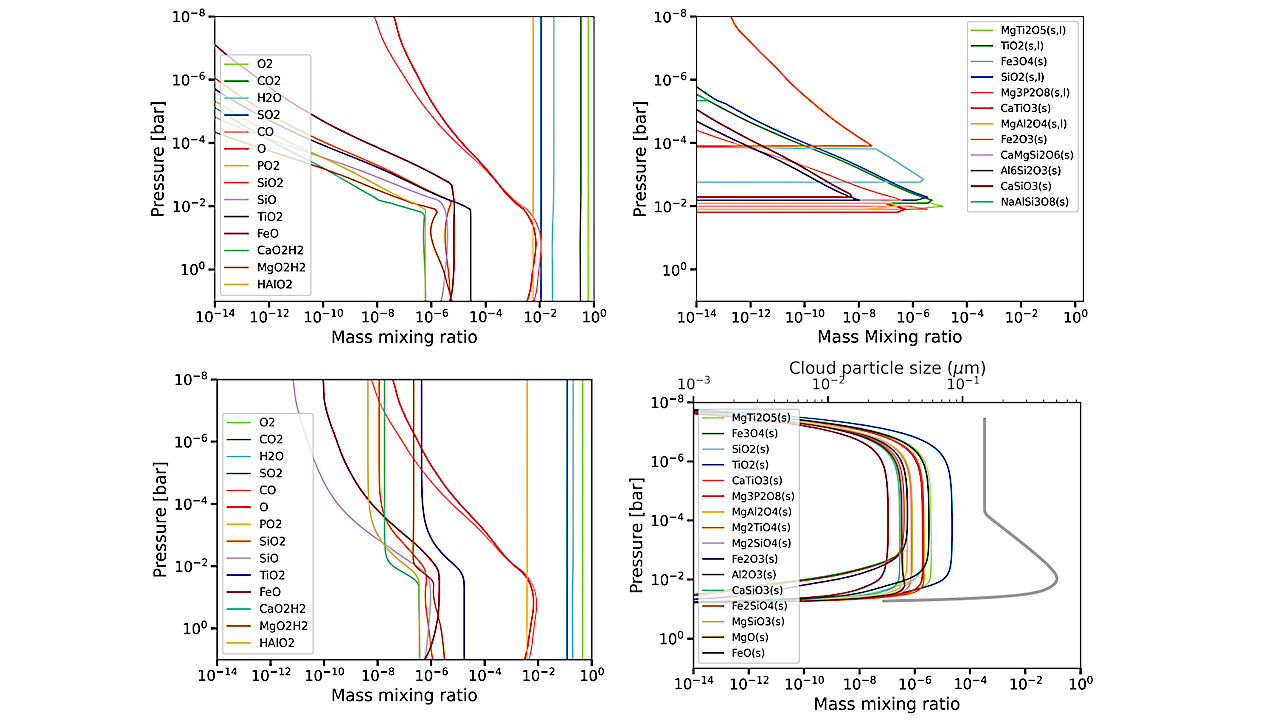
The composition of the atmosphere of 55 Cnc e is still unknown but suggests the presence of volatiles. We have run cloud formation models on a grid of N-dominated, O-dominated, C-dominated and H-dominated atmospheres to investigate which type of cloud we could expect on hot super-Earths and hot sub-Neptunes (1000K < T < 3000K). Our models combine radiative transfer with equilibrium chemistry of the gaseous and condensed phases, vertical mixing of condensable species, sedimentation, nucleation and coagulation.
We find that the condensability of species is highly dependent on the oxygen abundance of an atmosphere. Oxygen poor atmospheres can be heated by UV and optical absorbers PS, TiO and CN which create temperature inversions. These inhibit condensation. Oxygen rich atmospheres are colder without temperature inversions, and are therefore more favourable environments for cloud formation.
The major expected cloud component in O-dominated atmospheres with solar refractory abundance is TiO2(s). Spectral features of clouds in these worlds are stronger in transmission than in emission, in particular at short wavelengths. We find a lack of optical data of solid species in comparison to the variety of stable cloud components which can form on hot, rocky planets.
Leoni J. Janssen, Yamila Miguel, Michiel Min, Helong Huang, Mantas Zilinskas, Christiaan P. A. van Buchem
Subjects: Earth and Planetary Astrophysics (astro-ph.EP)
Cite as: arXiv:2601.15927 [astro-ph.EP] (or arXiv:2601.15927v1 [astro-ph.EP] for this version)
https://doi.org/10.48550/arXiv.2601.15927
Focus to learn more
Submission history
From: Leoni Janssen
[v1] Thu, 22 Jan 2026 13:05:07 UTC (8,706 KB)
https://arxiv.org/abs/2601.15927
Astrobiology,