Direct Detection Of Hydrogen Reveals A New Macroscopic Crustal Water Reservoir On Early Mars

The next great leap in Martian exploration will be the return of samples to Earth. To ensure the maximum scientific return from studying these samples, the development and utilisation of nondestructive analytical techniques are essential to enable early three-dimensional characterisation of their interiors.
Neutron computed tomography is a powerful method in this context: it is highly sensitive to hydrogen and complements the more conventional X-ray computed tomography. Because the distribution and nature of hydrous phases are central to understanding the habitability, the climatic and geological evolution, and potential biosignatures of Mars, identifying hydrogenbearing phases in Martian crustal rocks is of particular importance.
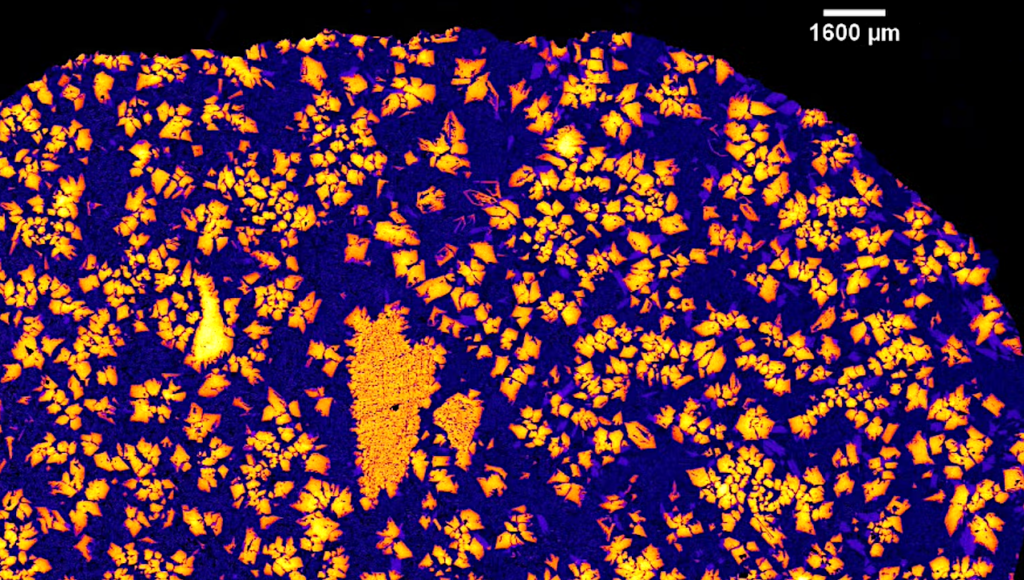
Using the only Martian crustal material available on Earth, the NWA 7034 meteorite and its pairs, we show that combined neutron and X-ray computed tomography enables non-destructive sample-wide mapping of hydrogen and reveals the distribution and petrographic contexts of hydrous phases.
We identify hydrogen-rich iron oxyhydroxides within ancient igneous clasts, forming a macroscopic mineralogical water reservoir within the meteorite. These alteration assemblages closely resemble those observed in samples collected by the Perseverance rover in Jezero crater, where hydrated iron oxyhydroxides are also present. This similarity suggests that such phases may represent a widespread near-surface water reservoir on early Mars.
Estrid Buhl Naver (1 and 2), Katrine Wulff Nikolajsen (3), Martin Sæbye Carøe (4), Domenico Battaglia (1), Jens Frydenvang (3), Martin Bizzarro (3), Jakob Sauer Jørgensen (4), Kim Lefmann (5), Anders Kaestner (6), David Christian Mannes (6), Phil Cook (7 and 8), Henrik Birkedal (9), Thorbjørn Erik Køppen Christensen (4 and 10), Innokenty Kantor (2 and 10), Henning Friis Poulsen (2), Luise Theil Kuhn (1) ((1) Department of Energy Conversion and Storage, Technical University of Denmark, Kgs. Lyngby, Denmark, (2) Department of Physics, Technical University of Denmark, Kgs. Lyngby, Denmark, (3) Centre for Star and Planet Formation, Globe Institute, University of Copenhagen, Copenhagen, Denmark, (4) Department of Applied Mathematics and Computer Science, Technical University of Denmark, Kgs. Lyngby, Denmark, (5) Nanoscience Center, Niels Bohr Institute, University of Copenhagen, Copenhagen, Denmark, (6) PSI Center for Neutron and Muon Sciences, Paul Scherrer Institut, Villigen, Switzerland, (7) European Synchrotron Radiation Facility, Grenoble, France, (8) Danish Technological Institute, Høje Taastrup, Denmark, (9) Department of Chemistry, Aarhus University, Aarhus, Denmark, (10) MAX IV Laboratory, Lund University, Lund, Sweden)
Comments: E.B. Naver and K. W. Nikolajsen have contributed equally
Subjects: Earth and Planetary Astrophysics (astro-ph.EP)
Cite as: arXiv:2601.08390 [astro-ph.EP] (or arXiv:2601.08390v1 [astro-ph.EP] for this version)
https://doi.org/10.48550/arXiv.2601.08390
Focus to learn more
Submission history
From: Estrid Naver
[v1] Tue, 13 Jan 2026 09:58:02 UTC (5,211 KB)
https://arxiv.org/abs/2601.08390
Astrobiology,