A Youthful Titan Implied By Improved Impact Simulations
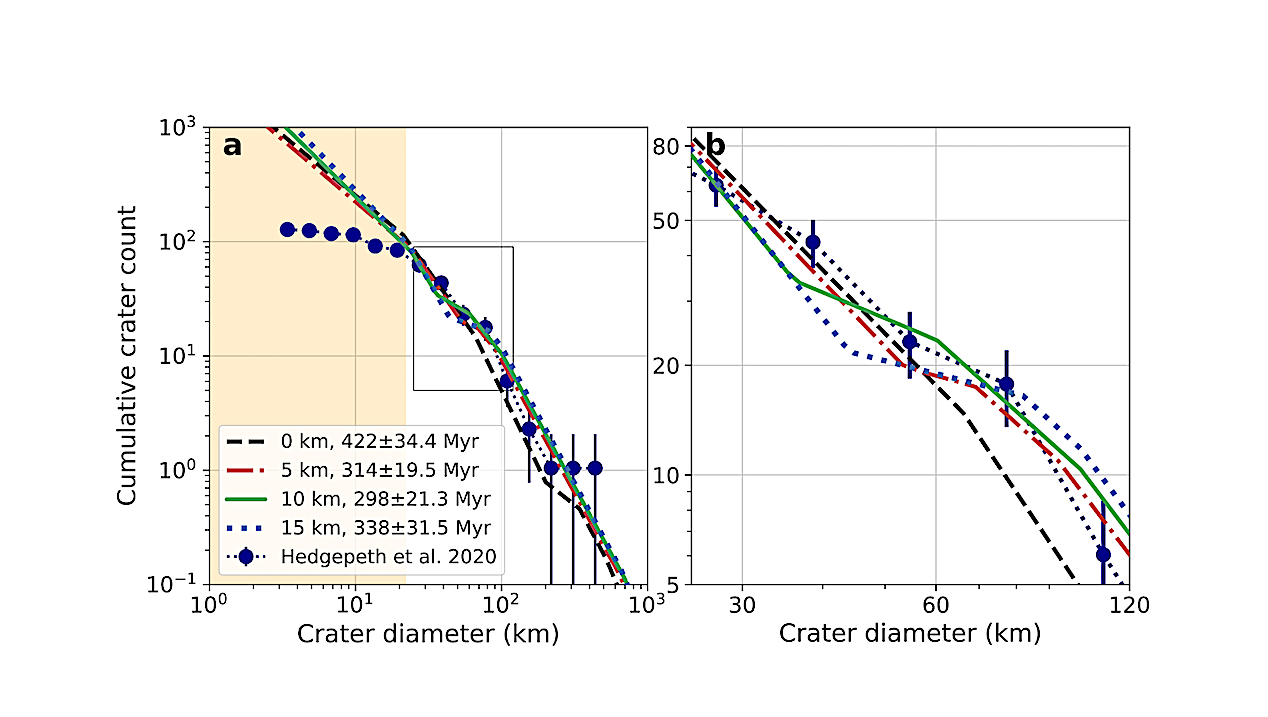
The small number of impact craters found on Titan suggests that its surface is relatively young. Previous work estimated its surface age to be between 200 and 1000 Myr. This estimate, however, is based on crater scaling laws for water and sand, which are not representative of the composition of Titan’s icy surface.
Titan’s surface is likely composed of water ice, methane clathrates, or a combination of both. Here, we perform impact simulations for impactors of various sizes that strike an icy target with a 0-15 km thick methane clathrate cap layer.
We derive new crater scaling laws based on our numerical results, and find that Titan’s surface age is 300-340 Myr, assuming heliocentric impactors and surface clathrates. This age, which represents the crater retention age, indicates a relatively youthful surface, suggesting that active endogenic and/or exogenic processes have recently reshaped Titan’s surface.
Shigeru Wakita, Brandon C. Johnson, Jason M. Soderblom, Catherine D. Neish
Comments: 17 pages, 3 figures, accepted for publication in Geophysical Research Letters
Subjects: Earth and Planetary Astrophysics (astro-ph.EP)
Cite as: arXiv:2601.08306 [astro-ph.EP] (or arXiv:2601.08306v1 [astro-ph.EP] for this version)
https://doi.org/10.48550/arXiv.2601.08306
Focus to learn more
Submission history
From: Shigeru Wakita
[v1] Tue, 13 Jan 2026 07:50:55 UTC (77 KB)
https://arxiv.org/abs/2601.08306
Astrobiology,