Absence Of A Subsurface Ocean On Titan Indicated By Cassini Data

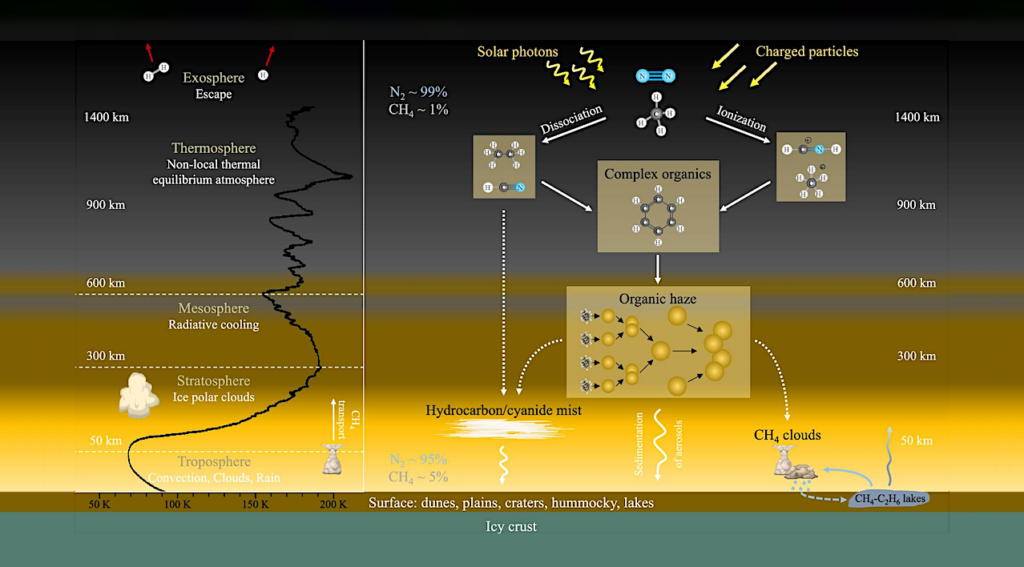
The Cassini spacecraft orbited Saturn from 2004 to 2017, performing over a hundred flybys of Titan, Saturn’s largest moon.
Ten of these flybys were dedicated to gravity field measurements, yielding unprecedented insight into the moon’s interior structure. The first four flybys revealed a weakly differentiated deep interior compared to Ganymede, consisting of a large (~2000 km, Titan’s radius is 2575 km) and low-density (~2600 kg/m3) rocky core and a ~600 km thick hydrosphere.
The inclusion of additional radio tracking data allowed the first measurement of Titan’s response to the gravitational tides exerted by Saturn, quantified by the real part Re(k2) of the complex tidal Love number k2. This measurement was interpreted as evidence of the existence of a global subsurface ocean beneath Titan’s ice shell.
We reanalyzed Cassini radio tracking data with improved techniques, including processing of open loop tracking data and phase compression, and derived a new measurement of Titan’s gravity field and tidal response. The improved precision on the determination of the tidal Love number yields the detection for the first time of the phase lag associated with tidal dissipation, quantified by Im(k2).
This new measurement corresponds to a remarkably low tidal quality factor (Q ~5), indicating strong tidal dissipation in the interior of Titan (Q of solid Earth is ~300). This finding is consistent with independent evidence from a recent analysis of Titan’s spin state.
We modeled the interior of Titan to interpret the measurements of Re(k2) and Im(k2) and investigate the implications of the strong tidal dissipation. Because the presence of an ocean substantially reduces the tidal dissipation generated below it, we show that the new measurements are inconsistent with the existence of a subsurface ocean.
We introduce a new oceanless model that simultaneously explains all the observations, reconciling measurements of the gravity field (moment of inertia, complex tidal Love number k2) and rotational state (obliquity, Cassini plane offset) for the first time. The new measurement has also strong implications for Titan’s thermal and orbital evolution, and the evolution of the Saturn system, indicating that Saturn’s Q at Titan’s orbital frequency might be even lower (Q ~ 75) than recently inferred from astrometric and radio science data.
Astrobiology