Tricorder Tech: Laser Ablation Sampling With Low‐Power Plasma: A LA‐MIP‐MS Instrument for Spaceflight
Rationale
Inductively coupled plasma (ICP) is a commonly used ion source for mass spectrometry‐based chemical analysis of a wide range of materials. Traditional ICP ion sources use high power (> 1000 W) and significant gas flow (> 10 L/min), rendering them unsuitable for spaceflight, as they are too resource‐intensive for planetary spacecraft.
Methods
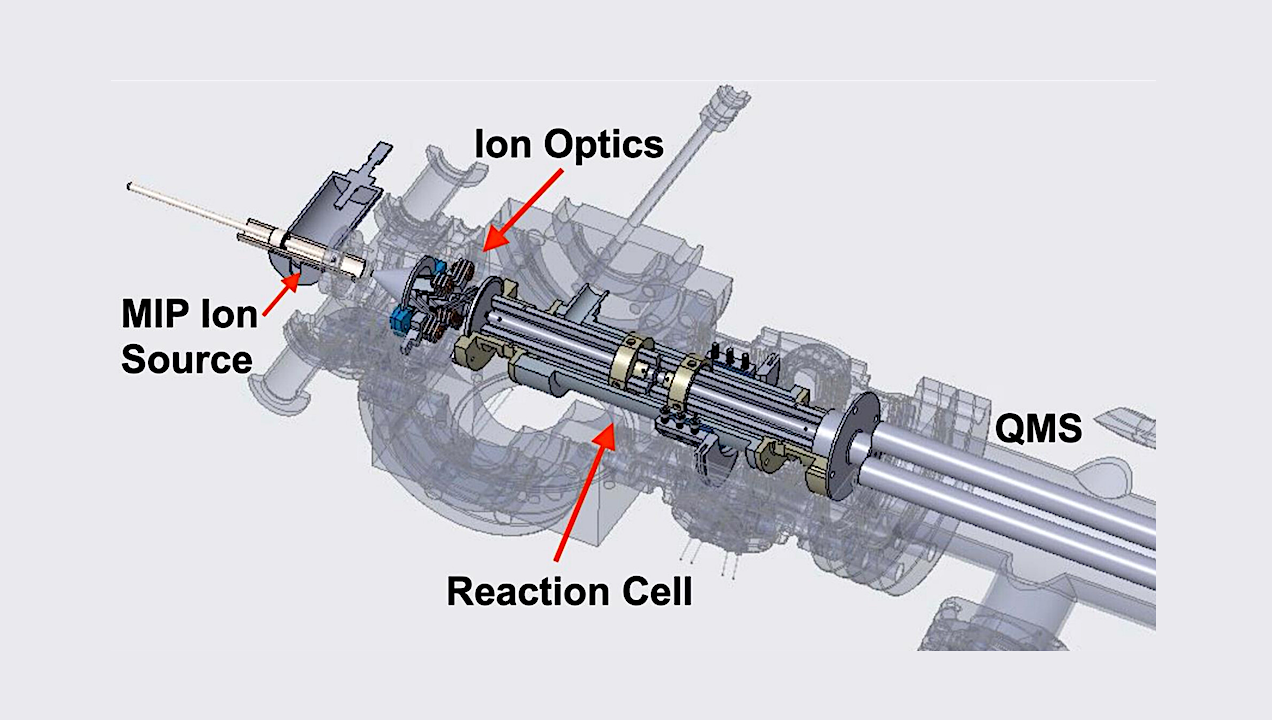
To address the technology gap, we designed and developed a laser ablation microwave‐induced plasma mass spectrometer (LA‐MIP‐MS) and experimentally validated the analytical performance of a prototype instrument capable of providing in situ analyses during planetary science missions. We developed a low‐pressure plasma ion source and interfaced it to a heritage quadrupole mass spectrometer (QMS) to perform elemental and isotopic analysis of solid samples via laser ablation. The low power plasma ion source was generated at < 1 Torr (< 133 Pa) using 30 W of power and 50 mL/min of He. Analytes were introduced via laser ablation (266 nm); we report elemental abundances and isotopic ratios for Cu, Ni, and Fe metals.
Results
Our experiments confirmed quantification accuracy for stainless steel within 1.4–4% of values measured by x‐ray fluorescence (XRF), with precision ranging from ±9.1 to 22% (2σm). Cu and Ni isotopic ratios were measured with ±0.8–3% (2σm) precision and reproducibility ranging from 0.12% to 11.8%. Measured limits of detection ranged from 21 ppmw for 57Fe to 780 ppmw for 54Fe, with limits of detection for Cr, Mn, and Ni below 240 ppmw.
Conclusions
This technique adds to the roster of instrumentation available for planetary missions by enabling elemental and isotopic analysis with orders of magnitude less power and plasma gas relative to commercial ICP‐MS systems. This work paves the way for low resource LA‐MIP‐MS instruments as a viable technique to be applied to a wide range of applications for terrestrial and spaceflight chemical analysis of geologic materials.
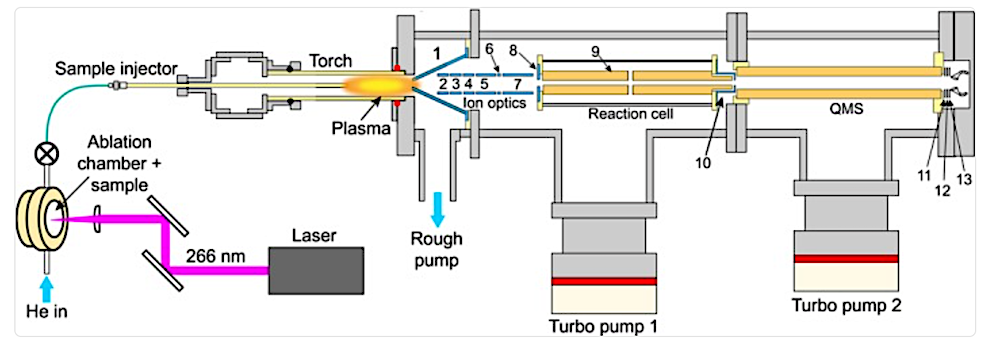
Schematic of LA‐MIP‐MS constructed for this study. Table 1 provides typical data for lens voltages, forward power, gas type and flow rates, and laser parameters. — Rapid Communications In Mass Spectrometry
- Laser Ablation Sampling With Low‐Power Plasma: A LA‐MIP‐MS Instrument for Spaceflight, Rapid Communications In Mass Spectrometry via PubMed (open access)
- Laser Ablation Sampling With Low-Power Plasma: A LA-MIP-MS Instrument for Spaceflight, Rapid Communications In Mass Spectrometry via PubMed (open access)
Astrobiology, Tricorder,