Rock Vapour Is Opaque: Implications For Dynamics And Observations Of Lava Planets
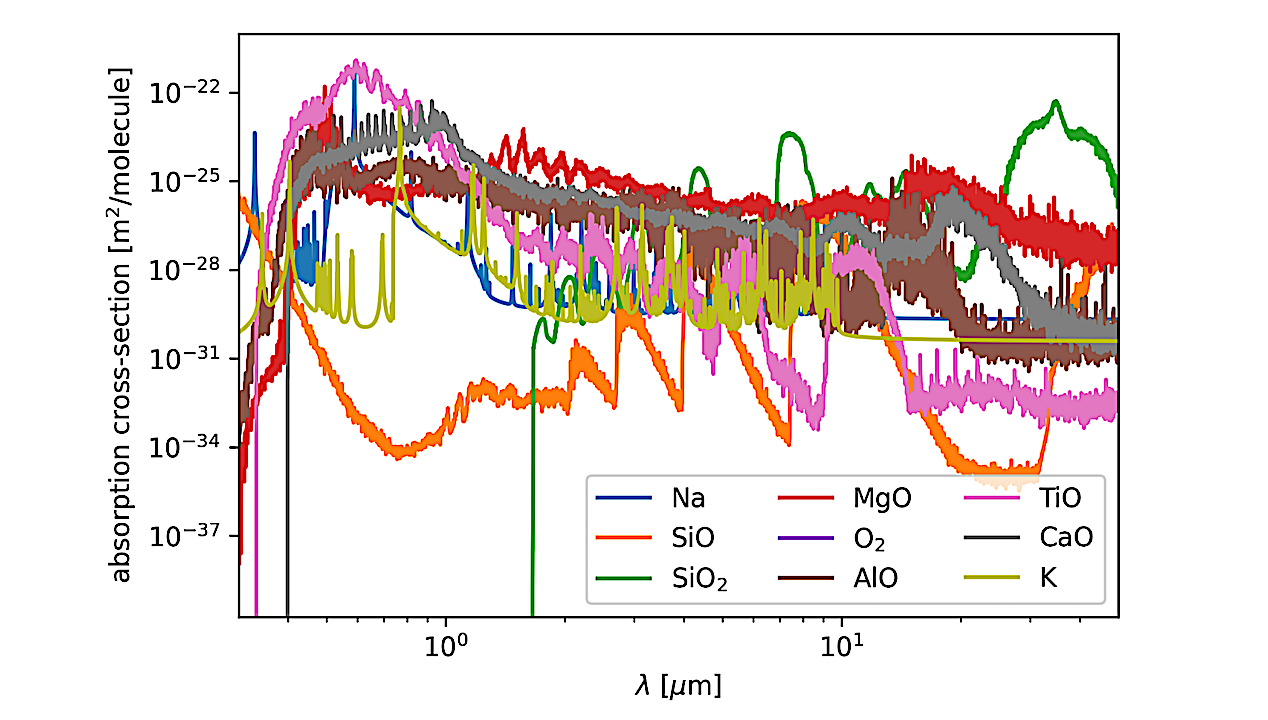
Extreme instellation on lava planets causes the rocky surface to melt and vaporize. Because the rock vapour composition is intrinsically tied to the mantle, atmospheric characterization of lava planets can hold valuable insight into the interior processes of rocky planets.
To help interpret current data and strategize for future observations, we develop the model SonicVapour to simulate the dynamics of chemically complex secondary atmosphere of lava planets.
We find that for planets with surface temperatures exceeding 2700 K, the rock vapour outgassed is optically thick, making the atmosphere vertically isothermal thus suppressing convection and severely limiting atmospheric detection via emission spectroscopy. In contrast, cooler planets with surfaces between 2300 K – 2700 K have an atmospheric opacity close to 50% and produce distinct spectral features.
Counter-intuitively, therefore, cooler lava planet atmospheres are easier to detect. Our results ultimately emphasize the importance of considering atmospheric “detectability” in tandem with signal-to-noise for future observation programs.
T. Giang Nguyen, Nicolas B. Cowan, Gunnar Montseny Gens, Charles-Edouard Boukare, William Eaton, Karolina Sienko
Comments: 6 pages, 6 figures; manuscript submitted to the Open Journal of Astrophysics
Subjects: Earth and Planetary Astrophysics (astro-ph.EP)
Cite as: arXiv:2511.11800 [astro-ph.EP] (or arXiv:2511.11800v1 [astro-ph.EP] for this version)
https://doi.org/10.48550/arXiv.2511.11800
Focus to learn more
Submission history
From: Giang Nguyen
[v1] Fri, 14 Nov 2025 19:00:01 UTC (346 KB)
https://arxiv.org/abs/2511.11800
Astrobiology,