JWST TRAPPIST-1 e/b Program: Motivation and First Observations
One of the forefront goals in the field of exoplanets is the detection of an atmosphere on a temperate terrestrial exoplanet, and among the best suited systems to do so is TRAPPIST-1.
However, JWST transit observations of the TRAPPIST-1 planets show significant contamination from stellar surface features that we are unable to confidently model. Here, we present the motivation and first observations of our JWST multi-cycle program of TRAPPIST-1 e, which utilize close transits of the airless TRAPPIST-1 b to model-independently correct for stellar contamination, with the goal of determining whether TRAPPIST-1 e has an Earth-like mean molecular weight atmosphere containing CO2.
We present our simulations, which show that with the 15 close transit observations, we will be able to detect this atmosphere on TRAPPIST-1 e at ΔlnZ=5 or greater confidence assuming we are able to correct for stellar contamination using the close transit observations.
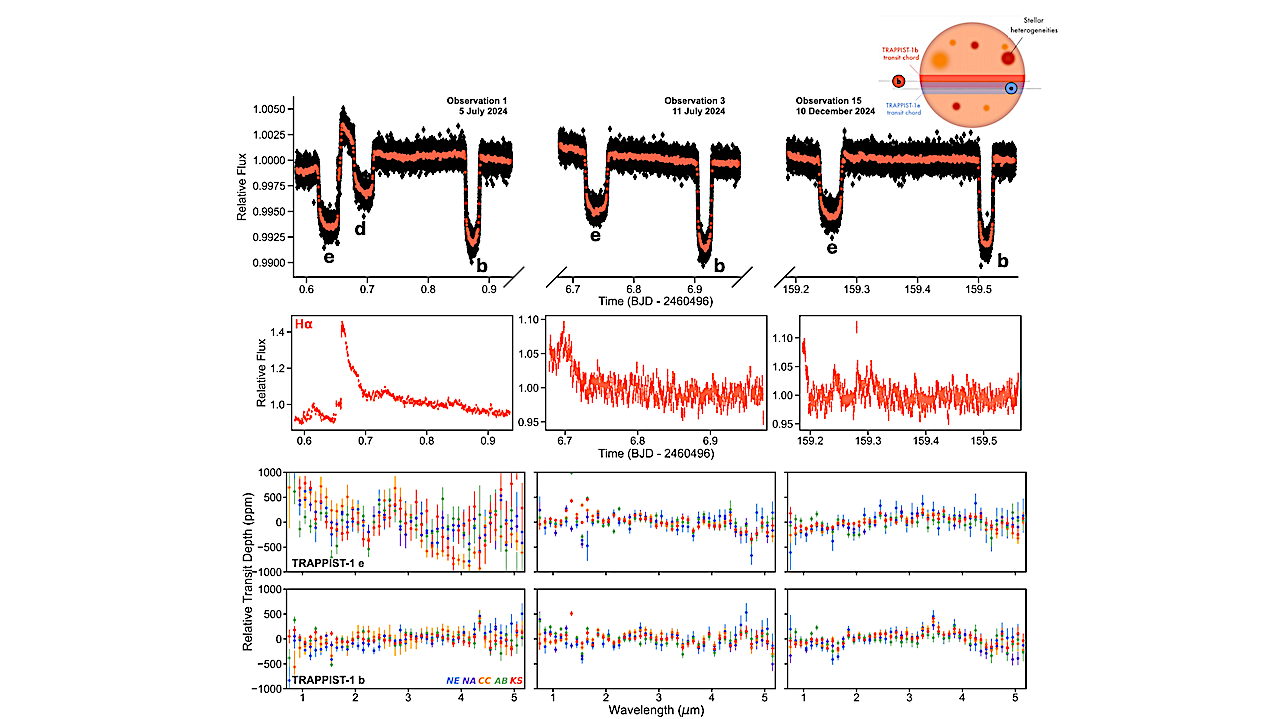
We also show the first three observations of our program. We find that our ability to correct for stellar contamination can be inhibited when strong stellar flares are present, as flares can break the assumption that the star does not change meaningfully between planetary transits.
The cleanest observation demonstrates the removal of stellar contamination contribution through an increased preference for a flat line over the original TRAPPIST-1 e spectrum, but highlights how minor data analysis assumptions can propagate significantly when searching for small atmospheric signals. This is amplified when using the signals from multiple planets, which is important to consider as we continue our atmospheric search.
Natalie H. Allen, Néstor Espinoza, V. A. Boehm, Caleb I. Cañas, Kevin B. Stevenson, Nikole K. Lewis, Ryan J. MacDonald, Brett M. Morris, Eric Agol, Knicole Colón, Hannah Diamond-Lowe, Ana Glidden, Amélie Gressier, Jingcheng Huang, Zifan Lin, Douglas Long, Dana R. Louie, Meredith A. MacGregor, Laurent Pueyo, Benjamin V. Rackham, Sukrit Ranjan, Sara Seager, Guadalupe Tovar Mendoza, Jeff A. Valenti, Daniel Valentine, Roeland P. van der Marel, Hannah R. Wakeford
Comments: 26 pages, 15 figures, accepted for publication in AJ
Subjects: Earth and Planetary Astrophysics (astro-ph.EP)
Cite as: arXiv:2512.07695 [astro-ph.EP] (or arXiv:2512.07695v1 [astro-ph.EP] for this version)
https://doi.org/10.48550/arXiv.2512.07695
Focus to learn more
Submission history
From: Natalie Allen
[v1] Mon, 8 Dec 2025 16:35:58 UTC (36,129 KB)
https://arxiv.org/abs/2512.07695
Astrobiology,