🚀 NASA Astrobiology Report: PESTO Search for Life Instrumentation Study For Solar System Life Detection
Search for Life Instrument Study Identifying Scientific Knowledge and Technology Gaps
https://www.nasa.gov/wp-content/uploads/2026/05/pesto-astrobio-report-final-draft.pdf?emrc=eaa475
Draft for Community Feedback
Foreword
Study Background and Scope
The search for life beyond Earth remains one of the most compelling scientific priorities identified in the 2023 Planetary Science and Astrobiology Decadal Survey (National Academies, 2023). Central to this vision is Question 11:
Q11. Search for life elsewhere. Is there evidence of past or present life in the solar system beyond Earth, and how do we detect it?
Meeting the objective of detecting life requires more than increasingly sensitive instruments. It demands a quantitative, end-to-end estimate of the biomass potentially present in a habitable environment, environmental context and physical transport efficiencies from that habitable zone to a sampling location, and understanding of how mission sample acquisition capabilities, sample ingest and processing, and analysis influence our ability to detect and confidently interpret biosignatures within complex and often noise-dominated planetary sample matrices. Table 21-1 of the 2023 Origins, Worlds, and Life (OWL) Planetary Science and Astrobiology Decadal Survey emphasizes the need for technologies that can distinguish biological signals from abiotic chemistry, reduce ambiguity, and improve detection limits across complementary measurement domains (National Academies, 2023).
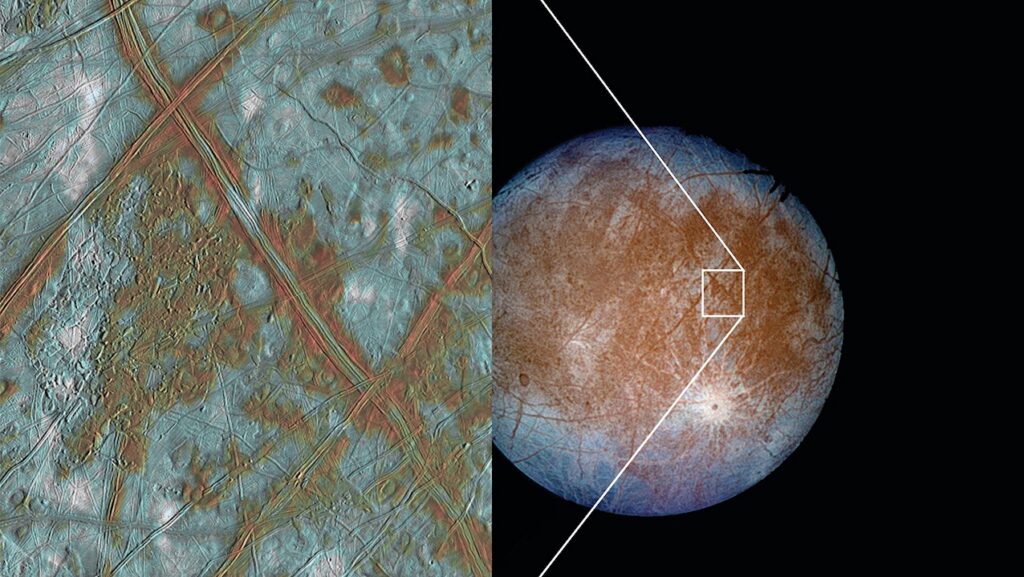
The purpose of the study is to identify gaps in existing scientific knowledge and technology that could hinder the success of future in situ life detection missions within the solar system. The scope of the study includes instruments and other technologies relevant to biosignature detection including sample collection and handling systems as well as sample preparation and processing. Spacecraft enabling technologies such as avionics and communications systems are not considered. The environments and operational concepts studied included Mars subsurface permafrost and Europa and Enceladus near-surface or plumes with samples collected by landers or spacecraft fly-through plume capture.
The study addresses the following questions:
- Given the estimated potential range of biosignature quantity at a sampling location, which of these measurements can be made with existing technologies and what is their maturity level for spaceflight and function within the applicable planetary environment.
- What technology and science knowledge gaps exist for biosignature detection and which should be prioritized for development to most effectively provide detection confidence?
Study findings will be one element considered by NASA’s Planetary Exploration Space Technology for identifying future technology development investment priorities in support of addressing the OWL Decadal’s Question 11. Yet, additionally, the analysis also highlights opportunities for combining processing steps and enabling streamlined life-detection payload architectures as well as identifying biosignature analytes that benefit from parallel or serial processing approaches.
Astrobiology, AbSciCon,