Maximum Lifetime Of The Vegetative Biosphere
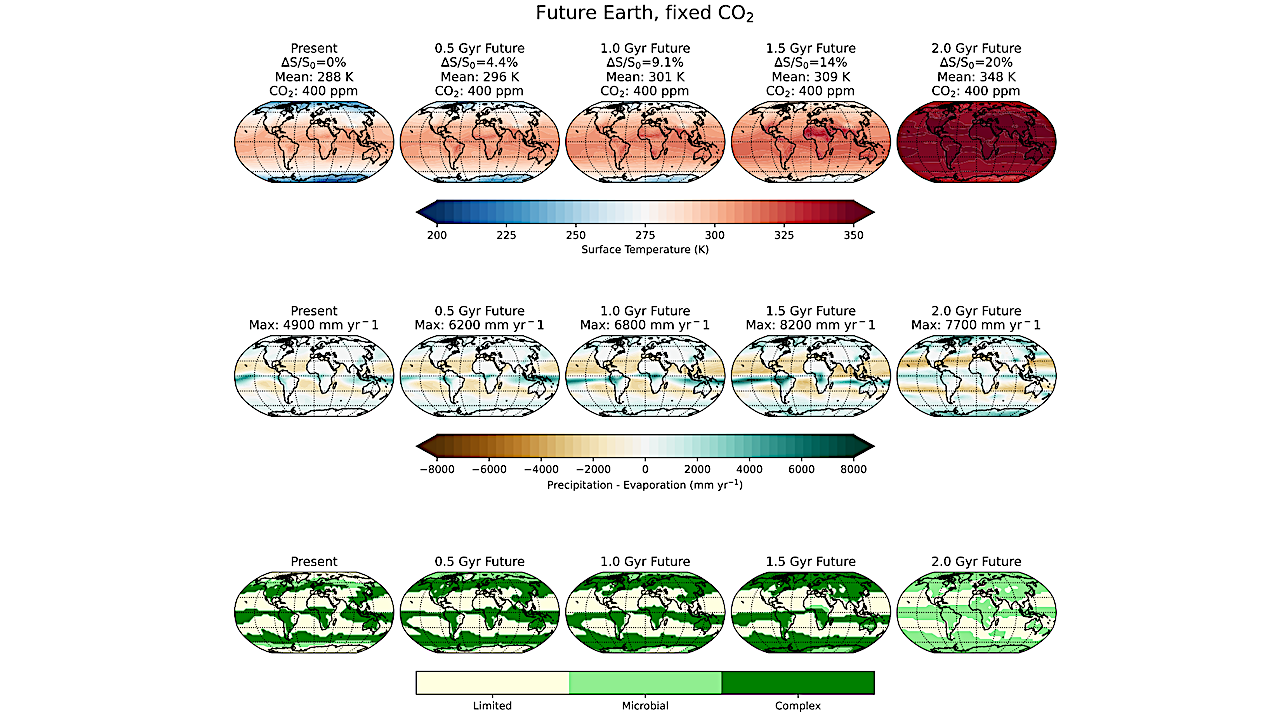
We use a three-dimensional model to calculate steady-state climates at various intervals in Earth’s future, across a parameter space of increasing insolation and decreasing CO2 mixing ratio.
Comparison with prior results shows an overestimation of warming by one-dimensional models when solar constant is increased and CO2 mixing ratio is fixed. We consider two future trajectories as limiting cases: strong weathering, in which surface temperature remains constant but CO2 is drawn down; and weak weathering, in which CO2 remains constant and surface temperature increases.
Under strong weathering, we find the conventional 10 ppm CO2 starvation limit for C4 photosynthesis occurs at 1.35 Gyr; however, we suggest that crassulacean acid metabolism (CAM) photosynthesis could persist below this limit and note that aquatic macrophytes can utilize dissolved bicarbonate if atmospheric CO2 is low.
If we take the CO2 starvation limit at 1 ppm instead, then the vegetative biosphere could continue until 1.84 Gyr. Thermal limits apply instead under weak weathering, in which Earth would be too hot for most land plants at 1.68 Gyr (>323 K) and too hot for all land plants (>338 K) at 1.87 Gyr. These lifetimes approach the moist and runaway greenhouse limits for Earth.
We discuss other possible mechanisms for extending the lifetime of Earth’s biosphere, noting that both technological intervention and evolutionary processes could enable life to adapt to a brightening sun.
Jacob Haqq-Misra, Eric Wolf
Comments: Accepted by Journal of Geophysical Research – Atmospheres
Subjects: Earth and Planetary Astrophysics (astro-ph.EP)
Cite as: arXiv:2605.22404 [astro-ph.EP] (or arXiv:2605.22404v1 [astro-ph.EP] for this version)
https://doi.org/10.48550/arXiv.2605.22404
Focus to learn more
Submission history
From: Jacob Haqq-Misra
[v1] Thu, 21 May 2026 12:32:10 UTC (3,385 KB)
https://arxiv.org/abs/2605.22404
Astrobiology,