How To Actually Build Your Own Working Tricorder
Editor’s note: Hamzah Abugosh has built a functional tricorder. I share the same fascination he has with the notion of a Tricorder as seen on Star Trek since I was a kid in the 1960s. My friend John Hines and I used to talk about this a lot in the 1990s when he fiddled around with building one at NASA Ames (among many other inventions).

Well, the person behind PioteLabs on YouTube (SUBSCRIBE!) – Hamzah Abugosh @aabugosh is similarly fascinated. So … he set off to actually build a tricorder (see below).
As we plan expeditions back to the Moon and then to Mars and Beyond – by scientists eager to answer Astrobiology and Astrogeology questions – the need for a device such as this is inevitable.
This is just a prototype. And you get to see the entire process that went into creating it. Loads of information is posted on GitHub. Hamzah admits that this version does not do the “Bio” aspect of what a Star Trek tricorder does – yet – but that was due (at present time) to cost and complexity. But its on his upgrade list. So you need to send Hamzah your thoughts on what an Astrobiologist would want in such a device.
So let’s get started. Note: this thing is called a “THRIcorder” – not a “TRIcorder””. Over to Hamzah:
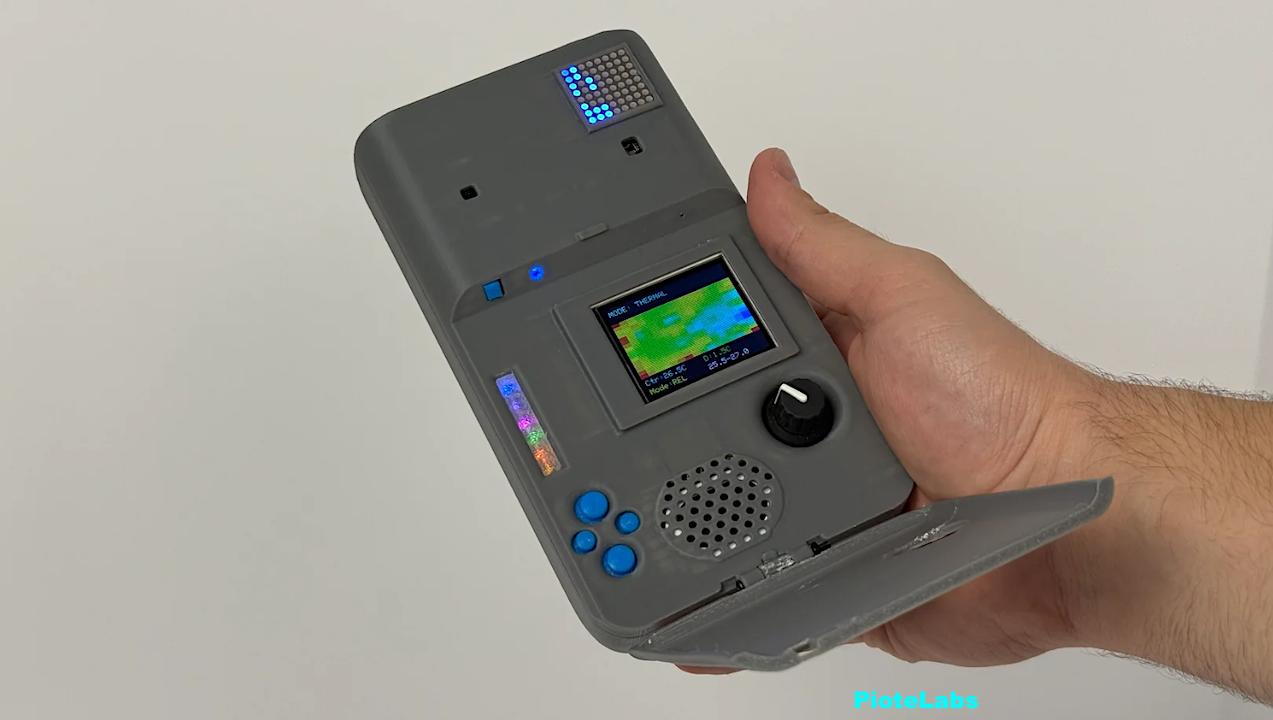
In this video I build a fully functional tricorder inspired by Star Trek: The Next Generation; a handheld device that actually scans the world around it. It runs on an ESP32 with a stack of sensors packed into a 3D printed enclosure I designed myself. Across its modes it handles thermal imaging, environmental sensing (temperature, humidity, pressure, VOCs, and UV), distance, compass heading, and color detection, real-time sound analysis with logging, and wifi/Bluetooth scanning. It saves snapshots and logs to an SD card and hosts its own web page so you can pull files straight to your phone, with custom LED matrix animations for each mode.
The whole thing is open source. The code, STL files, and full shopping list are free for anyone to download and build their own.
- Website: https://www.piotelabs.com
- Code, STLs & shopping list: https://www.piotelabs.com/products/thricorder-files-only
- Github: https://github.com/PioteLabs/ThriCorder
- Discord: Coming soon!
Hi everyone, I love scifi so I recently made a functional open-source Sci fi scanner inspired by Star Trek’s TriCorder, took a while and a lot of PLA and CAD to get everything to fit just right but it’s been a pretty awesome experience.
- I have all the files available for free, including the list of components I used and the software for on GitHub: https://github.com/PioteLabs/ThriCorder
- STLs are free on my website: https://www.piotelabs.com/products/thricorder-files-only
- I also made a simulated version of the software if your curious: https://www.piotelabs.com/pages/thricorder-firmware-simulator
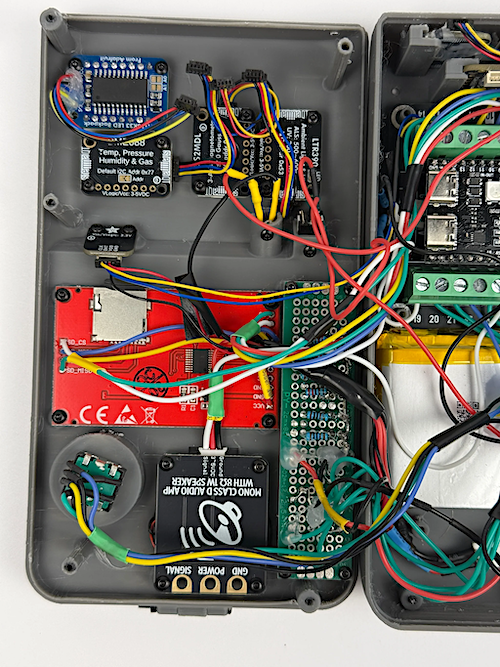
I do want to continue to work on and improve it after a little break, since this took me a few months.It would be awesome if anyone tries it for themselves, I’d love to see it. It is working pretty well right now, but theres a lot of rough edges just as a disclaimer. And the components added up to >$200. But you can get a dummy one working with alot less if you want it to just make screen, sounds and have LEDs.
It has a few modes for scanning:
- Environmental: Temp, humidity, UV, VOCs
- Measure: distance, magnetometer, color
- Sound: audio waves, record logs
- Thermal Imaging
- Wifi/BLE scanner
- Files: Web host
Earlier posts on Tricorders at Astrobiology.com
Astrobiology,