ExoMars Rosalind Franklin Astrobiology Rover Targets A Vast Bed Of Clay In Its Search For Life
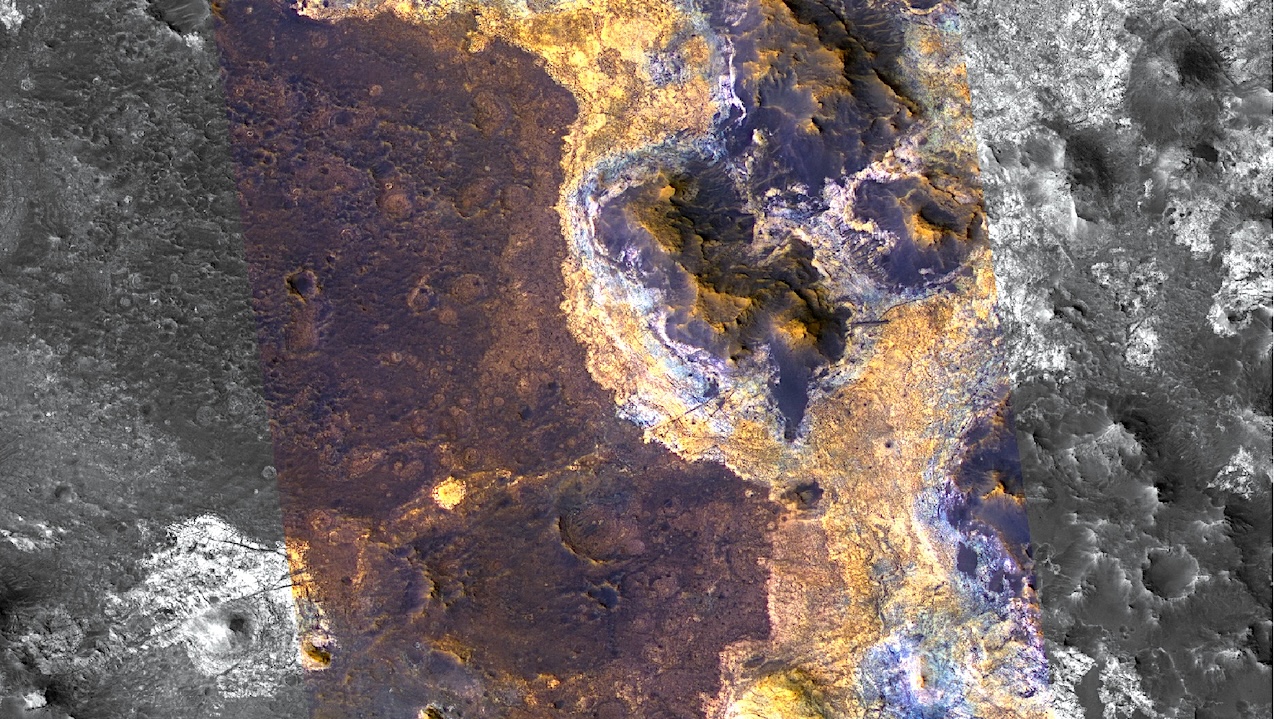
In the region where the ExoMars Rosalind Franklin rover will search for signs of life, clay deposits extend beyond previous estimates, a new study finds. One hypothesis even suggests a vast ocean once covered the landing site.
Clay minerals require liquid water to form and hold clues of a time when the Red Planet was wetter and more hospitable to life. The findings point to the presence of large amounts of water shaping the region, and possibly the entire planet. This has important implications for Mars’s past climate and habitability.
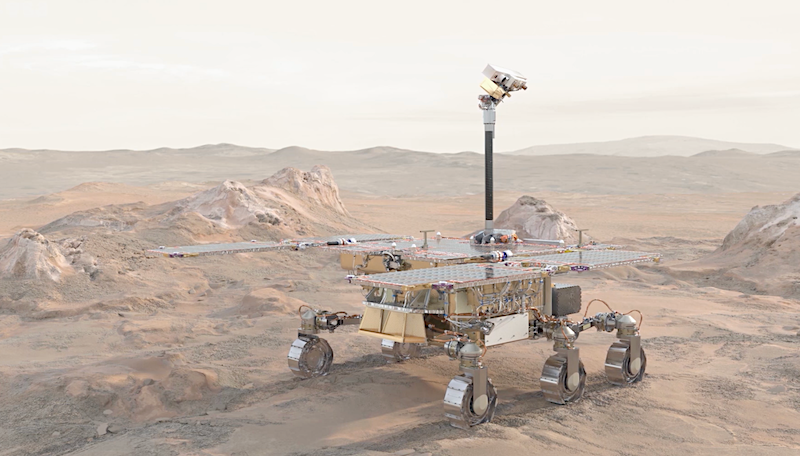
Rosalind Franklin rover exploring martian site — ESA larger image
Our rover will land at Oxia Planum to explore this once water-rich region.
The robotic explorer will investigate whether its clay-rich sediments have traces of past life in them and learn about the water environment in which they formed.
An ancient deep ocean?
As Oxia Planum lies in an open basin, it is possible that the clay deposits were shaped by an extensive body of water reaching several kilometres in depth around four billion years ago.
Another scenario could be that large amounts of water flooded vast plains from ancient groundwater reservoirs. Once its wheels and drill hit the ground, the ExoMars rover will attempt to verify the most plausible scenario.
Oxia Planum geological map — ESA
The study found that the clay deposits at the landing site reached as far as Mawrth Vallis, an area some 300 km from Oxia Planum that was also shortlisted as a candidate landing site. Stretching roughly 600 km across and rising over a kilometre in altitude, the deposits are vast in scale. If an ocean did form them, its shorelines would rank among the highest ever theorised for Mars.
“Because the area is so large, we are not talking about a localised occurrence, but rather a regional or global process that would have required immense amounts of water. We are targeting the oldest deposits in the sequence, which makes the potential implications for the geology and early climate of Mars very relevant for the Rosalind Franklin mission in its search for life,” explains Jorge Vago, ExoMars project scientist.
Understanding the nature and origin of these clay minerals is essential for reconstructing the planet’s climate and assessing its habitability. “We now have a new timeline: Oxia Planum’s clays formed first, about four billion years ago, predating those at Mawrth Vallis. By landing at Oxia Planum, we’ll uncover a large-scale process that shaped ancient clays across Mars,” says Inés Torres Auré, lead author of the publication from the University of Lyon, France.
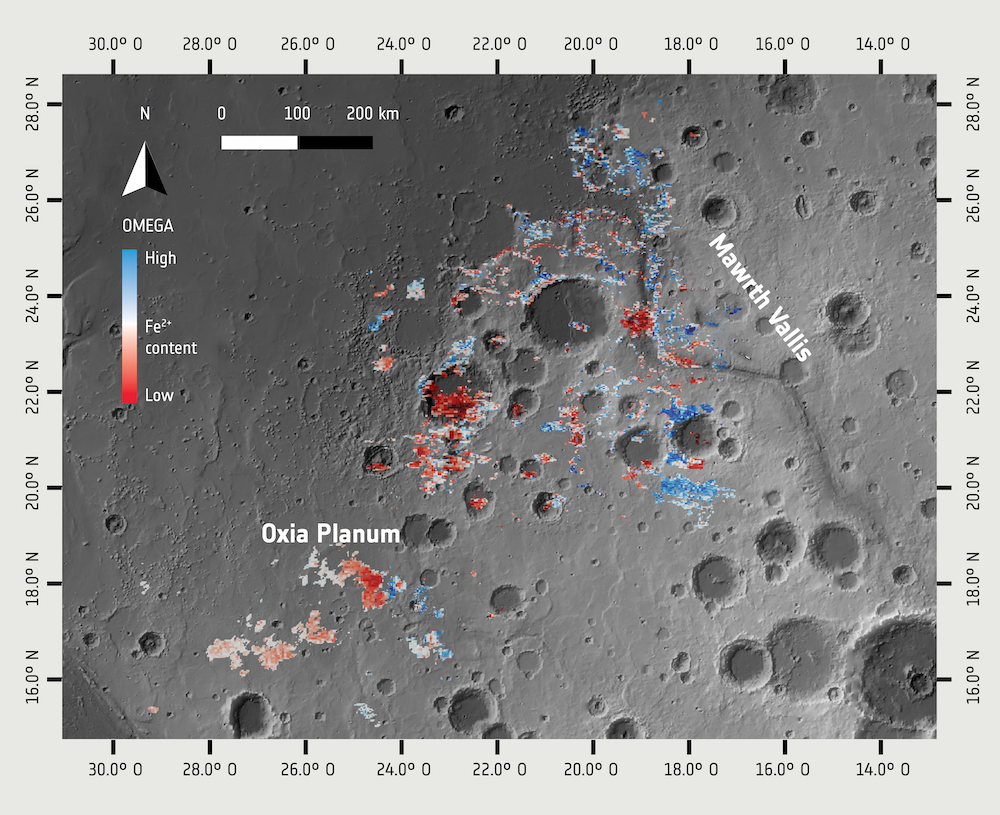
OMEGA-scale maps from Mars Express illustrating ferrous iron content across the region between Oxia Planum and Mawrth Vallis on Mars. — ESA larger image
Environmental change recorded in clay
Scientists used the OMEGA instrument on ESA’s Mars Express orbiter and the CRISM instrument on NASA’s Mars Reconnaissance Orbiter to examine the mineralogy and reconstruct the rock layering between Oxia Planum and Mawrth Vallis. Their analysis revealed that both sites have similar mineral layers.
At the boundary between the two main clay-bearing units, the team also identified a paleosurface: a remnant of an ancient, exposed surface that was heavily cratered and later covered by younger deposits. This paleosurface marks a pause in sedimentation, followed by a shift in water chemistry and mineralogy across both sites.
These results align with recent studies suggesting an intermittently wet climate on early Mars.
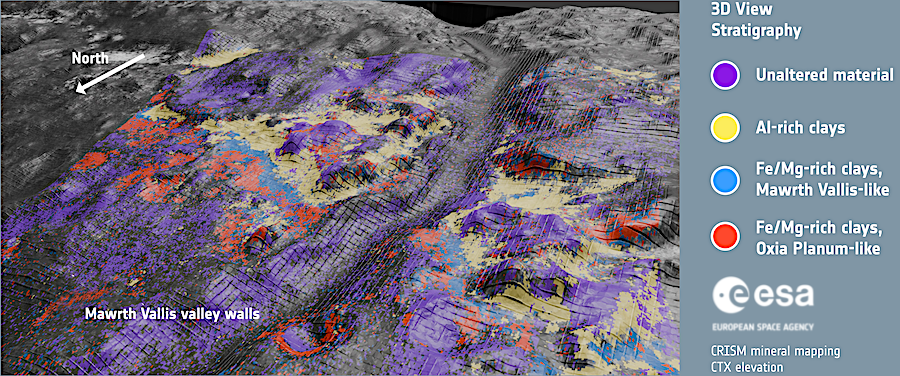
Mineralogy at Mawrth Vallis walls — 3D views of the Mawrth Vallis region using spectral data from the CRISM instrument on NASA’s Mars Reconnaissance Orbiter. The legend examines the mineralogy and reconstruct the rock layering between Oxia Planum and Mawrth Vallis. — ESA larger image
“We have identified a pause in deposition, which is quite puzzling because it implies a period of minimal surface activity (except for meteorite bombardment), followed by a shift in water chemistry and mineralogy in both Oxia Planum and Mawrth Vallis,” adds Inés.
Guided by this finding, the Rosalind Franklin rover is well equipped to confirm the orbiters’ results from the surface and help reconstruct Mars’ early water history.
The work ahead
The ExoMars rover has a unique suite of instruments for the job. Cameras, spectrometers, a ground-penetrating radar and an analytical lab will investigate the landscape’s geological context and examine samples collected with a drill able to reach two metres below the martian surface.
“We will use the instruments on board to ground truth the discoveries made from orbit, learn about the ancient environment in which they formed, and if they preserve any evidence of martian life. Warmth and nutrients on an early martian seabed could have provided habitats for early life,” says Elliot Sefton-Nash, ExoMars deputy project scientist.
Below the surface – ExoMars Rosalind Franklin mission — ESA
The onboard laboratory will carry out a detailed scientific analysis to detect traces of biological signatures.
“To prepare for the rover’s arrival, we are working to map the full extent of these deposits, identify any additional pauses in their formation, and quantify their duration. This will provide deeper insights into Mars’s early history before the rover starts working on the surface,” adds Inés.
Paper “Clay continuity between Oxia Planum and Mawrth Vallis” (open access) published in Icarus on 2 June 2026, by Inés Torres Auré et al. The ERC OCEANID project is led by Prof. Cathy Quantin-Nataf at the University of Lyon.
Astrobiology